Quantitative Foundations of Ecological and Evolutionary Dynamics - Class 01
Explore quantitative foundations of ecology and evolution with Joshua Weitz, covering key concepts and mathematical approaches for understanding complex biological systems.
Knizhnik-Zamolodchikov from Quantum Isomonodromy
Explore quantum isomonodromy and its connection to Knizhnik-Zamolodchikov equations in moduli space quantization.
From the A2 Quiver Towards the Painlevé I T Function
Explore quantisation of moduli spaces through the A2 quiver and Painlevé I T function, gaining insights into advanced mathematical concepts.
Heun Connection Matrix from Liouville Conormal Blocks and Darboux Theorem
Explore the Heun connection matrix, Liouville conormal blocks, and Darboux theorem in the context of quantizing moduli spaces.
Separation of Variables and Correlation Functions from Spin Chains to CFT
Explore separation of variables and correlation functions in spin chains and CFT, bridging condensed matter physics and quantum field theory.
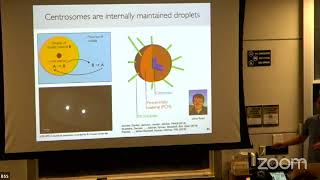
Chemically Active Droplets - Lecture 3
Explore chemically active droplets and their properties in this advanced physics lecture, part of the Boulder School series.
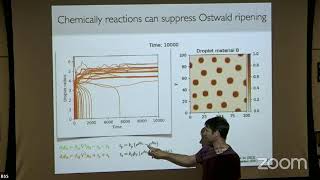
Chemically Active Droplets - Part II
Explore chemically active droplets and their fascinating properties in this advanced physics lecture by D. Zwicker.
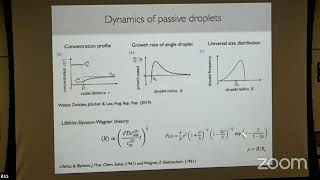
Chemically Active Droplets - Lecture 1
Explore the fascinating world of chemically active droplets with expert D. Zwicker, delving into their properties, behavior, and applications in physics.

Model-Constrained Deep Learning Approaches for Scientific Machine Learning
Explore model-aware machine learning methods combining scientific computing and data-driven models. Learn about ROM-ML and Autoencoder-based Inversion approaches for PDE-constrained inverse problems.

Análisis de la Tasa de Transmisión Dependiente del Tiempo en Modelos Epidemiológicos
Explore el análisis matemático de modelos epidemiológicos SEIR, incluyendo problemas directos e inversos, regularización Tikhonov y aplicaciones con datos sintéticos y reales.
3D Boundary Vertex Operator Algebras and Higgs Branches
Delve into advanced mathematical physics concepts exploring the relationship between 3D boundary vertex operator algebras and Higgs branches in quantum field theory.
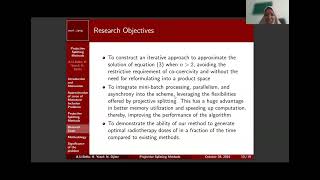
Critical Domain Size and Travelling Waves
Explore mathematical concepts of critical domain size and travelling waves in oncology, examining their applications through advanced theoretical frameworks and practical examples.
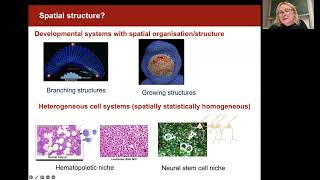
Introduction to Mathematical Modeling of Leukemia - Part 1
Explore the mathematical foundations of leukemia research through expert analysis of oncological models and their applications in understanding disease progression and treatment strategies.
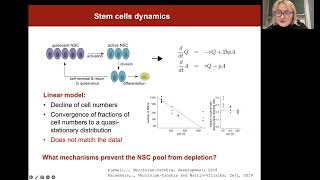
Mathematical Models of Leukemia - Part 2
Delve into advanced mathematical modeling of leukemia dynamics, exploring theoretical frameworks and analytical approaches for understanding cancer progression and treatment strategies.
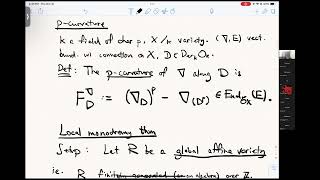
The Exponential Type Conjecture for Quantum Connections
Delve into quantum connections and formal singularity types, exploring the exponential type conjecture proof for closed monotone symplectic manifolds through mod p arguments and Katz's theorem.
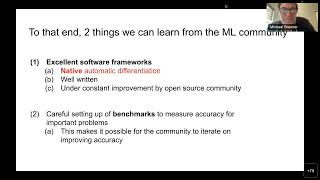
Scientific Uses of Automatic Differentiation - DDPS
Explore automatic differentiation's scientific applications beyond machine learning. Discover innovative approaches in PDEs, self-assembly, fluid dynamics, and protein modeling using large-scale optimization.
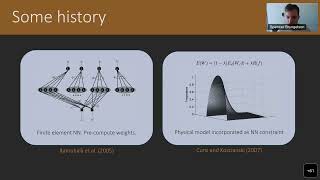
Competitive Physics Informed Networks - Overcoming Limitations in PDE Solutions
Explore competitive physics-informed neural networks for solving PDEs with unprecedented accuracy. Learn about adversarial approaches and zero-sum games to achieve single-precision accuracy in numerical simulations.
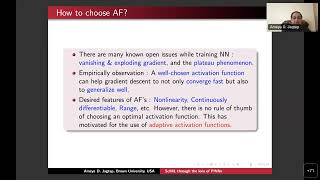
Scientific Machine Learning through the Lens of Physics-Informed Neural Networks
Explore physics-informed neural networks (PINNs) as an alternative to traditional scientific computation, addressing limitations and showcasing applications in solving complex physical problems.
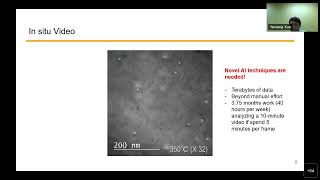
Scaling Up AI: Embedding Physics Modeling into End-to-end Learning and Harnessing Random Projection
Explore AI-driven scientific discovery through embedding physics models in end-to-end learning and utilizing random projection for efficient simulation and gradient propagation in PDE-based systems.
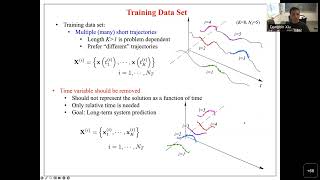
Data-Driven Modeling of Unknown Systems with Deep Neural Networks
Explore data-driven modeling of unknown systems using deep neural networks. Learn to discover and approximate evolution operators for predictive analysis across various problem domains.
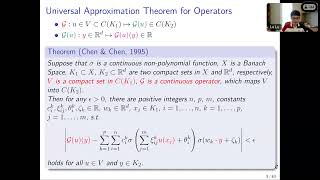
Deep Neural Operators with Reliable Extrapolation for Multiphysics and Multiscale Problems
Explore deep neural operators for complex systems, focusing on DeepONet and its extensions for multiphysics and multiscale problems. Learn about extrapolation challenges and solutions in deep learning models.