The Modified Energy Method for a Nonlocal Quasilinear Wave Equation
Explore nonlinear waves and relativity through the modified energy method for a nonlocal quasilinear wave equation in this advanced mathematics lecture.
Waves on Kerr-de Sitter Space
Explore wave propagation on Kerr-de Sitter spaces in the subextremal range, featuring updates on joint research with Peter Hintz and Oliver Petersen.
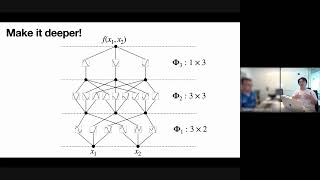
Kolmogorov-Arnold Networks - Alternatives to Multi-Layer Perceptrons
Explore Kolmogorov-Arnold Networks as alternatives to MLPs, offering improved accuracy and interpretability in data fitting and PDE solving. Discover their potential for scientific collaboration and law discovery.

Kirk Lecture: A Recent Technology for Scientific Computing - The Virtual Element Method
Explore the Virtual Element Method, a generalization of FEM for solving PDEs using polygonal/polyhedral meshes, offering improved accuracy, efficiency, and flexibility in scientific computing.
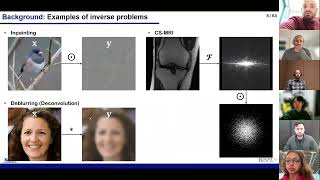
Diffusion Models for Inverse Problems
Explore advanced techniques for solving inverse problems using diffusion models, focusing on posterior sampling and manifold constraints.
Time Integration of Tree Tensor Networks
Explore numerical methods for time-dependent quantum dynamics using tree tensor networks, focusing on efficient algorithms and error analysis for high-dimensional problems.
Secure Numerical Computations Using Fully Homomorphic Encryption
Explore secure cloud computing with homomorphic encryption using Julia packages. Learn to protect sensitive data while performing numerical computations on untrusted systems.
State of Julia's SciML Ecosystem - Current Status and Future Directions
Comprehensive overview of Julia's SciML ecosystem, highlighting maturity levels of various packages, current development focus, and future directions in scientific machine learning and differential equations.
Modeling and Simulation of Sampled-Data Systems
Explore modeling and simulation of sampled-data systems, including discrete-time partitions, clocks, and interactions between continuous and discrete components using ModelingToolkit in Julia.
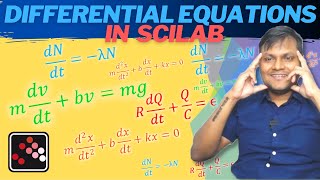
Solving Differential Equations in Scilab - First and Second Order ODEs
Learn to solve first and second order differential equations in Scilab using the ODE command, with practical examples from physics like radioactive decay, capacitor charging, and harmonic oscillators.
Flows on Graded Manifolds - Part I
Explore graded manifolds and their flows, delving into advanced mathematical concepts with expert guidance from Jan Vysoký.
NeuroMANCER - Differentiable Programming Library for Data-driven Modeling and Control
Explore NeuroMANCER: an open-source library for integrating machine learning with scientific computing, focusing on parametric optimization, system identification, and optimal control.
A Connection between Probability, Physics and Neural Networks
Explore the intersection of probability, physics, and neural networks, focusing on constructing physics-consistent models using Gaussian processes and the central limit theorem.
PirateNets - Physics-Informed Deep Learning with Residual Adaptive Networks
Explore PirateNets: a novel deep learning architecture for solving PDE-governed problems, offering improved stability and efficiency over traditional physics-informed neural networks.
Kalman-Bucy Informed Neural Networks for System Identification
Combining physics-informed neural networks and Kalman filters to identify parameters in continuous-time systems with noisy measurements, improving model precision for complex systems.
Quantitative Foundations of Ecological and Evolutionary Dynamics - Class 07
Explore quantitative foundations of ecological and evolutionary dynamics through advanced mathematical concepts and modeling techniques.
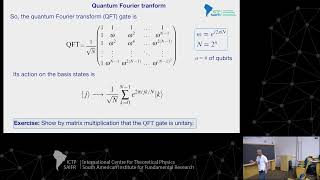
Quantum Algorithms: From Basics to Differential Equations - Lecture 3
Explore quantum algorithms, progressing from foundational concepts to advanced applications in solving differential equations.
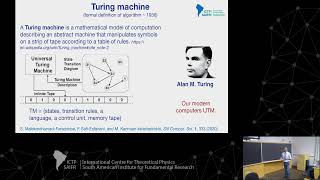
Quantum Algorithms: From Basics to Differential Equations - Lecture 1
Explore quantum algorithms, from foundational concepts to advanced applications in solving differential equations. Gain insights into cutting-edge quantum computation techniques.
From Liouville to Painlevé and Heun via CFT/Isomonodromy Relation
Explore conformal field theory through integrable, probabilistic, and supersymmetric perspectives, connecting Liouville theory to Painlevé and Heun equations.
Quantitative Foundations of Ecological and Evolutionary Dynamics - Class 3
Explore quantitative foundations of ecological and evolutionary dynamics through advanced mathematical concepts and modeling techniques.
Quantitative Foundations of Ecological and Evolutionary Dynamics - Class 02
Explore quantitative foundations of ecology and evolution through advanced mathematical concepts and modeling techniques in this comprehensive lecture.