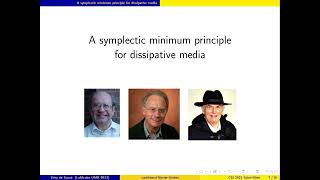
A Variational Principle of Minimum for Navier-Stokes Equation Based on the Symplectic Formalism
Explore a variational principle of minimum for Navier-Stokes equations using symplectic formalism, advancing understanding of fluid dynamics and mathematical physics.
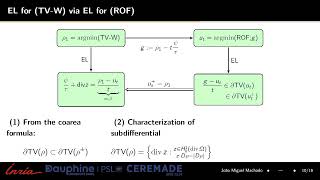
The Total Variation Wasserstein Problem - A New Derivation of the Euler-Lagrange Equations
Explore a novel derivation of Euler-Lagrange equations for the Total Variation Wasserstein problem, advancing understanding in mathematical optimization and transport theory.
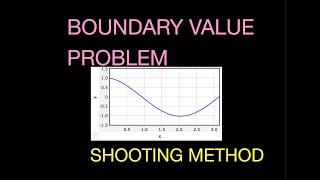
Solving a Boundary Value Problem with the Shooting Method and Python
Learn to solve boundary value problems using the shooting method and Python, with Euler method implementation and animated graph visualization.
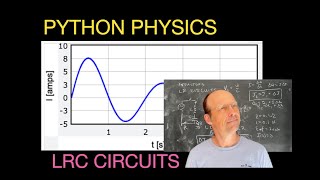
Python Physics: Modeling LR and LRC Circuits
Model LR and LRC circuits using Python, exploring electrical concepts and enhancing programming skills for physics simulations.
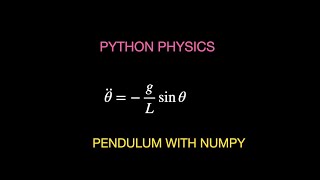
Python Physics: Modeling a Pendulum with Jupyter Notebooks
Model a pendulum's motion using Python and Jupyter Notebooks. Learn to apply Newton's second law in polar coordinates and visualize the results through practical coding exercises.
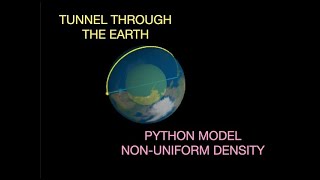
Falling Through the Center of a Non-Uniform Density Earth - Python Simulation
Explore Earth's interior through a 3D Python model, comparing orbital and tunnel travel times with varying density distributions.
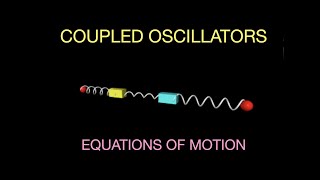
Equations of Motion for Coupled Oscillators
Explore equations of motion for coupled oscillators, focusing on systems with equal masses and springs. Learn to derive and analyze these fundamental physics concepts.
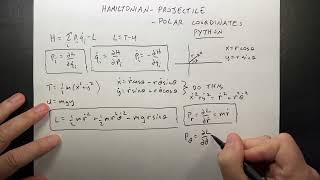
Hamiltonian Mechanics for Projectile Motion in Polar Coordinates
Explore Hamiltonian mechanics for projectile motion using polar coordinates, with Python code implementation for practical understanding.
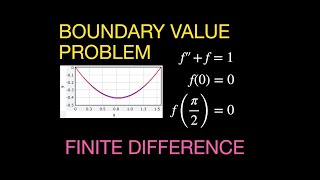
Solving a Boundary Value Problem with the Finite Difference Method - Python
Implement finite difference method in Python to solve boundary value problems for differential equations. Learn practical numerical techniques.
Python Physics: Modeling the Motion of a Coffee Filter with Air Drag
Model coffee filter motion with air drag using Python, breaking complex physics into manageable time intervals for accurate simulations.
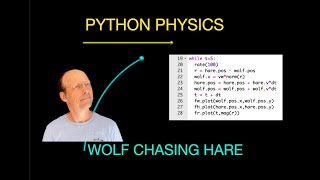
Python Physics: Modeling the Wolf and Hare Problem
Model wolf-hare chase dynamics using Python, exploring predator-prey motion patterns and computational problem-solving in physics simulations.
Physics Informed Neural Networks - BC Incorporation
Explore Physics Informed Neural Networks and learn techniques for incorporating boundary conditions in these advanced machine learning models.
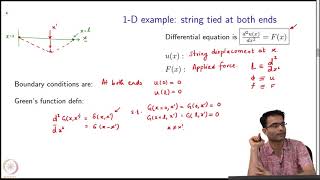
Introduction to Green's Function - A One-Dimensional Example
Explore Green's Function through a one-dimensional example, gaining insights into this mathematical concept and its applications in physics and engineering.
Code Walkthrough for PINNs in Burgers Equation
Explore Physics-Informed Neural Networks (PINNs) applied to the Burgers equation through a detailed code walkthrough.
Physics Informed Neural Networks - Introduction
Explore the fundamentals of Physics Informed Neural Networks in this concise introduction.
Laminated Metamaterials - Divergence Form Equations and Homogenisation
Explore divergence form equations with sign-indefinite coefficients, solution criteria, and homogenization methods for oscillatory ill-posed problems in quantum theory.
Hessian-Aware Stochastic Differential Equation Modeling of SGD
Explore a novel SDE model for SGD that incorporates Hessian information, improving accuracy in capturing escaping behaviors and achieving exact recovery for quadratic objectives.
Model Reparametrization with StructuralIdentifiability.jl - JuliaCon 2024
Explore StructuralIdentifiability.jl's new features for rapid identification of identifiable functions and model reparametrization, enhancing modeling and control practices.

Combined Stochastic Models for Cancer Patient Trajectories
Integrating diverse clinical data into a unified stochastic model for cancer patient trajectories, combining tumor growth, metastasis, and survival data using Julia for simulation and Bayesian inference.
Real Time ODEs for Sound Synthesis and Parameter Exploration - JuliaCon 2024
Explore real-time ODEs for sound synthesis and parameter analysis using Julia, combining visual and auditory representations to unveil dynamical system behaviors and control parameters.
Interpretable Hierarchical Calibration of Agent-Based Models
Explore scientific machine learning's fusion of traditional modeling and ML, focusing on neural network surrogates for agent-based models in epidemiology and automated hierarchical calibration.