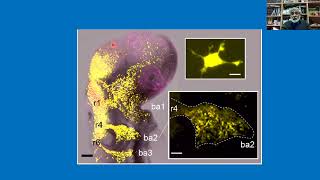
Modelling Collective Cell Migration
Explore mathematical models of collective cell migration in development and cancer, combining theory and experiments to gain insights into biological processes and cell phenotype cooperation.
Indirect Diffusion Effect and Convergence to Equilibrium
Explores indirect diffusion in reaction-diffusion systems, showing how non-diffusing species can still reach equilibrium through interactions with diffusing species and reversible reactions.
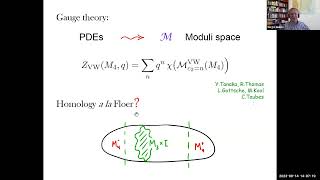
Floer Theory and Quantum Groups
Explore Floer theory, quantum groups, and gauge theories in 3-manifolds. Discover connections between moduli spaces, Floer invariants, and skein modules in topological quantum field theory.
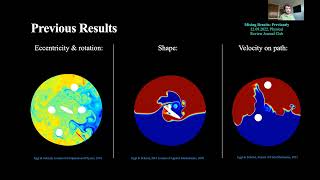
Mixing Enhancement for Binary Fluids Using PDE-Constrained Optimization
Optimization approach for enhancing binary fluid mixing efficiency through innovative stirring protocols and stirrer shapes, utilizing unsteady hydrodynamics and vortex-shedding to improve homogeneity within energy constraints.

Landau Damping and Related Effects in Kinetic Models of Plasma Physics
Explore asymptotic stability in plasma physics, covering Landau damping, plasma echoes, and collision-enhanced dissipation. Gain insights into recent progress and open directions in collisionless and weakly collisional plasmas.
The Galerkin-Truncated Burgers Equation - Crossover from Inviscid-Thermalized to K by Marc Brachet
Explores the Galerkin-truncated Burgers equation, examining the transition from inviscid-thermalized to Kolmogorov scaling in turbulence. Offers insights into fluid dynamics and mathematical modeling of complex flow phenomena.
Introduction to Difference Equations - Computational Quantum Mechanics Part 1
Transform differential equations into difference equations for computer-based quantum mechanics study. Explore this process using the heat equation and learn to create visualizations with VPython.
Pendulum Simulation: Double Pendulum Dynamics - Part 4
Explore the challenges of simulating a double pendulum system, including unexpected results and troubleshooting techniques in VPython.
Modern Numerical Methods in Computational Relativity - Lecture 4
Explore advanced numerical techniques in computational relativity, focusing on solving Einstein's field equations for gravitational-wave astronomy and astrophysical phenomena modeling.
Introduction to Numerical Relativistic Hydrodynamics - Lecture 4
Explore advanced concepts in numerical relativistic hydrodynamics, focusing on computational techniques for modeling high-energy astrophysical phenomena and gravitational wave sources.
Introduction to Numerical Relativistic Hydrodynamics - Lecture 3
Explore advanced concepts in numerical relativistic hydrodynamics, focusing on computational techniques for modeling high-energy astrophysical phenomena and gravitational wave sources.
Non-Abelian Band Singularities and Anomalous Floquet Braiding
Explore non-Abelian band singularities and anomalous Floquet braiding in quantum systems, focusing on stability and coherent time evolution in many-body quantum matter under external drives.
Floquet Fermi and Non-Fermi Liquids by Inti Sodeman
Explore Floquet Fermi and Non-Fermi Liquids in quantum systems, focusing on stability under external drives and mechanisms constraining many-body dynamics in Hilbert space.
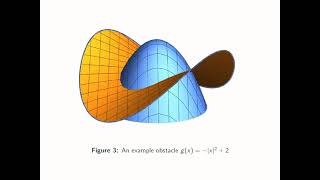
A Perturbation and Free Boundary Approach to the Monopolist's Problem
Explore a mathematical approach to the Monopolist's problem using perturbation theory and free boundary methods, offering insights into economic optimization strategies.
Floquet Many-body Physics - From ETH to Spatiotemporal Order - Lecture 2
Explore quantum many-body systems under coherent time evolution, focusing on stability mechanisms, non-equilibrium physics, and novel phases of quantum matter. Insights for quantum device operation and control.
Quantum States under Floquet Heating
Explore quantum states under Floquet heating, examining stability mechanisms in many-body systems and their implications for non-equilibrium physics and quantum technologies.

Coupled Oscillators: Matrices - Lecture by Supurna Sinha
Explore coupled oscillators and matrix applications in physics. Gain insights into theoretical aspects through hands-on experiments and open-ended discussions. Designed for women pursuing physics careers.
Elliptic Orthogonal Polynomials and Their Integrability
Explore elliptic orthogonal polynomials and their integrability through Riemann-Hilbert analysis, examining discrete and continuous integrable systems and connections to the sixth Painlevé equation.
An Understanding of Physical Solutions and Blow-Up Phenomenon in Nonlinear Noisy Leaky Integrate and Fire Neuronal Models
Explore physical solutions and blow-up phenomena in Nonlinear Noisy Leaky Integrate and Fire neuronal models with Alejandro Ramos Lora.

Transition from Fractional Diffusion to Normal Diffusion in Kinetic Models
Explore the transition between fractional and normal diffusion in kinetic models, examining mathematical principles and applications in complex systems.
Phase Separation in Active Brownian Particles
Explore models of active matter systems, focusing on motility-induced phase separation in self-propelled particles and the resulting macroscopic PDEs.