High Mode Transport Noise Improves Vorticity Blow Up Control in 3D
Explores regularizing effects of transport noise on 3D Navier-Stokes equations, demonstrating improved vorticity control and well-posedness under specific noise conditions.
Rough Perturbations of the Navier Stokes System
Explore rough perturbations of Navier-Stokes equations, focusing on solution definitions, well-posedness, and physical relevance in terms of conserved quantities.
A Gradient Flow Approach to Kinetic Equations
Gradient flow approach to linear kinetic equations, exploring entropy dissipation inequality and large deviation principles. Discusses potential extensions to non-linear cases and connections to Markov chains.
Numerical Homogenization Based Fast Solver for Multiscale PDEs
Explore numerical homogenization for multiscale PDEs, covering Bayesian approaches, exponential decaying bases, and efficient solvers. Learn about applications in geophysics, materials science, and biology.
Collisions in Plasmas - The Landau Equation - Part IV
Explore plasma collisions through the Landau equation, covering entropy structure, factorization theorems, and computational aspects of this advanced mathematical topic.
Machine Learning to Improve the Exchange and Correlation Functional in DFT
Explore machine learning approaches to improve exchange and correlation functionals in density functional theory, discussing physically informed methods and their advantages in quantum mechanics.
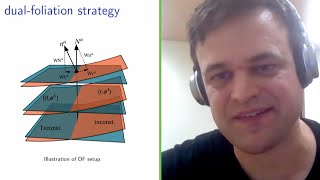
Dual-Frame Generalized Harmonic Gauge on Hyperboloidal Slices - IPAM at UCLA
Explore advanced techniques in general relativity, focusing on including future null-infinity in computational domains for cosmic censorship studies and gravitational wave astronomy applications.
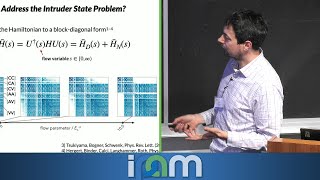
Many-Electron Effective Hamiltonians from Similarity Renormalization Group
Explore many-electron effective Hamiltonians using similarity renormalization group, focusing on bond-breaking reactions, spin states, and excited states of molecules with near-degenerate electronic structures.

The Visions of Shamans and Saints - Dynamic Instabilities in Neuroscience by Bard Ermentrout
Explore neural patterns, from motor activity to brain imaging, and their connections to paleolithic art and hallucinations. Discover mechanisms behind spatial and temporal patterns in neuroscience.
Fractal Uncertainty Principle and Quantum Chaos
Explore quantum chaos and fractal uncertainty principle in wave equations, with applications to eigenfunctions, Schrödinger equation, and hyperbolic surfaces. Gain insights beyond classical/quantum correspondence.
Non-stationary Quantum Many-body Dynamics - Lecture 1
Explore non-stationary quantum many-body dynamics in this lecture, covering advanced concepts in periodically and quasi-periodically driven complex systems.
Non-stationary Quantum Many-body Dynamics - Lecture 2
Explore non-stationary quantum many-body dynamics in this advanced physics lecture, delving into complex systems and their behavior under periodic and quasi-periodic driving forces.
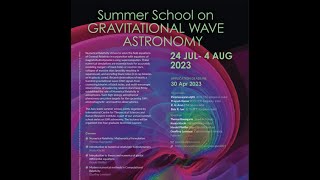
Modern Numerical Methods in Computational Relativity - Lecture 5
Explore advanced numerical techniques in computational relativity, focusing on simulating black hole mergers and other high-energy astrophysical phenomena for gravitational-wave astronomy.
Modern Numerical Methods in Computational Relativity - Lecture 2
Explore advanced numerical techniques for solving Einstein's equations in computational relativity, focusing on applications in gravitational-wave astronomy and astrophysical simulations.
Modern Numerical Methods in Computational Relativity - Lecture 3
Explore advanced numerical techniques for solving Einstein's equations in computational relativity, focusing on modeling gravitational waves from merging black holes and neutron stars.

Modern Numerical Methods in Computational Relativity - Lecture 1
Explore modern numerical methods for solving Einstein's equations in computational relativity, essential for modeling gravitational waves from black hole and neutron star mergers.
Introduction to Numerical Relativistic Hydrodynamics - Lecture 5
Explore advanced concepts in numerical relativistic hydrodynamics, focusing on computational techniques for modeling high-energy astrophysical phenomena and gravitational wave sources.
Introduction to Numerical Relativistic Hydrodynamics - Lecture 2
Explore advanced concepts in numerical relativistic hydrodynamics, focusing on mathematical formulations and computational techniques for modeling high-energy astrophysical phenomena.
Introduction to Numerical Relativistic Hydrodynamics - Lecture 1
Explore numerical relativistic hydrodynamics, essential for modeling high-energy astrophysical phenomena like black hole mergers and supernovae, crucial for gravitational-wave astronomy advancements.
Regularity of the Boltzmann Equation in Bounded Domains - II
Explore advanced mathematical concepts in nonlocal PDEs, focusing on the Boltzmann equation's regularity in bounded domains. Gain insights from expert Tonon, D. in this in-depth lecture.
Collisions in Plasmas: The Landau Equation - Part 5
Explore plasma collisions through the Landau equation, delving into advanced mathematical concepts and their applications in physics and probability theory.