
Uncertainty Quantification of Quantum Chemical Methods - IPAM at UCLA
Explore uncertainty quantification in quantum chemistry, covering error estimation, benchmarking, and machine learning approaches for improved accuracy in computational methods.

Optimal Learning from Data
Explore optimal learning from data, including error recovery, discrete optimization, and handling noisy measurements. Insights on deep learning and stochastic settings provided.
Regression Analysis in Machine Learning - Linear Regression - Logistic Regression
Comprehensive exploration of regression analysis, covering linear and logistic techniques. Learn to leverage data relationships for informed decision-making in various business contexts.

Normal Distribution Excel Exercise - Probability and Statistics - Khan Academy
Explore how normal distribution approximates binomial distribution for large trials using Excel. Gain practical insights into probability concepts through hands-on spreadsheet analysis.

Variations on the Wire Problem - Optimization in Geometry for Math Teachers
Explore optimization through hands-on activities, addressing Common Core Standards. Learn to cut and bend wire into polygons for minimum or maximum enclosed area, enhancing high school math instruction.
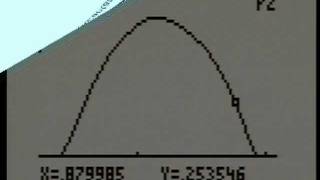
Measuring Speed - Average and Instantaneous Velocity - Part 1
Explore average and instantaneous velocity concepts through practical examples and data analysis techniques in this engaging calculus lesson.
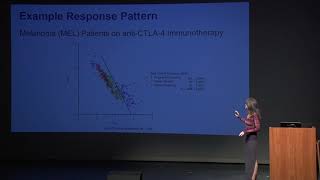
Teaching Contemporary Math - Modeling Cancer Treatment
Explore innovative approaches to teaching math through real-world applications in cancer treatment, data modeling, and error analysis with Helen Moore.
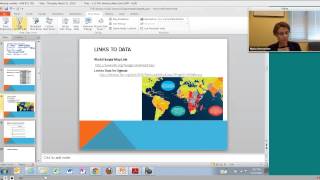
Distinguishing Between Linear and Exponential Growth in Mathematics - Real-World Applications
Explore real-world applications of linear and exponential growth through population and food production data, using calculators for analysis and modeling in mathematics.
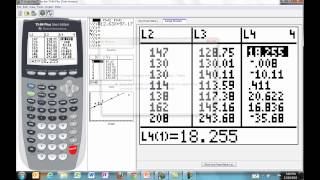
Linear Data Analysis for Math Common Core Standards - Part 3
Explore linear functions for real-world data modeling, focusing on slope and intercept interpretation, linear regression, and residual analysis using interactive tools and practical examples.
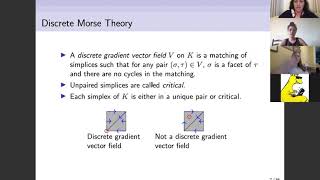
Morse-Based Fibering of the Rank Invariant
Explore multi-parameter persistence in data analysis using discrete Morse theory to compute rank invariants, partition parameter space, and deduce persistence diagrams for equivalent classes of lines.
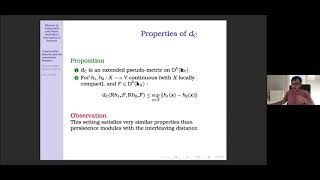
Sheaves as Computable and Stable Topological Invariants for Datasets
Explores sheaf theory in topological data analysis, connecting level-sets persistence with derived sheaves. Presents functorial equivalences, stability theorems, and barcode decompositions for continuous data analysis.
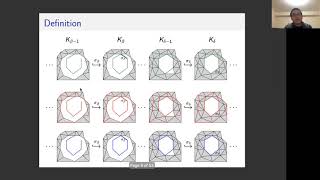
Computing Minimal Persistent Cycles - Polynomial and Hard Cases
Explores computing minimal persistent cycles in algebraic topology, discussing polynomial and NP-hard cases, and presenting algorithms for weak pseudomanifolds with applications to scientific data analysis.
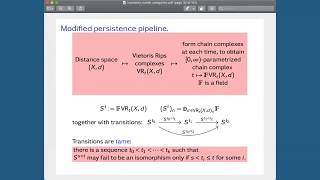
Wojciech Chachólski - TDA Invariants and Model Categories
Exploring TDA invariants and model categories in data analysis, focusing on simplification techniques from homotopy theory to extract meaningful summaries while balancing information retention.
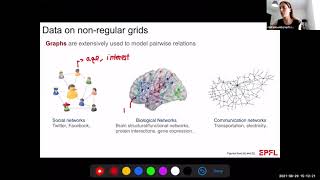
Simplicial Neural Networks
Explore simplicial neural networks, a generalization of graph neural networks for multi-dimensional data, and their applications in imputing missing data on coauthorship complexes.
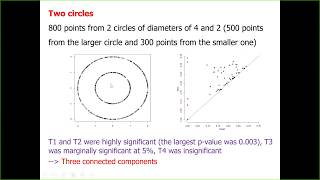
Modeling and Replicating Persistence Diagrams
Explore modeling and replicating persistence diagrams for statistical inference in topological data analysis. Learn about RST approach, parametric modeling, and improvements for clustered data.
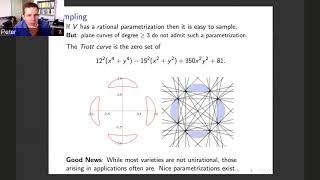
Bernd Sturmfels - Learning Algebraic Varieties from Samples
Explore algebraic varieties through sampling, focusing on topology and geometry. Learn algorithms for determining dimensions and polynomials, with practical applications in Julia.
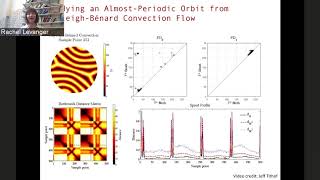
Rachel Levanger - A Comparison Framework for Interleaved Persistence Modules
Explore rigorous tracking of noise in persistent homology, comparing approximation techniques and addressing non-uniform sub-level set filtrations in topological data analysis.
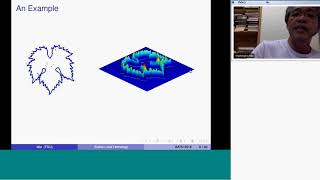
Washington Mio - Stable Homology of Metric Measure Spaces
Explore stable homology in metric measure spaces, covering Wasserstein distance, local homology stability, and applications in data analysis and taxonomic classification.

Jürgen Jost - Geometry and Topology of Data
Explore geometric and topological approaches to data analysis, focusing on ball intersections, curvature concepts, and convexity in metric spaces.
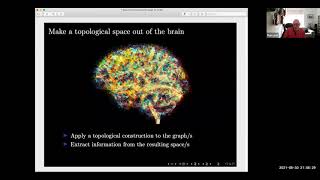
An Application of Neighborhoods in Directed Graphs in the Classification of Binary Dynamics
Explore graph theory applications in classifying binary dynamics, focusing on vertex neighborhoods and their use in analyzing neuronal network activity, with insights from the Blue Brain Project.
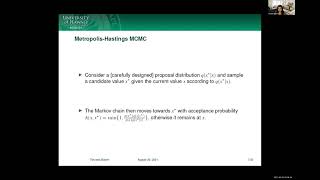
Farzana Nasrin - Random Persistence Diagram Generator
Explore a method for generating random persistence diagrams using parametric models and Markov chain Monte Carlo algorithms, with applications in material science and topology.