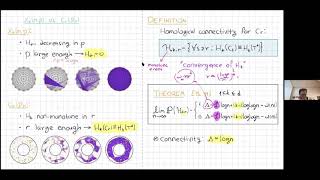
Omer Bobrowski - Random Simplicial Complexes
Explore higher-dimensional generalizations of random graphs, focusing on random d-complexes and Cech complexes. Learn about connectivity, cycle formation, and giant components in these structures.
Statistics and Data Analysis for Cosmology - Lecture 1
Explore probability concepts in cosmology, including joint and conditional probability, PDFs, independence, Bayes' theorem, and data modeling for analyzing cosmic phenomena.
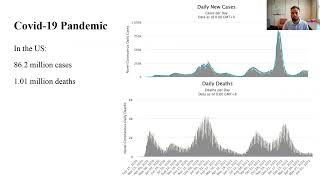
Mathematical Modeling of Diseases Spread - The Dextrous Use of Simple Machine-Learning Tools
Explore machine learning techniques for modeling disease spread, focusing on data preparation, model training, and interpreting results to inform public health policies.
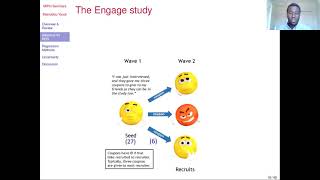
Recent Developments in Respondent-Driven Sampling
Explore recent advancements in respondent-driven sampling techniques for surveying hidden populations, including network-based approaches and regression methods for data analysis.
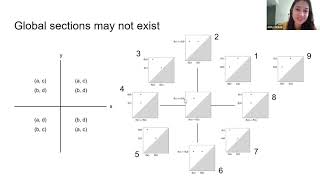
Persistence Diagram Bundles- A Multidimensional Generalization of Vineyards
Explore persistence diagram bundles, a multidimensional generalization of vineyards for analyzing topological changes in data sets with multiple parameters, including computation methods and potential applications.
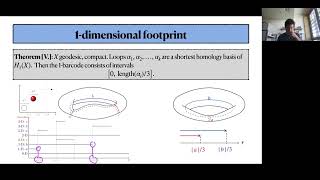
Žiga Virk - Information Encoded in Persistence Diagrams
Explore topological data analysis through persistence diagrams, uncovering spatial properties like homology, geodesics, and proximity in various mathematical contexts.
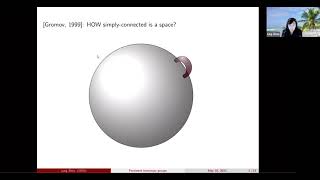
Persistent Homotopy Groups of Metric Spaces
Explore persistent homotopy groups of metric spaces, their stability, and advantages over persistent homology. Learn about tree-like structures and ultrametrics in fundamental groups.
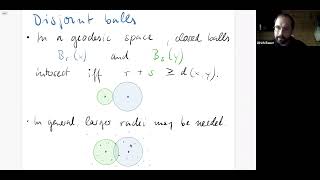
Ulrich Bauer - Gromov Hyperbolicity, Geodesic Defect, and Apparent Pairs in Rips Filtrations
Explore Gromov hyperbolicity, geodesic defect, and apparent pairs in Rips filtrations, extending Rips' results on contractibility and examining computational implications for persistent homology.
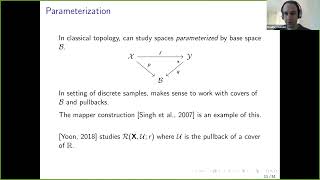
Bradley Nelson: Parameterized Vietoris-Rips Filtrations via Covers
Explore computational topology techniques for large filtered geometric complexes, focusing on Vietoris-Rips filtrations and cover-based methods for parallel computation and compression.

The Medical Test Paradox and Redesigning Bayes' Rule
Explore the medical test paradox and a redesigned Bayes' rule, focusing on likelihood ratios and Bayes factors to enhance understanding of conditional probability in diagnostic testing.
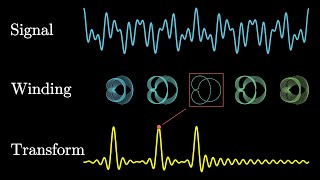
What is the Fourier Transform? A Visual Introduction
Animated exploration of the Fourier Transform, offering a visual and intuitive understanding of this complex mathematical concept. Ideal for those seeking a clear, engaging introduction to signal processing fundamentals.
Morning Session- Causality
Explore racial bias in data, examining tensions between quantitative and qualitative approaches. Experts discuss implications for fairness and accuracy in research and decision-making.
Tractable Probabilistic Circuits
Explore recent developments in tractable probabilistic circuit models, their efficient learning from data, and applications in causal inference algorithms for computing marginal probabilities and related queries.
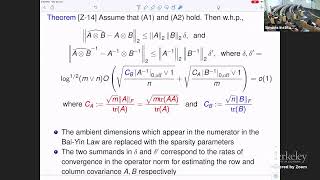
Tensor Graphical Models for Complex and High Dimensional Data
Explore advanced statistical methods for analyzing complex, high-dimensional data using tensor graphical models, with applications in algorithmic inference and combinatorial structures.
Efficient Algorithms for Outlier-Robust Regression
Explore advanced techniques for outlier-robust regression, focusing on efficient algorithms and their applications in high-dimensional statistics and machine learning.
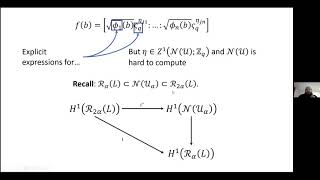
Data Driven Torsion Coordinates and Wasserstein Stability
Explore data-driven torsion coordinates in finite Lens spaces, LPCA dimensionality reduction, and Wasserstein stability for topological data analysis and nonlinear dimensionality reduction.
Geometry and Topology of Decision
Explore geometric and topological approaches to decision-making when faced with conflicting expert opinions, examining theoretical concepts and practical applications in various scenarios.
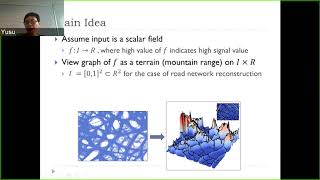
Graph Reconstruction via Discrete Morse Theory
Explore graph reconstruction using discrete Morse theory, focusing on geometric graphs and density data. Learn about theoretical guarantees and applications in road network reconstruction.
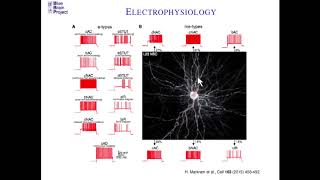
Kathryn Hess - Bedlewo: Topology Meets Neuroscience
Explore how topology applies to neuroscience across scales, from neurons to brain regions. Discover topological analysis of microconnectomes and neuron classification, with insights into brain imaging data.
Recent Advances in Theory and Implementation of Multi-Parameter Persistence
Explores recent developments in multi-parameter persistence, covering stable filtrations and discrete descriptors. Includes interactive clustering software demo and discusses extensions of one-parameter persistence concepts.
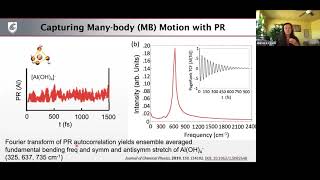
Multiscale Many-body Correlations and Structure in Chemistry Data
Integrating graphs, topology, and geometry to analyze complex chemistry data, providing insights into multiscale correlations and structures beyond traditional methods.