
Wave Function Evolver: Lennard-Jones Simulation Analysis - Episode 10
Explore Lennard-Jones simulation behavior by modifying potential energy minimum locations. Augment code to analyze changes and generate insights for physics enthusiasts and programmers.

Projectile Motion Model Validation - Lecture 9
Explore projectile motion model validation through real-world examples and video analysis, enhancing understanding of physics concepts and practical applications.

Projectiles - Multiple Launches Using Loops
Explore projectile trajectories by systematically altering properties, enhancing understanding of physics concepts through coding and visualization techniques.

Stopping Complex Diseases: A Preventive Approach with Genomics and Technology
Explore a preventive approach to complex diseases using genomics, technology, and existing research data, as presented by David Agus at TEDMED 2011.

Giorgio Parisi and Team Discuss the Configuration of Jammed Packings
Nobel Laureate Giorgio Parisi and team discuss long-range correlations in jammed packings, revealing insights into the structure and behavior of three-dimensional systems of hard spheres at jamming.
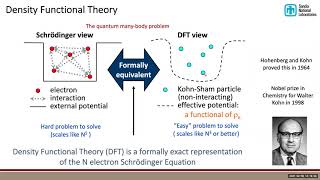
Shock Physics on the Sandia Z Pulsed Power Machine
Explore extreme dynamic compression studies using the Sandia Z Machine, focusing on deuterium's molecular-to-atomic transition and insulator-to-metal transition under various pressure and temperature conditions.

Genomic Technologies and Bioinformatics 101 - Webinar - Ambry Genetics
Introductory overview of next-generation sequencing technologies, covering sample preparation, data analysis, and bioinformatics concepts. Suitable for beginners interested in genomic data collection and interpretation.
Review Tools of UCSC Genome Browser - Clinical Diagnostic Series - Webinar - Ambry Genetics
Explore UCSC Genome Browser's tools for visualizing and analyzing genomic data through an interactive demo, covering features like data tracks, multi-region browser, and personal genome snips.
Ambry Genetics - Applications of Diagnostic Exome Sequencing
Explore diagnostic exome sequencing applications in neonatal intensive care, covering methods, results, case studies, and benefits of early genetic diagnosis for newborns.

Who Can Make Meaningful Change in the Climate Crisis?
Exploring diverse perspectives on effective climate action, from government policies to grassroots initiatives. Experts discuss the roles of various stakeholders and strategies for creating meaningful change and sustainable development.

The Last Stargazers - With Emily Levesque
Explore the evolving world of professional astronomy, from remote observatories to cutting-edge technology, and the shift from human to robotic stargazers in this captivating journey through space science.
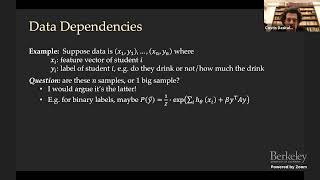
Learning Ising Models from One, Ten or a Thousand Samples
Explore statistical learning theory and Ising models, focusing on sample complexity and efficient algorithms for learning in high-dimensional settings.
Genomics, Medicine, Epidemiology and Data Interpretation
Explore racial bias in genomics, medicine, and epidemiology with experts discussing data interpretation challenges and the tension between quantitative and qualitative approaches.
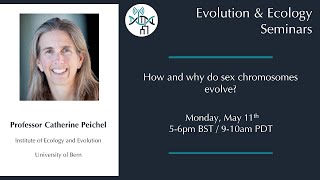
How and Why Do Sex Chromosomes Evolve?
Explore sex chromosome evolution, focusing on sticklebacks. Learn about conservation, diversity, and evolutionary models, with insights into gene expression and reproductive isolation.
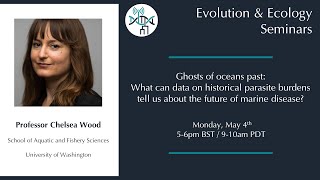
Ghosts of Oceans Past
Explore historical parasite burdens in marine ecosystems and their implications for future marine diseases, using museum specimens and innovative research methods.
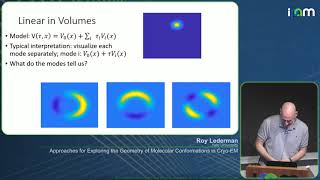
Approaches for Exploring the Geometry of Molecular Conformations in Cryo-EM
Explore advanced techniques for analyzing molecular conformations in cryo-electron microscopy, focusing on emerging approaches for complex conformational heterogeneity and associated challenges.
Can Evolution Be Understood Quantitatively? by Daniel Fisher
Explore quantitative approaches to understanding evolution, from basic laws to complex dynamics, using microbial experiments and theoretical models to unravel evolutionary processes and their implications.
Capturing Turbulent Dynamics and Statistics in Experiments Using Exact Coherent States
Explore turbulent dynamics using Exact Coherent States, revealing coherent structures in experiments, forecasting turbulent evolution, and providing a geometric description of transient turbulence.
OpenFold - Lessons and Insights From Rebuilding and Retraining AlphaFold2
Insights from rebuilding AlphaFold2: OpenFold's optimized implementation, training process analysis, and implications for protein structure prediction and broader applications in structural biology.
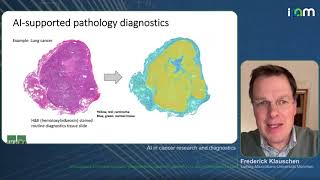
AI in Cancer Research and Diagnostics - IPAM at UCLA
Explore AI's impact on cancer diagnostics, focusing on pathology applications, explainable methods, and multi-modal data integration for research and clinical use.
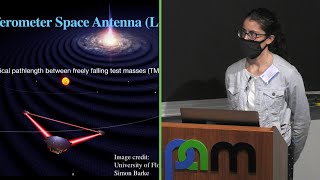
LISA and the Global Analysis of Galactic Binary Gravitational Wave Signals
Explore LISA's role in detecting galactic binary gravitational waves, including data analysis challenges, global fitting techniques, and future prospects for multi-source gravitational wave detection.