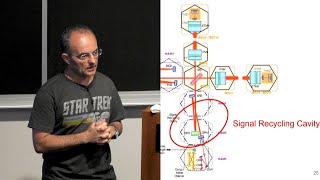
Characterization of Ground-Based Gravitational-Wave Detector Data - IPAM at UCLA
Explore techniques for distinguishing gravitational wave signals from noise in detector data, including traditional methods and innovative approaches to improve data quality and reduce search backgrounds.
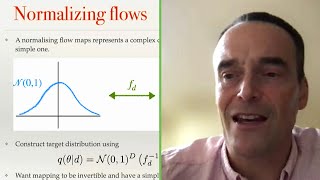
Rapid and Robust Parameter Estimation for Gravitational Wave Observations
Explore rapid parameter estimation techniques for gravitational wave observations, focusing on machine learning approaches like DINGO that use normalizing flows to efficiently analyze data from future detectors.
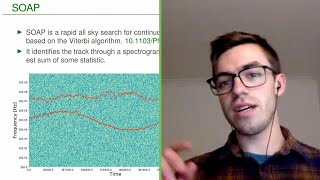
Rapidly Searching for Continuous Gravitational Waves
Explore challenges and solutions in detecting continuous gravitational waves from neutron stars, focusing on SOAP's rapid search method using neural networks for signal identification and parameter estimation.
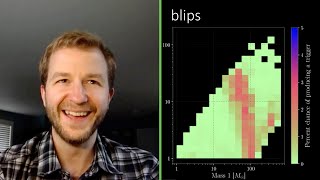
Nobody Likes a Glitch - IPAM at UCLA
Explore transient noise artifacts in gravitational wave astronomy, their impact on signal detection, and innovative approaches for understanding and mitigating these glitches in data analysis.
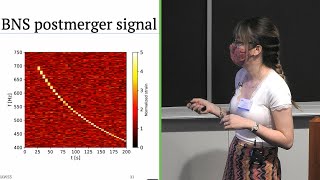
Power Spectral Density Uncertainty and Gravitational-Wave Parameter Estimation
Explore power spectral density uncertainty in gravitational-wave parameter estimation, its impact on Bayesian analysis, and methods to incorporate this uncertainty for more accurate results in compact binary coalescence detection.
Elchanan Mossel: Combinatorial Statistics and the Sciences
Explore combinatorial statistics, broadcasting on trees, and their applications in biology and network analysis, with insights into phylogenetic inference and community detection.
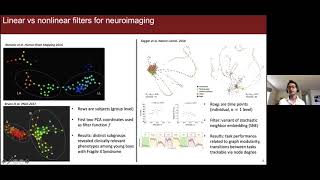
Exploring Brain Dynamics During Ongoing Cognition Using Mapper
Exploring brain dynamics using Mapper: analyzing fMRI data with geometric techniques to reveal whole-brain activity patterns and predict task performance in multitask paradigms.
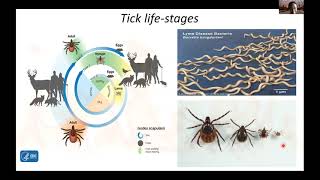
Ticks and Fire - Exploring the Effects of Prescribed Fire on Tick-Borne Disease
Explore the impact of prescribed fire on tick-borne diseases through mathematical modeling, data analysis, and spatial considerations in this seminar on ecological disease management.
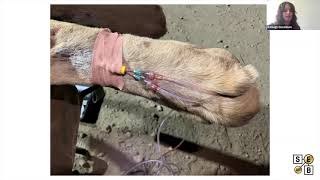
Comparison of the Cardiovascular Effects With Three Different Drug Combinations in African Lions
Explore cardiovascular effects of immobilization drug combinations in free-ranging African lions, examining research findings and implications for wildlife conservation.
Cosmology - DM Halo - Local Group - Risa Wechsler (Stanford)
Explore cosmology, dark matter halos, and the local group with Stanford researcher Risa Wechsler. Gain insights into cutting-edge astrophysical concepts and their implications for our understanding of the universe.
Modeling Dwarf Galaxy Formation with UniverseMachine - Richie Wang (Stanford)
Explore dwarf galaxy formation using UniverseMachine, a statistical tool for modeling galaxy evolution in cosmological simulations. Learn about abundance matching, multiresolution simulations, and future research directions.
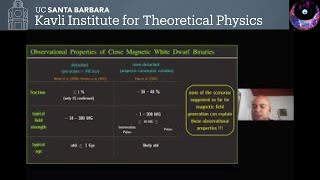
Formation and Evolution of Close Magnetic White Dwarf Binaries - Diogo Belloni
Explore the formation and evolution of close magnetic white dwarf binaries, their impact on astrophysics, and implications for stellar remnants and galactic populations.
Data-Driven Subgrid-Scale Modeling - Stability, Extrapolation, & Interpretation
Explores data-driven subgrid-scale modeling in climate science, focusing on stability, extrapolation, and interpretation. Discusses advancements in theoretical understanding and the potential of machine learning to address complex climate processes.
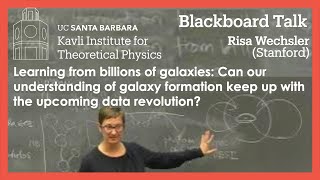
Learning from Billions of Galaxies - Can Our Understanding of Galaxy Formation Keep Up With the Upcoming Data Revolution?
Exploring the challenges and opportunities in understanding galaxy formation as we enter a new era of astronomical data, with insights from billions of observed galaxies.
On the Origins of High-Energy Neutrinos
Explore the origins of high-energy neutrinos with Ali Kheirandish, covering interdisciplinary developments in neutrino physics and their impact on astrophysics, cosmology, and particle physics.
Status of Neutrino Oscillation Experiments - Andre deGouvea
Comprehensive overview of current neutrino oscillation experiments, exploring recent findings, challenges, and future directions in this cutting-edge field of particle physics research.
Status of the DUNE Experiment - Leigh Whitehead
Comprehensive overview of the DUNE experiment's current status, exploring its goals, technology, and potential for groundbreaking neutrino physics discoveries.
Short-Baseline Review - Accelerators - Ornella Palamara
Explore short-baseline neutrino experiments and their role in advancing our understanding of neutrino physics, with insights from Fermilab expert Ornella Palamara.
Results from the NOvA Experiment - Zoya Vallari
Explore the latest findings from the NOvA neutrino experiment, presented by Zoya Vallari from Caltech. Gain insights into cutting-edge neutrino physics research and its implications for our understanding of the universe.
Do We Need to Go Beyond Cold Dark Matter?
Exploring the necessity of expanding beyond Cold Dark Matter theory in cosmology, examining current evidence and potential alternatives for a more comprehensive understanding of the universe.
Application of Constrained Simulations in Understanding Galaxy-Halo Connection
Explore constrained simulations to understand galaxy-halo connections, enhancing our knowledge of cosmic structure formation and the relationship between dark matter and visible galaxies.