Dark Energy by Varun Sahni
Explore dark energy's role in cosmic acceleration, its observational evidence, and theoretical models. Gain insights into this mysterious force shaping the universe's expansion and structure.
Dark Energy by Varun Sahni
Explore the mysteries of dark energy and its implications for cosmology in this lecture by Varun Sahni, part of a comprehensive program on cutting-edge topics in modern astrophysics and cosmological research.
Dark Energy by Varun Sahni
Explore the mysteries of dark energy and its role in cosmic expansion. Delve into current theories, observational evidence, and implications for the Universe's future.
Galaxy Formation by Kandaswamy Subramanian
Explore galaxy formation processes, including dark matter's role, structure growth, and observational insights. Gain a comprehensive understanding of cosmic evolution and structure formation.
21cm Physics and Cosmology by Somnath Bharadwaj
Explore 21cm physics and its applications in cosmology, focusing on the study of dark matter, dark energy, and the Universe's reionization history through advanced observational techniques.
Gravitational Lensing by Alan Heavens
Explore gravitational lensing in cosmology with Prof. Alan Heavens. Learn about this powerful tool for studying dark matter, dark energy, and the structure of the universe.
Cosmological Structure Formation by Aseem Paranjape
Explore cosmological structure formation, covering perturbation theory, large-scale structure growth, and the cosmic web. Gain insights into the evolution of the universe and its components.
Cosmological Perturbation Theory - CMB by D Pogosyan
Explore cosmological perturbation theory and CMB anisotropies in this advanced lecture, delving into the intricacies of cosmic structure formation and early universe physics.
21cm Physics and Cosmology by Somnath Bharadwaj
Explore 21cm physics and cosmology in this lecture, covering key concepts, observational techniques, and implications for understanding the early universe and cosmic structure formation.
Cosmological Perturbation Theory - CMB by D Pogosyan
Explore cosmological perturbation theory and CMB anisotropies in this lecture, part of a comprehensive program on the future of cosmology and unresolved mysteries of the Universe.
Our Amazing Universe- Astronomical Revelations and New Mysteries by François R. Bouchet
Explore astronomical observations constraining the Cosmos, radical ideas on its origin, and mysteries like Dark Matter and Dark Energy. Learn how we uncover these cosmic secrets.

Astrophysics with Neil DeGrasse Tyson - Dark Matter, Particle Physics, & Cosmic Science
Explore cosmic mysteries with Neil deGrasse Tyson, from dark matter to the universe's energy balance. Uncover scientific breakthroughs, examine unsolved problems in astrophysics, and ponder the shape of space-time.
What Is Dark Matter? - With Peter Fisher
Explore dark matter's nature and its gravitational effects on galaxies with particle physicist Peter Fisher. Learn about ongoing research and its potential impact on science.
Particle Physics Made Easy - With Pauline Gagnon
Explore particle physics, the Large Hadron Collider, and CERN's groundbreaking research with Pauline Gagnon. Discover the Higgs boson, dark matter, and potential revolutions in our understanding of the universe.
The Search for Objective Reality - With Jim Peebles
Explore the nature of science and objective reality through cosmology with Nobel laureate P.J.E. Peebles. Delve into key concepts like dark matter, the expanding universe, and acoustic oscillations in this thought-provoking lecture.
How We Know Dark Matter Exists - The Evidence for Modern Physics
Explore the evidence for dark matter's existence, from historical observations to modern theories and testing methods. Delve into gravitational lensing, modified Newtonian equations, and potential explanations for this mysterious cosmic phenomenon.

The Multiverse, Science or Science Fiction? - Sean Carroll
Explore the scientific validity of multiverse theory with Sean Carroll, examining concepts like vacuum energy, eternal inflation, and string theory, while addressing challenges and future directions in this fascinating field.
Is Dark Matter Real? - With Sabine Hossenfelder
Physicist Sabine Hossenfelder explores evidence for dark matter, proposing a superfluid theory that combines dark matter with modified general relativity to explain cosmic observations.
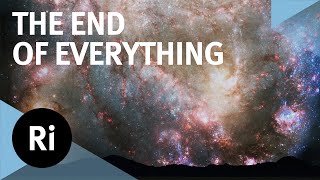
The End of Everything - With Katie Mack
Explore cosmic endings with astrophysicist Katie Mack, delving into quantum mechanics, cosmology, and string theory to uncover potential fates of our universe based on current scientific understanding.
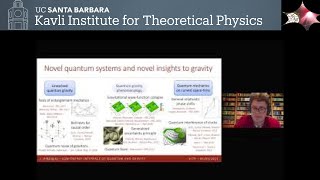
Low-Energy Interface of Quantum and Gravity - Igor Pikovski
Exploring the interface between quantum mechanics and gravity through novel experiments, focusing on atomic clocks, interferometry, and quantum effects in gravitational fields.
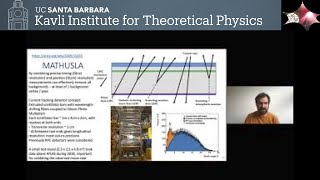
Far Detectors at the LHC - Jamie Boyd
Explores novel experiments for fundamental physics, focusing on far detectors at the LHC. Covers topics like dark matter, axions, and weak short-range forces, discussing opportunities and challenges in experimental physics.