Novel Experiments for Fundamental Physics - General Discussion - KITP Conference Participants
Explore cutting-edge experiments in fundamental physics, including dark matter, axions, and gravitational waves. Discuss theoretical interpretations and potential advancements using cold atoms and interferometric techniques.
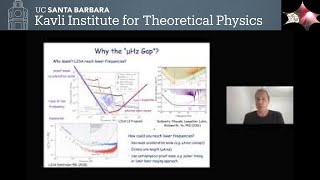
Gravitational Waves and New Physics - Peter Graham
Exploring gravitational waves and new physics through novel experiments, focusing on atomic clocks, pulsar timing, and asteroids to detect weak signals and test fundamental physics theories.
How Well Do We Know Our Universe? by Jayant Narlikar
Explore the evolution of our understanding of the universe, from ancient ideas to modern cosmology, challenging current theories and advocating for alternative perspectives in astrophysics.
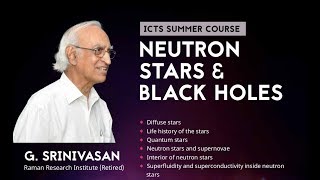
Universe or Multiverse? - Neutron Stars and Black Holes Lecture 14
Explore the universe's expansion, cosmic microwave background, and inflationary theories. Delve into cosmological phase transitions, gauge theories, and the concept of multiverses in this comprehensive lecture.
The QCD Axion - Lecture 1
Comprehensive lecture on QCD axions, covering theoretical foundations, strong CP problem, spontaneous symmetry breaking, and axion models. Explores potential solutions to dark matter mysteries.
Introduction to Primordial Black Hole Dark Matter - Lecture 1
Explore primordial black holes as dark matter candidates, covering formation mechanisms, abundance, mass functions, and detection prospects through gravitational waves from binary mergers.
Introduction to Primordial Black Hole Dark Matter - Lecture 2
Explore primordial black holes as dark matter candidates through gravitational wave detection, microlensing, and fast radio bursts. Discover constraints, observational prospects, and implications for cosmology.
Reionization - Evidence and Observational Constraints - Lecture 1
Explore the epoch of reionization, its evidence, and observational constraints through absorption signatures, Lyman-alpha forest, and CMBR angular power spectrum in this comprehensive lecture.
Galaxy Clusters - Lecture 1
Explore galaxy clusters' formation, evolution, and role in cosmology. Learn about their history, current research status, and characterization methods using the Jeans equation.
Cosmology with Large-Scale Structure - Lecture 1
Explore large-scale structure as a cosmological probe, covering statistical approaches, bias models, and testing methods. Learn how LSS informs our understanding of the universe's composition and evolution.
21cm Physics and Cosmology - Lecture 2
Explore 21cm physics in cosmology, covering spin temperature, radiative transfer, and 21-cm brightness temperature. Gain insights into the Universe's expansion and structure formation.
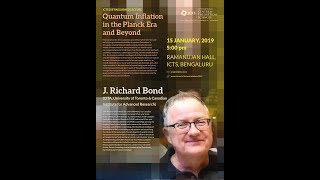
Quantum Inflation in the Planck Era and Beyond by J. Richard Bond
Explore quantum fluctuations in the early universe, cosmic microwave background data, and the quest for physics beyond the standard model of cosmology through cutting-edge experiments and observations.
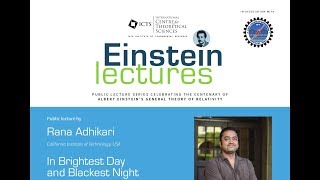
In Brightest Day and Blackest Night by Rana Adhikari
Explore gravitational wave detection, its impact on astronomy, and LIGO's ultra-sensitive interferometers. Learn about black holes, spacetime distortions, and future challenges in this field of fundamental physics and cosmology.
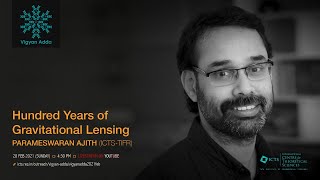
Hundred Years of Gravitational Lensing
Explore gravitational lensing's history, applications in astronomy, and its potential with gravitational waves. Learn about new astronomical probes and recent discoveries in this field.
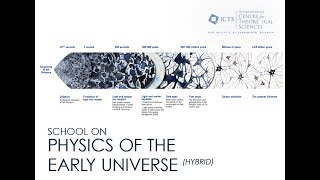
Dark Matter: Properties and Behavior in the Early Universe - Lecture 1
Comprehensive exploration of dark matter's nature, thermal history, and interactions in the early universe, examining empirical evidence and theoretical constraints to understand its properties and behavior.
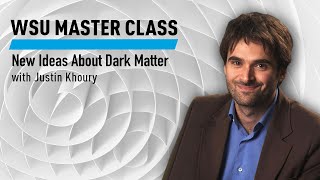
New Ideas About Dark Matter - Quantum Effects and Non-Newtonian Gravity
Explore quantum effects in dark matter and their potential impact on galactic structure with physicist Justin Khoury, offering new perspectives on the universe's formation.
The Dark Side of the Universe - Exploring Dark Energy and Cosmology
Explore the mysteries of dark energy and dark matter with renowned cosmologist Michael Turner, delving into the universe's origin, evolution, and the cutting-edge research shaping our understanding of cosmic phenomena.
Shedding New Light on Dark Matter
Explore groundbreaking insights on dark matter with physicists Brian Greene and Priyamvada Natarajan, discussing new research, mapping techniques, and the future of cosmic simulations.
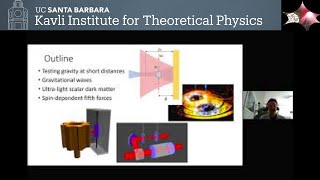
Experimental Tests of Novel Short Range Forces with AMO Methods - Andy Geraci
Exploring novel short-range forces using atomic, molecular, and optical methods. Geraci discusses experimental techniques and their potential for advancing fundamental physics research.
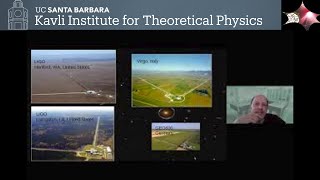
Quantum-Enhanced Interferometry for New Physics - Hartmut Grote
Explore quantum-enhanced interferometry for fundamental physics experiments, discussing advancements in precision measurements and potential applications in dark matter detection and gravitational wave research.
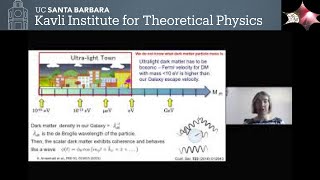
Fundamental Physics with Atoms and Molecules - Marianna Safronova
Explore cutting-edge experiments in fundamental physics using atoms and molecules. Learn about advancements in testing dark matter, symmetry violations, and gravitational waves through cold atom techniques and interferometry.