Cosmological Simulations by R. Angulo
Explore cosmological simulations in this lecture, covering key concepts, techniques, and applications in modern cosmology research for understanding the universe's structure and evolution.
Decoding the Physics of the Early Universe Through Primordial Black Holes, Dark Matter and GWs
Explore the complex physics of primordial black holes, their role in universe reheating, dark matter production, and gravitational waves through advanced theoretical concepts and recent observational data.
Quantum Sensing at meV Energy-Scales for Dark Matter Searches
Delve into advanced quantum sensing techniques for dark matter detection, exploring meV energy-scale measurements, superconducting qubit applications, and calibration challenges in particle physics research.
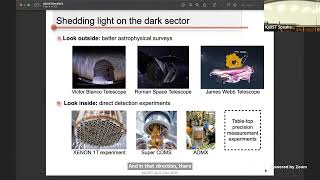
Searching for Dark Matter and Dark Energy with Mechanical Systems
Explore groundbreaking research on detecting dark matter and dark energy using mechanical systems, examining innovative detection methods and experimental approaches in quantum physics.
New Particle Searches with Nonlinear Optics
Explore cutting-edge particle physics research using nonlinear optics, focusing on axions and dark photons detection through Dark SPDC process and innovative quantum measurement techniques.
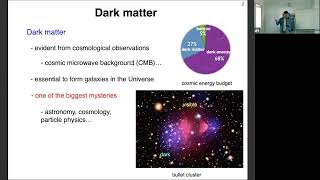
Current Status of Self-Interacting Dark Matter
Explore the latest findings on self-interacting dark matter, examining velocity-dependent cross sections and their implications for dark matter halos across different cosmic scales.
Dark Matter Models and Motivation - Tim Tait
Explore dark matter models, motivations, and detection methods. Covers theoretical approaches, experimental probes, and emerging directions in particle physics and cosmology.
Dark Matter and Other Hidden Treasures in the Neutrino Sector - Kevork Abazajian
Explore dark matter, neutrino physics, and their cosmic implications. Discover interdisciplinary developments in particle astrophysics and cosmology, from theory to experimental observations.

The Particle at the End of the Universe
Explore the Higgs boson discovery, its significance in particle physics, and the groundbreaking work at CERN's Large Hadron Collider with physicist Sean Carroll.

How to Know a Neutrino - With Art McDonald
Nobel laureate Art McDonald explores neutrino detection, the Sudbury Neutrino Observatory's groundbreaking discoveries, and future research into dark matter and rare radioactive processes at SNOLAB.
Our Universe and How It Works - With Jo Dunkley
Explore the universe's origins, evolution, and mysteries with astrophysicist Jo Dunkley. From the Big Bang to black holes, discover cutting-edge debates on cosmic phenomena and the possibility of multiple universes.

The Invisible Universe - Priyamvada Natarajan Public Lecture
Explore dark matter and black holes with Yale professor Priyamvada Natarajan. Discover the latest insights on mapping dark matter distribution and tracing black hole growth history in this engaging lecture.
Studying Physics to Explore the Cosmos - Katie Mack at IFWIS
Astrophysicist Katie Mack shares her journey in physics, discussing dark matter, black holes, and her experiences from high school to professional research, inspiring future women in STEM careers.

The Building Blocks of the Universe
Explore subatomic physics, supercomputer calculations of quarks and gluons, mass origins, nuclear reactions powering the Sun, and dark matter's nature in this guided tour of the universe's fundamental building blocks.
Erik Verlinde Public Lecture - A New View on Gravity and the Dark Side of the Cosmos
Explore emergent gravity and its implications for understanding the universe, from particles to cosmos, with Dr. Erik Verlinde's groundbreaking research on dark matter and black holes.
Ripple Effects - A Forum on Gravitational Waves
Expert panel discusses the detection of gravitational waves, exploring their significance, implications for physics and astronomy, and future research directions in this groundbreaking field.
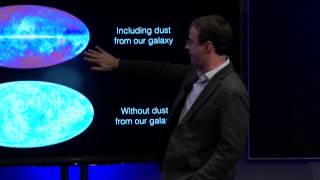
Cosmology in the 21st Century
Explore the expanding universe, from the big bang to dark matter, with cosmologist Kendrick Smith. Gain insights into cosmic phenomena and our current understanding of the universe's composition and evolution.

The Mystery of Dark Matter
Explore dark matter's effects on galactic star speeds, current theories, and detection experiments in this comprehensive introduction to one of physics' greatest mysteries.

The Darkest Secrets of the Universe
Explore cosmic mysteries with Dr. GuhaThakurta: dark matter, galaxy cannibalism, black holes, and gravitational phenomena. Uncover hidden connections in the universe and contemplate the fragility of human life.

Initial Exoplanet Discoveries from TESS
Explore NASA's TESS mission, its exoplanet discoveries, and how it compares to Kepler. Learn about the observatory's design and data availability through MAST at the Space Telescope Science Institute.

Black Holes and Other Dark Matters
Explore gravitational waves, black holes, and dark matter with Dr. Kamionkowski as he discusses LIGO's groundbreaking discovery and its implications for our understanding of the universe.