
Encrypted Messaging: Current Challenges and Future Implications
Expert panel explores the history, current state, and global implications of encryption debates, discussing potential solutions and mitigations for preserving digital privacy and security.
Secure Computation with RAMs - Dr. Mariana Raykova, Yale University
Explore secure computation techniques for protecting private data, including ORAM constructions and encrypted search schemes. Learn about cryptographic advancements for efficient and privacy-preserving data processing.
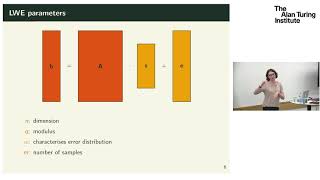
Security and Encoding in Fully Homomorphic Encryption - Rachel Player, Sorbonne Université
Explore security and encoding in Fully Homomorphic Encryption, covering Ring-LWE parameters, NIST post-quantum standardization, and efficient encoding techniques for higher-depth circuit evaluation.
Privacy-Preserving Information Sharing - Tools and Applications
Explore privacy-preserving techniques for secure information sharing, including two-party computation, private set intersection, and authorized PSI, with applications in collaborative anomaly detection.

Solving Private Set Intersection via Cuckoo Hashing - Benny Pinkas, Bar-Ilan University, Israel
Explore private set intersection protocols, including custom and generic MPC approaches, with a focus on Cuckoo hashing for efficient computation of PSI variants in cryptography and security.
CompTIA CASP+ Certification Training - Cryptography and PKI
Comprehensive training on cryptography and PKI for CompTIA CASP+ certification, covering hashing, encryption algorithms, protocols, and certificates. Includes practice exams and labs.

Hashmaps in C++ - C++ Placement Series
Comprehensive exploration of hashmaps in C++, covering implementation, STL usage, hash functions, collision handling, and practical applications for efficient data storage and retrieval.
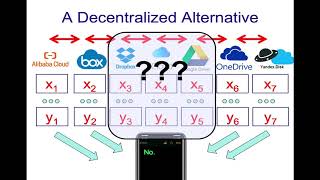
Secure Multiparty Computation
Explore secure multiparty computation techniques for protecting data confidentiality while enabling collaborative analysis, from encryption to advanced protocols like BGW and Yao's.
Fully Linear PCPs and Their Cryptographic Applications
Explore probabilistically checkable proofs, distributed verifiers, and cryptographic applications with a focus on fully linear PCPs and their impact on secure protocols and communication complexity.

How to Do Fiat-Shamir in the Standard Model
Explore interactive protocols, Fiat-Shamir transformation, and delegation in cryptography. Learn about security assumptions, hash functions, and correlation intractability in probabilistic proof systems.

How to Delegate Computations Publicly
Explore probabilistically checkable and interactive proof systems, focusing on publicly verifiable arguments and non-interactive protocols for delegating computations.
PLONK - Permutations Over Lagrange-Bases for Oecumenical Noninteractive Arguments of Knowledge
Explore PLONK, a cryptographic protocol for zero-knowledge proofs, covering permutation checks, polynomial protocols, and applications in blockchain technology.

Transparent SNARKs from DARK Compilers
Explore transparent SNARKs and DARK compilers in cryptography. Learn about polynomial commitments, interactive proof systems, and recent advancements in zero-knowledge proofs for blockchain applications.
Efficient Zero Knowledge Proof from Interactive Proofs
Explore efficient zero-knowledge proofs derived from interactive proofs, focusing on new algorithms, performance improvements, and comparisons to existing systems.
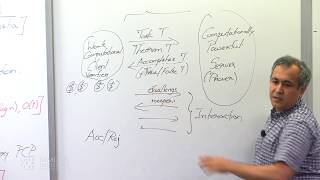
Probabilistically Checkable Proofs - Part I
Explore probabilistically checkable proofs, focusing on proof verification, randomized verifiers, and proof rewriting techniques in this advanced theoretical computer science lecture.
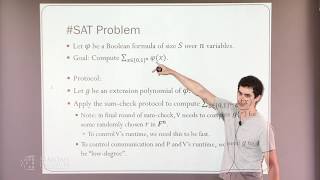
Interactive Proofs - Part II
Explore advanced concepts in interactive proofs, including arithmetician protocols, sharpset, and general-purpose techniques. Learn about applications, limitations, and cutting-edge developments in this field.
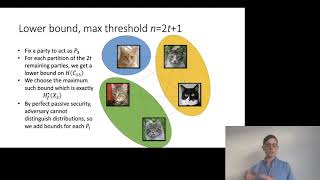
More Communication Lower Bounds for Information-Theoretic MPC
Explores communication complexity lower bounds in information-theoretic secure multiparty computation, covering perfect passive and malicious security settings with various party thresholds and reactive functionalities.
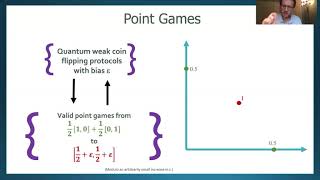
The Impossibility of Efficient Quantum Weak Coin Flipping
Explore quantum coin-flipping, its history, and recent developments in point games, profile functions, and communication rounds in quantum protocols.
Data Structures Meet Cryptography - 3SUM with Preprocessing
Explore the intersection of data structures and cryptography, focusing on the 3SUM problem with preprocessing and its implications for algorithmic efficiency and security.
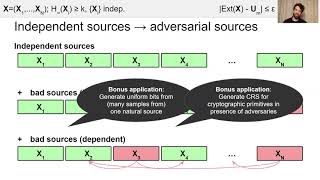
Extractors for Adversarial Sources via Extremal Hypergraphs
Explore advanced techniques in randomness extraction and their applications in cryptography, focusing on adversarial sources and extremal hypergraphs.
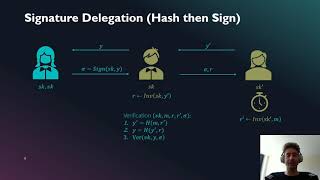
One-Shot Signatures and Applications to Hybrid Quantum-Classical Authentication
Explore quantum-classical hybrid authentication, including one-shot signatures, chameleon hashing, and innovative applications in cryptocurrency and quantum proofs.