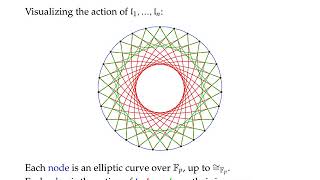
Rational Isogenies from Irrational Endomorphisms
Explore rational isogenies derived from irrational endomorphisms in cryptography, covering CSIDH, isogeny graphs, and twisting endomorphisms with applications to post-quantum cryptography.
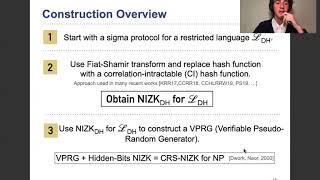
Non-Interactive Zero-Knowledge in Pairing-Free Groups from Weaker Assumptions
Explore advanced cryptographic techniques for non-interactive zero-knowledge proofs in pairing-free groups, focusing on improved constructions and weaker assumptions.
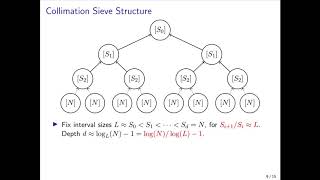
He Gives C-Sieves on the CSIDH
Explore quantum attacks on CSIDH cryptosystem, focusing on collimation sieve techniques and their implications for proposed parameters' security in post-quantum cryptography.
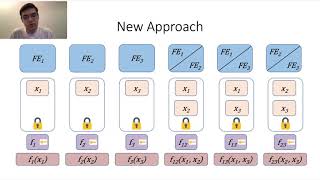
Combiners for Functional Encryption, Unconditionally
Explore cryptographic combiners for functional encryption, focusing on new approaches and challenges in secure multi-party computation and input-local MPC.
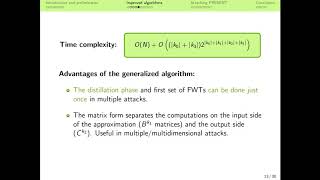
Improving Key-Recovery in Linear Attacks - Application to 28-Round PRESENT
Explore advanced techniques for improving key recovery in linear cryptanalysis, focusing on the PRESENT block cipher and introducing novel approaches to enhance attack efficiency.
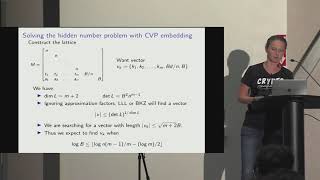
Biased Nonce Sense - Lattice Attacks Against Weak ECDSA Signatures in the Wild
Explore ECDSA signature vulnerabilities, lattice attacks, and cryptographic weaknesses in real-world scenarios. Learn about countermeasures and implications for secure implementations.
Automating the Development of Chosen Ciphertext Attacks
Explore automated techniques for developing chosen ciphertext attacks in cryptography, including format oracles, theory solvers, and practical examples like PKCS #7 and bitwise padding.
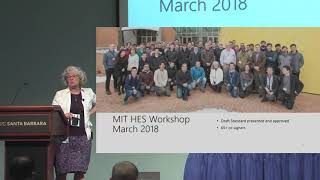
Homomorphic Encryption - A Community Effort
Explore the standardization of Homomorphic Encryption, its community efforts, workshops, and resources. Learn about the principles, history, and issues in this emerging field.
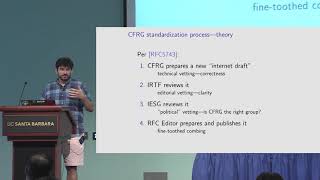
BLS Signatures, Hashing to Curves, and More - Dispatches from the IETF
Explore advanced cryptography standardization at IETF, focusing on BLS signatures and hash-to-curve efforts. Learn about the RFC process, lessons learned, and key cryptographic concepts.

Panel and Further Discussion
Expert panel explores cryptographic standardization challenges, balancing innovation with adoption, security models, and industry needs. Insights on prioritization, incentives, and creating effective standards for advanced cryptography.
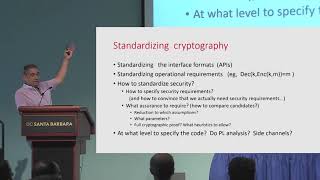
Towards Standardizing Zero Knowledge
Overview of ZKProof standardization efforts, challenges, and progress towards composable security for succinct non-interactive zero-knowledge proofs, with implications for emerging standards.
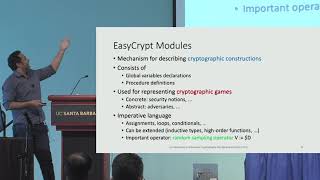
Computer Aided Verification and Software Synthesis for Secure Multi Party Computation Protocols
Explore computer-aided verification and software synthesis for secure multi-party computation protocols, focusing on high-assurance implementations and formal proofs using EasyCrypt and automated toolchains.
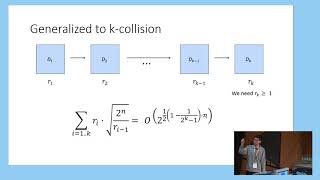
On Finding Quantum Multi-Collisions
Explore quantum multi-collision finding, its complexity, and comparison to classical methods. Learn about "The Reciprocal Plus 1" rule and quantum lazy sampling techniques.
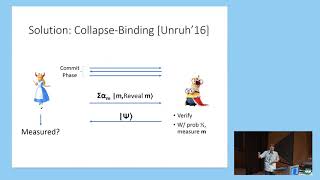
Quantum Lightning Never Strikes the Same State Twice
Explore quantum cryptography concepts like no-cloning, quantum money, and lightning, with applications to blockchain and commitment schemes. Discusses limitations and potential constructions.
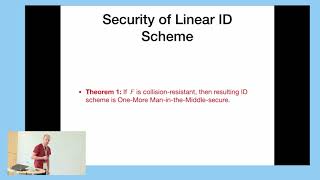
A Modular Treatment of Blind Signatures from Identification Schemes
Explore cryptographic blind signatures, their security, and applications in anonymous systems through a modular treatment based on identification schemes.
Efficient Verifiable Delay Functions
Explore verifiable delay functions, their requirements, and cryptographic implementations. Learn about time lock puzzles, succinct proofs, and security assumptions in this advanced cryptography topic.
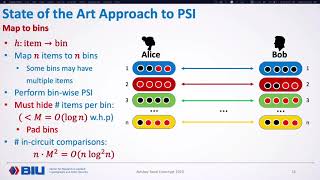
Efficient Circuit-Based PSI with Linear Communication
Explore efficient circuit-based Private Set Intersection techniques with linear communication, applicable to Google Ads and Google Pay, featuring oblivious PRF and optimization strategies.
Saber on ARM- CCA Secure Module Lattice Based Key Encapsulation on ARM
Explore efficient implementation of Saber, a lattice-based key encapsulation mechanism, on ARM Cortex-M0 and M4 processors, focusing on optimization techniques and performance analysis.
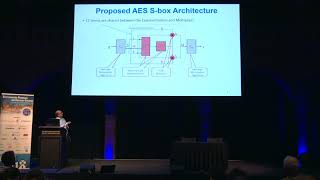
Smashing the Implementation Records of AES S-Box
Explore innovative techniques for optimizing AES S-box implementation, focusing on logic minimization, exponentiation, and output multipliers to achieve record-breaking performance.

Persistent Fault Analysis on Block Ciphers
Explores persistent fault analysis on block ciphers, discussing attack methods, countermeasures, and experimental results. Provides insights for cryptography researchers and security professionals.
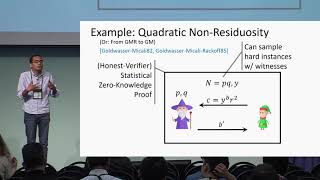
From Laconic Zero Knowledge to Public Key Cryptography
Explore the connection between laconic zero-knowledge proofs and public key cryptography, examining key concepts, results, and implications for cryptographic systems.