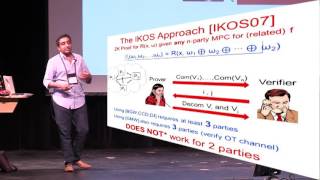
On the Power of Secure Two Party Computation
Explore secure two-party computation, zero-knowledge proofs, and MPC protocols. Learn about garbled circuits and their applications in cryptography and privacy-preserving technologies.
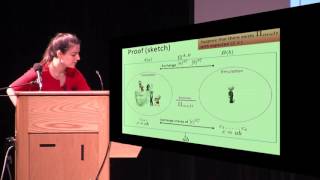
On the Communication Required for Unconditionally Secure Multiplication
Explore unconditionally secure multiplication protocols, analyzing communication requirements and theoretical implications in cryptographic systems.

Generalized Tweakable Even Mansour with Improved Security Guarantees
Explore improved security guarantees for XPX Generalized Tweakable Even Mansour, enhancing related-key security and addressing weaknesses in normal block ciphers.

The SKINNY Family of Lightweight Tweakable Block Ciphers
Explores the SKINNY family of lightweight tweakable block ciphers, discussing their design, implementation, and security features for resource-constrained devices in cryptography.

The Multi User Security of Authenticated Encryption - AES GCM in TLS 1.3
Explore authenticated encryption, AES-GCM, and their multi-user security implications in TLS 1.3, as presented by Bellare and Tackmann at Crypto 2016.
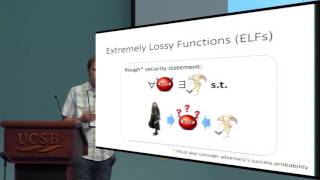
The Magic of ELFs
Explore the concept of Extremely Lossy Functions (ELFs) in cryptography, their applications, and how they compare to standard lossy functions and random oracles.
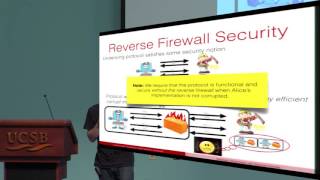
Message Transmission with Reverse Firewalls - Secure Communication on Corrupted Machines
Explore secure communication on corrupted machines through reverse firewalls, addressing algorithm substitution attacks and perandomizable hybrid encryption for enhanced message transmission protocols.
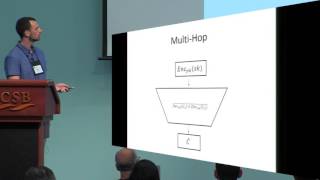
Lattice Based Fully Dynamic Multi Key FHE with Short Ciphertexts
Learn about advanced cryptographic techniques using lattices for fully dynamic multi-key homomorphic encryption with compact ciphertexts, based on research presented at Crypto 2016.
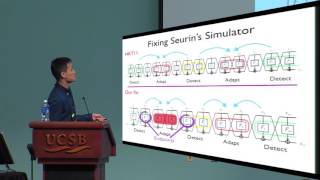
Indifferentiability of 8 Round Feistel Networks
Explore the cryptographic concept of indifferentiability in 8-round Feistel networks, examining its implications for secure block cipher design and analysis.

Key Wrapping for Cryptographic APIs
Explore modular approaches to symmetric-key cryptographic APIs, focusing on key wrapping techniques and their applications in secure systems design.

Key-Alternating Ciphers and Key-Length Extension - Exact Bounds and Multi-user Security
Explore exact bounds and multi-user security in key-alternating ciphers and key-length extension, advancing cryptographic understanding and applications.
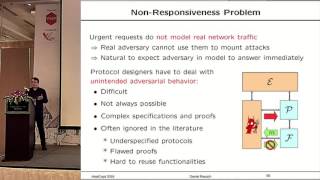
Universal Composition with Responsive Environments
Explore compositional protocol analysis, simulation-based security models, and solutions for non-responsiveness in cryptographic protocols. Learn to apply these concepts to real-world examples.
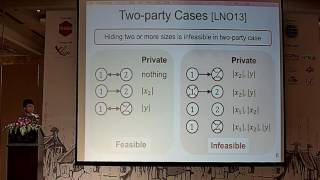
Size-Hiding Computation for Multiple Parties
Explore secure multi-party computation techniques for hiding data sizes, with applications in privacy-preserving data analysis and secure information sharing protocols.
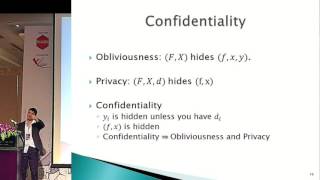
Reactive Garbling - Foundation, Instantiation, Application
Explore reactive garbling schemes, their foundations, implementations, and applications in cryptography. Learn about secure computation techniques and their practical uses.

Indistinguishable Proofs of Work or Knowledge
Explore privacy-preserving proofs of work/knowledge, pricing functions, and cryptographic puzzles. Learn about innovative algorithms and applications in this cutting-edge cryptography talk.

How to Circumvent the Two Ciphertext Lower Bound for Linear Garbling Schemes
Explores innovative techniques to overcome limitations in linear garbling schemes, focusing on circumventing the two-ciphertext lower bound for improved efficiency in secure computation protocols.

Efficient Public Key Distance Bounding Protocol
Learn about an efficient public key distance bounding protocol, its implementation, and security implications in cryptography and network communications.
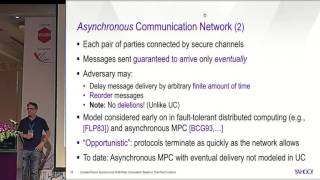
Constant Round Asynchronous Multi Party Computation Based on One Way Functions
Explore constant-round asynchronous multi-party computation protocols using one-way functions, enhancing secure distributed computing in asynchronous networks.

A Shuffle Argument Secure in the Generic Model
Explore secure shuffle arguments in the generic model, focusing on e-voting applications, mix-nets, and zero-knowledge proofs using bilinear pairings and the Generic Bilinear Group Model.

Optimization of LPN Solving Algorithms
Explore optimization techniques for LPN solving algorithms, including sparse secret, claw reduce, drop reduce, and code reduce methods. Learn about their applications and effectiveness.
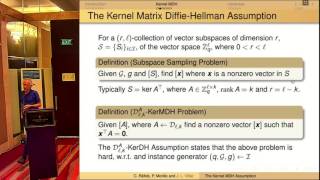
The Kernel Matrix Diffie Hellman Assumption
Explore the Kernel Matrix Diffie-Hellman Assumption and its applications in cryptography, covering matrix distributions, computational problems, and black-box separations.