Collective Intelligence as Collective Computation - Future Directions
Explore collective intelligence as computation, examining principles of information processing, dimension reduction, and emergent phenomena in biological and social systems.
Waists, Widths and Symplectic Embeddings
Explore geometric measures of manifolds and their applications to symplectic embeddings. Discover area estimates for minimal submanifolds and quantitative symplectic camels in this advanced mathematics talk.

Entropy and C^0 Stability of Hypersurfaces - IPAM at UCLA
Explore entropy's role in hypersurface complexity, focusing on sphere rigidity, stability properties, and generalizations in higher dimensions. Gain insights into cutting-edge research in geometric analysis.
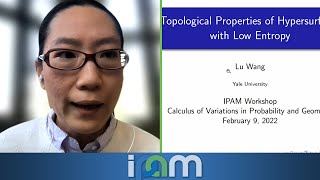
Topological Properties of Hypersurfaces with Low Entropy - IPAM at UCLA
Explore topological properties of hypersurfaces with low entropy, focusing on Colding-Minicozzi entropy, mean curvature flow, and closed hypersurfaces in this advanced mathematics lecture.

Variational Quantum Architectures for Linear Algebra Applications
Explore variational quantum algorithms for linear algebra applications, including singular value decomposition, linear system solving, and generative models, with focus on NISQ-era implementations and real-world examples.
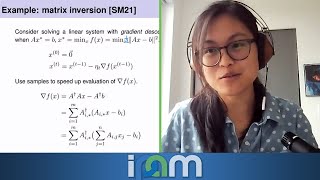
On Quantum Linear Algebra for Machine Learning - IPAM at UCLA
Explore quantum singular value transformation for machine learning, its applications, limitations, and connections to classical algorithms in this technical talk on quantum linear algebra.
Efficient Quantum Algorithm for Dissipative Nonlinear Differential Equations
Explore efficient quantum algorithms for nonlinear differential equations, overcoming limitations through Carleman linearization. Discover potential applications in biology, fluid dynamics, and plasma physics.

Uncertainty Quantification of Quantum Chemical Methods - IPAM at UCLA
Explore uncertainty quantification in quantum chemistry, covering error estimation, benchmarking, and machine learning approaches for improved accuracy in computational methods.

Maria Esteban - Spectral Results and Open Problems for Dirac-Coulomb Operators With Charge Distributions
Explore spectral results and open problems for Dirac-Coulomb operators with general charge distributions, focusing on self-adjoint extensions, eigenvalue characterizations, and electron stability conditions.
Deep Learning for Combinatorial Optimization - Count Your Flops & Make Your Flops Count
Explores deep learning for combinatorial optimization, focusing on reducing computation through learned models while balancing solution quality. Discusses practical examples, challenges, and future research directions.
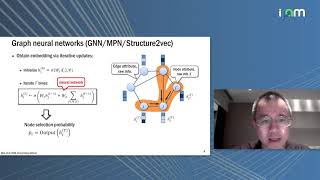
A Framework for Differentiable Discovery of Graph Algorithms
Explore graph algorithm discovery using deep learning and tree decomposition. Learn effective techniques for NP-complete problems with interpretable results and expanded search space.
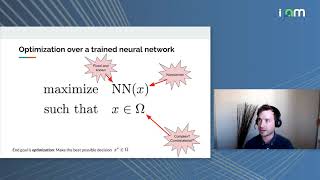
Neural Network Verification as Piecewise Linear Optimization
Neural network verification as piecewise linear optimization: exploring robust methods to prove model reliability against attacks, using LP and MIP formulations for efficient problem-solving in various network types.
Solving High Dimensional HJ Equations Using Generalized Hopf-Lax Formulas vs Using Machine Learning
Explore advanced techniques for solving high-dimensional Hamilton-Jacobi equations, comparing generalized Hopf-Lax formulas with machine learning approaches in control and differential games.
Building Manifolds from Error Correcting Codes - IPAM at UCLA
Explore the intersection of error correcting codes and manifold construction, delving into quantum error correction, topology, and complex mathematical concepts.
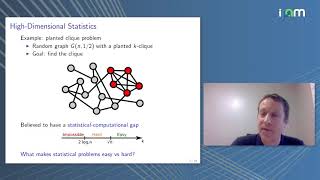
The Kikuchi Hierarchy and Tensor PCA
Explores advanced algorithms for tensor PCA, introducing a new hierarchy inspired by Kikuchi free energy to improve belief propagation performance and match sum-of-squares methods.

The Convex Geometry of Blind Deconvolution and Matrix Completion Revisited
Explores convex geometry in blind deconvolution and matrix completion, analyzing dimensional factors in noise bounds and proposing alternative error scaling approaches for low-rank matrix recovery problems.

Optimal Learning from Data
Explore optimal learning from data, including error recovery, discrete optimization, and handling noisy measurements. Insights on deep learning and stochastic settings provided.

Machine Learned Regularisation for Solving Inverse Problems
Machine learned regularization techniques for solving inverse problems, focusing on image reconstruction from tomographic and blurred measurements. Explores data-driven approaches and discusses open mathematical challenges.

Fast FPT-Approximation of Branchwidth
Explore efficient graph decomposition techniques and FPT algorithms for approximating branchwidth, with applications in structural graph theory and dynamic programming.

Daniel Dadush- Integer Programming and the Kannan-Lovasz Conjecture
Explore advanced integer programming techniques, lattice theory, and the Kannan-Lovasz conjecture in this high-level overview of solving n-variable integer programs efficiently, with insights into recent progress and key concepts.
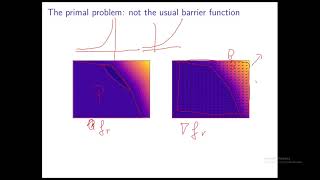
Francisco Criado - The Dual 1-Fair Packing Problem and Applications to Linear Programming
Explore proportional fairness in resource allocation, its dual problem, and applications to linear programming algorithms, focusing on geometric relationships and potential improvements.