
Sparse Integer Programming Is FPT
Explore sparse integer programming's fixed-parameter tractability, its implications for parameterized complexity, and related concepts in variable dimension optimization.
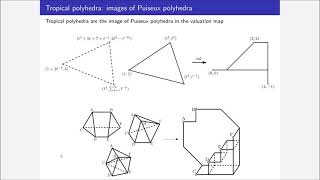
Face Structures of Tropical Polyhedra
Explore tropical polyhedra's face structures, focusing on monomial tropical polyhedra to overcome issues in classical definitions and investigate combinatorial properties.
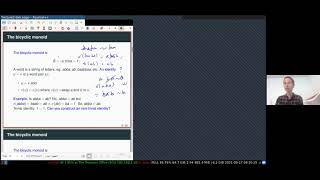
Tropical Solutions to Hard Problems in Auction Theory
Explore tropical mathematics' applications in auction theory, neural networks, and statistics through polytopes, algorithms, and semigroup matrices, unveiling powerful problem-solving techniques.
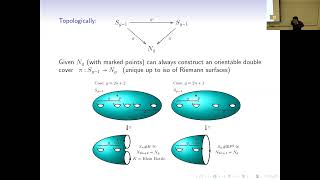
On the Nielsen Realization Problem and Cohomology of Mapping Class Groups of Non-orientable Surfaces
Exploración del problema de realización de Nielsen y cohomología de grupos de clases de mapeo en superficies no orientables, con aplicaciones en topología y teoría de grupos.
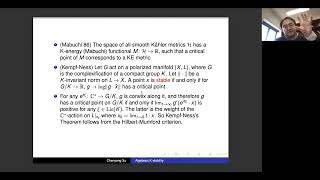
K-Stability of Fano Varieties
Explores K-stability of Fano varieties, connecting complex geometry and algebraic geometry. Discusses recent developments, including solved conjectures and the construction of a moduli space for Fano varieties.
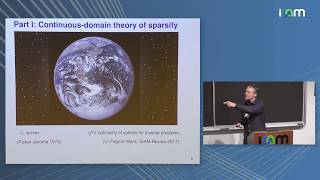
Splines and Imaging - From Compressed Sensing to Deep Neural Networks
Explore splines in imaging, from compressed sensing to deep neural networks. Unser demonstrates spline optimality in inverse problems and their connection to deep learning, offering insights into ReLU architecture and activation optimization.
Regression Analysis in Machine Learning - Linear Regression - Logistic Regression
Comprehensive exploration of regression analysis, covering linear and logistic techniques. Learn to leverage data relationships for informed decision-making in various business contexts.
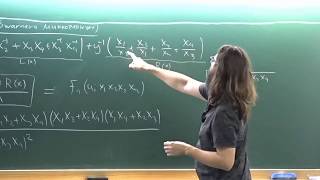
Mirror Symmetry for Character Varieties and Field Theory by Sergey Galkin
Explore mirror symmetry for character varieties, using threespace mirrors to construct SU(2) character variety mirrors on Riemann surfaces, with applications in topological field theory and random walks.
Introductory Lectures on First-Order Convex Optimization - Lecture 1
Explore first-order convex optimization, covering gradient descent, complexity, smoothness, and Nesterov's accelerated algorithm. Gain insights into theoretical foundations and practical applications in machine learning.
Modular Forms by Mahesh Kakde
Comprehensive exploration of modular forms, covering definitions, properties, and applications. Delves into Eisenstein series, theta functions, and related mathematical concepts for advanced learners in number theory.
Quadratic Forms and Hermite Constant, Reduction Theory by Radhika Ganapathy
Explores techniques for computing densest lattice packings, including quadratic forms, Hermite constants, and reduction theory. Covers perfect forms, eutactic lattices, and Voronoi's algorithm for listing perfect forms.
Gamma Convergence - Lecture 2
Explore gamma convergence, minimization problems, and homogenization in this advanced mathematics lecture. Learn about coercivity, lower semicontinuity, and integral functions in the context of multi-scale analysis.
Deep Learning and Computations of PDEs by Siddhartha Mishra
Explore deep learning applications in PDEs, uncertainty quantification, and optimization. Learn about operator learning, DeepOnet decomposition, and high-dimensional PDEs in this advanced lecture.

The Pitfalls of Using ML-Based Optimization - IPAM at UCLA
Explore pitfalls of ML-based optimization in graph problems, comparing traditional approaches for Force Path Cut and Hypergraph Discovery. Gain insights on limitations and potential improvements in AI applications.
Discrete Optimization-Aided Structured Learning at Scale - IPAM at UCLA
Explore discrete optimization techniques for structured learning, featuring algorithmic aspects, statistical setups, and approaches to feature selection and learning trees.
Using Machine Learning to Formulate Mathematical Conjectures - IPAM at UCLA
Explore how machine learning aids mathematicians in formulating conjectures, focusing on a discovery linking low-dimensional topology and geometry, with insights on the method's potential and limitations.

Formalizing Invisible Mathematics - IPAM at UCLA
Explore the challenges of formalizing mathematics for computers, examining unspoken conventions, proof assistant techniques, and potential solutions for flexible, user-extensible systems.
Learning How to Break Symmetry With Symmetry-Preserving Neural Networks - IPAM at UCLA
Explore symmetry-preserving neural networks for data efficiency and generalization, learning symmetry-breaking information, and predicting structural distortions in crystalline materials.
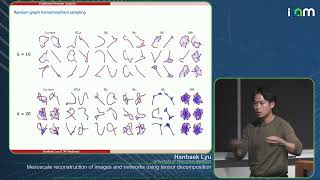
Mesoscale Reconstruction of Images and Networks Using Tensor Decomposition
Explore mesoscale reconstruction of images and networks using tensor decomposition, focusing on a unified framework, error bounds, and online CP-dictionary learning for multi-modal datasets.
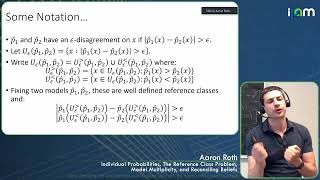
Individual Probability, Reference Class Problem, Model Multiplicity, Reconciling Belief
Explore individual probabilities, reference class problem, and model multiplicity in machine learning. Gain insights on reconciling beliefs and addressing challenges in probability estimation for individuals and groups.
Enhancing Markov Chain Monte Carlo Sampling Methods with Deep Learning
Explore advanced techniques combining Markov Chain Monte Carlo sampling with deep learning, focusing on importance sampling, normalizing flows, and non-equilibrium methods for enhanced efficiency in high-dimensional problems.