
Programming Language as Language
Explore programming languages as human languages, examining their structural elements, cognitive impacts, and role in shaping developer communities and mental models.
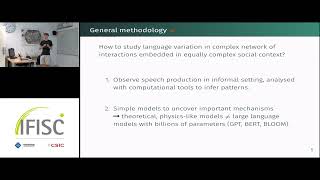
Diversity in and of Languages: How We Can Measure and Model Its Emergence to Unveil Underlying Social Processes
Explore linguistic diversity measurement and modeling techniques to uncover societal patterns and language emergence mechanisms.
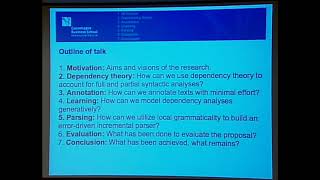
Modelling Human Syntax by Means of Probabilistic Dependency Grammars - 2007
Explore probabilistic dependency grammars for modeling human syntax, addressing linguistic phenomena beyond context-free grammars and discussing generative models and parsing algorithms.
Reducing Confusions and Ambiguities in Speech Translation - 2005
Explore techniques to enhance speech translation by addressing accent-related confusions, named entity recognition, and semantics-based disambiguation for improved accuracy and understanding.
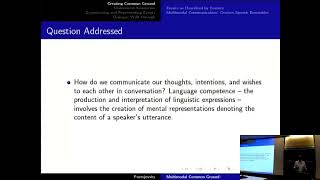
Modeling Common Ground for Multimodal Communication - 2018
Explore multimodal communication in human-machine interactions using a 3D simulation platform. Learn about VoxML modeling language for encoding objects and actions in shared task environments.
Syntactic Language Modeling for Machine Translation and Speech-Repair Detection - 2005
Explore syntactic language modeling techniques for improving machine translation and detecting speech repairs in natural language processing.
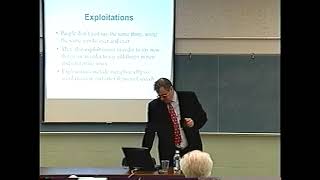
Norms and Exploitations: Mapping Meaning onto Use
Explore Corpus Pattern Analysis to map word meanings to typical contexts, reducing lexical entropy and linking patterns to applications like synonym sets or translations.
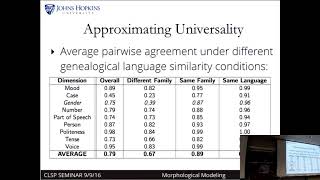
Rich Morphological Modeling for Multi-lingual HLT Applications - 2016
Explore advanced morphological modeling techniques for diverse languages, enhancing HLT applications through innovative approaches like neural networks and cross-lingual projection.
Practical Linguistically Motivated Parsing
Explore linguistically motivated parsing techniques with Stephen Clark, focusing on practical applications and advanced methodologies in natural language processing.
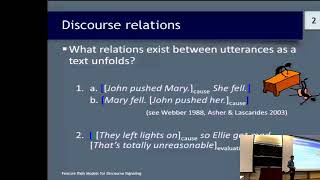
Feature Rich Models for Discourse Signaling - 2018
Explore computational models for discourse relations using rich annotations beyond text, including syntactic and semantic information, to capture complex discourse structures.

Text Geolocation and Dating: Light-Weight Language Grounding - 2012
Explore geolocation and dating of texts to identify latitude-longitude pairs and time periods related to documents. Learn about computational models of word meaning beyond standard word vectors.
Semantic Lexicons and Semantic Tagging: Towards Content Interoperability
Explore large-scale language resources, computational lexicons, and semantic tagging for content interoperability. Learn about European initiatives, challenges, and future paradigms in language technology.
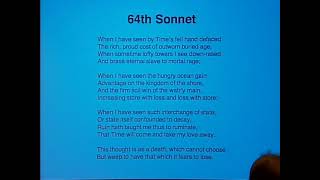
When Will Computers Understand Shakespeare?
Explore computational challenges in understanding Shakespeare's 64th sonnet and potential solutions, examining progress in AI language comprehension.
Speech, Language, and Machine Learning
Explore speech, language, and machine learning concepts with Jeff A. Bilmes from the University of Washington in this comprehensive lecture.
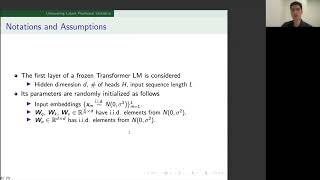
Toward Length Extrapolatable Transformers
Explore innovative techniques for enhancing transformer models' ability to handle longer sequences, improving their performance and scalability in natural language processing tasks.

CDG-Based Language Models - 2009
Explore context-dependent grammar-based language models and their applications in natural language processing and speech recognition.

Speech and Language Processing: Where Have We Been and Where Are We Going - 2003
Explore the past, present, and future of speech and language processing with insights on technological trends, data mining, and shifting priorities in the field.
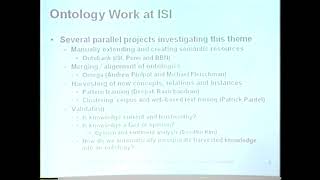
Towards Automatic Acquisition of Ontological Knowledge - 2004
Explore methods for extracting semantic relations between verbs and ontologizing lexical resources. Learn about VerbOcean and techniques for disambiguating grammatical templates in ontologies.
An Information State Approach to Collaborative Reference
Explore collaborative reference in dialogue systems using information state approaches. Gain insights into language processing and communication dynamics.
Towards Meaning: The Tectogrammatical Sentence Representation - 2001
Explore tectogrammatical sentence representation, a linguistic approach for analyzing sentence structure and meaning, presented by Jan Hajic in 2001.
CS 201: Introduction to Natural Language Processing - Lecture 11/17/2022
Explore natural language processing with Dan Jurafsky in this UCLA Computer Science lecture, covering key concepts and applications in computational linguistics.