Interpreting Emergent Communication in Nonhuman Species
Explore techniques for decoding and interpreting emergent communication patterns in non-human species, with insights from cutting-edge research and AI applications.
Linguistic Interaction in Humans and Machines - Understanding Higher-Level Intelligence
Exploring methods from cognitive science to study ML models and human cognition, focusing on language-based projects that analyze adaptation and generalization in linguistic interactions.

The Giant Leaps in Language Technology - And Who's Left Behind
Explore the impact of language technology on global communication and the importance of inclusive systems for low-resource languages. Discover how bridging linguistic gaps can shape a more equitable digital future.

Computing a Rosetta Stone for the Indus Script
Discover how modern computational techniques are being used to decipher the 4000-year-old Indus script, unlocking secrets of an ancient civilization in this fascinating TED talk by Rajesh Rao.
Coreference Resolution with spaCy and spaCy-Experimental
Master coreference resolution in Python using spaCy-Experimental - implement advanced natural language processing techniques to track and link entity mentions across text.

Text Embeddings, Classification, and Semantic Search with Python Code
Explore text embeddings for classification and semantic search with Python. Learn to transform text into computable vectors for powerful NLP applications.
Linguistically-Informed LLMs Perform Better
Explore how linguistics enhances LLM performance and shapes future improvements in AI language models.
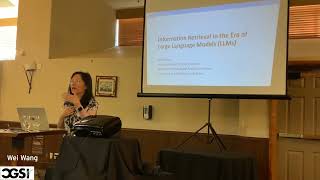
Information Retrieval in the Era of Large Language Models
Explore how large language models are transforming information retrieval systems, with focus on event detection, clinical data extraction, and social media analysis for epidemic prediction.
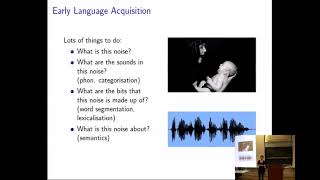
Using Semantics to Help Learn Phonetic Categories
Discover how semantics can enhance phonetic category learning through computational models and linguistic analysis in this research-focused exploration of language acquisition.

Trustworthy Formal Natural Language Specifications
Explore a novel approach to translating natural language specifications into formal claims within proof assistants, enhancing software verification and bridging the gap between informal and formal specifications.

Do Androids Know They're Only Dreaming of Electric Sheep?
Explore transformer language models' internal representations to detect and analyze hallucinatory behavior in AI-generated content, with insights on task-dependent patterns and evaluation methods.
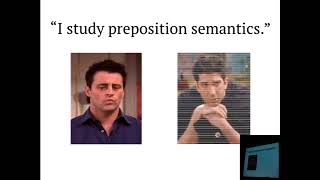
The Ins and Outs of Preposition Semantics - 2017
Explore preposition semantics, their crucial role in linking meaning, and challenges in comprehensive annotation and cross-linguistic analysis. Gain insights into ongoing research and corpus development.
Learning Constraint-Based Grammars from Representative Data - 2008
Explore constraint-based grammars for natural language processing, integrating syntax, semantics, and learning. Discover a new grammar formalism for deep language understanding and its applications in knowledge acquisition.
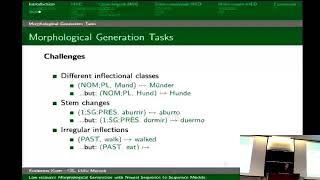
Low-resource Morphological Generation with Neural Sequence-to-Sequence Models
Explore neural sequence-to-sequence approaches for morphological generation in low-resource languages, including multi-task learning, cross-lingual transfer, and semi-supervised techniques.
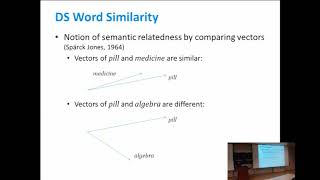
Towards Large-Scale Natural Language Inference with Distributional Semantics
Explore natural language inference using distributional semantics, covering summarization, semantic models, and knowledge induction for advanced text analysis.
Automatic Detection and Monitoring of Parkinson's Disease from Language and Speech
Explore cutting-edge techniques for detecting and monitoring Parkinson's disease through speech and language analysis, presented by PhD student Anna Favaro from Johns Hopkins University.

Tackling Fairness, Change, and Polysemy in Word Embeddings
Explore fairness, change, and polysemy in word embeddings with Felipe Bravo's presentation on cutting-edge research in natural language processing and machine learning.
Building Grammar Libraries for Mathematics and Avoiding Manual Work
Explore techniques for constructing efficient grammar libraries in mathematics, focusing on automation to minimize manual effort and enhance productivity in formal language development.
Understanding the Expressive Power of Transformers Through Formal Language Theory
Explore the intersection of formal language theory and machine learning, focusing on transformer expressiveness and recent developments in understanding their learning capabilities.

Ontological Semantics: An Overview
Explore a comprehensive approach to text meaning in computer processing, covering theories, methodologies, and implementations for effective natural language processing applications.
Identifying Minimalist Languages from Dependency Structures
Explore dependency structures to identify minimalist languages, delving into linguistic theory and computational approaches with Ed Stabler.