Quantum 2-SAT on Low Dimensional Systems is QMA_1-Complete
Delve into groundbreaking research exploring quantum satisfiability problems, examining complexity transitions in low-dimensional quantum systems and their computational implications for quantum information theory.
Classical Verification of Quantum Learning
Explore the verification framework enabling classical clients to reliably delegate learning tasks to quantum servers, focusing on parity learning and Fourier-sparse functions with mixture-of-superpositions examples.
New Approaches to Complexity via Quantum Graphs
Explore groundbreaking research on quantum graph complexity theory, examining clique problems and quantum channels while comparing complexity classes QMA(2), QMA, MA, and NP.
Provable Advantage in Quantum PAC Learning
Discover groundbreaking research on quantum PAC learning, exploring provable advantages over classical methods with square root improvements in sample complexity and theoretical quantum information science.
Guidable Local Hamiltonian Problems with Implications to Heuristic Ansatz State Preparation and Quantum PCP
Delve into advanced quantum computing theory exploring Guidable Local Hamiltonian problems, their complexity-theoretic implications, and connections to quantum PCP conjecture and state preparation methods.
A Shortcut to a Near-Optimal Quantum Linear System Solver
Discover a simplified approach to quantum linear system solving that achieves near-optimal performance through kernel reflection, offering improved efficiency for practical applications in quantum computing.
Oracle Separation of QMA and QCMA with Bounded Adaptivity
Delve into quantum complexity theory through an exploration of oracle separation between QMA and QCMA, focusing on bounded adaptivity in oracle queries and the novel concept of slipperiness.
Understanding Cryptographic Hardness in a Quantum World
Explore cutting-edge research on cryptographic security challenges and theoretical frameworks in quantum computing, focusing on hardness assumptions and their implications for future systems.
Quantum Complexity of Testing Signed Graph Clusterability
Explore quantum algorithms for testing signed graph clusterability, featuring a novel approach with O(N^1/3) query complexity and proven advantages over classical methods.
Two Prover Perfect Zero Knowledge for MIP* - Theory of Quantum Computation
Delve into advanced quantum computing theory exploring perfect zero-knowledge protocols in MIP* systems, focusing on two-prover implementations and boolean constraint systems for quantum computation.
Tight Bounds for General Computation in Noisy Broadcast Networks
Delve into the mathematical analysis of noise-resilient protocols in broadcast networks, exploring tight bounds for general computation and innovative simulation schemes with Dr. Saxena.
Applications of Algebraic Complexity to Unsupervised Learning
Delve into advanced algebraic complexity theory and its applications in unsupervised learning algorithms, exploring computational hardness of multivariate polynomials and efficient learning techniques.
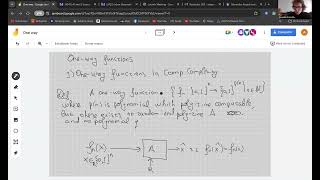
One-Way Computable Transformations - The Barmalias-Zhang Example
Dive into the mathematical exploration of one-way computable transformations through the Barmalias-Zhang example, examining its significance in computational complexity theory.
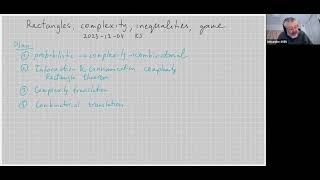
Rectangles, Complexity and Games in Communication Theory - December 4, 2023
Delve into communication complexity theory through rectangles, exploring inequality principles, combinatorial strategies, and their applications in computational game theory.
PAC Learning of Decision Trees
Explore the theoretical foundations of PAC learning algorithms and their application to decision tree construction in this advanced computational complexity seminar.
PAC Learning: From Finite Families to CNF Formulas - Lecture on March 20, 2023
Dive into PAC learning concepts, exploring finite families, conjunctions, k-CNFs, and NP-completeness in proper learning for 2-term CNF through advanced computational complexity theory.
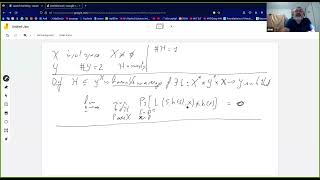
Basic Results About Learning in Computational Complexity - March 2023
Dive into fundamental concepts of computational complexity and learning theory through Bruno Bauwens' detailed exploration at the prestigious Kolmogorov seminar.
Introduction to Probably Approximately Correct (PAC) Learning
Dive into computational complexity and PAC-learning concepts through an in-depth seminar discussion at the prestigious Kolmogorov seminar series on complexity theory.
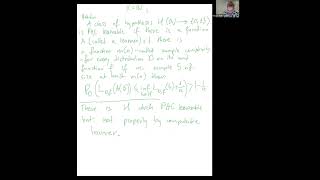
Computable PAC Learning - Part 2
Dive into advanced concepts of computable PAC learning through an in-depth exploration of theoretical frameworks and computational complexity in machine learning theory.
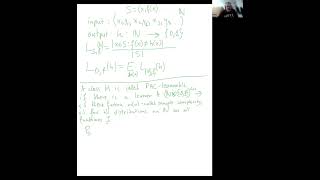
Computable PAC Learning - Part 1
Dive into computational complexity and PAC learning theory through an in-depth exploration of foundational concepts, statistical learning frameworks, and algorithmic approaches.
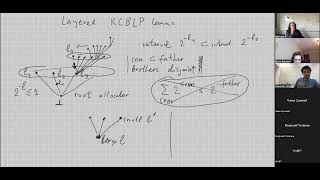
Kraft-Barmpalias-Lewis-Pye Lemma - October 24, 2022
Delve into the layered version of Kraft's lemma, exploring its mathematical foundations and applications in computational complexity theory through expert analysis.