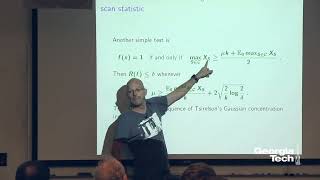
Combinatorial Testing Problems - Lecture 1
Explore combinatorial testing problems, including hidden clique and high-dimensional random geometric graphs, with insights on statistical challenges and estimation techniques.
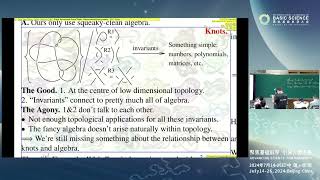
Knot Invariants from Finite Dimensional Integration
Explore finite dimensional integration for computing powerful knot invariants, surpassing traditional methods in efficiency and rigor while challenging established notions in knot theory.
The Tale of Math and Scalability - Predicting System Performance
Explore how mathematical principles can predict and enhance software system scalability, uncovering the hidden math behind efficient engineering practices.
Combinatorial Inequalities and Combinatorial Interpretations - Part I
Explore classical inequalities in enumerative and algebraic combinatorics, their combinatorial interpretations, and their impact on the field. Gain insights into complexity theoretic aspects.
Bayesian Inference of Causal Graphs: Current Status and Future Directions
Explore Bayesian inference for causal discovery, examining recent progress, challenges, and assumptions in modeling cause-effect relationships from observational data.
The Number of Random 2-SAT Solutions is Asymptotically Log-Normal
Explore discrete probability and statistics in a month-long program featuring talks, minicourses, and collaborative sessions. Engage with researchers and delve into topics like random 2-SAT solutions.
Entanglement Subvolume Law for 2D Frustration-Free Spin Systems
Explore entanglement entropy in 2D frustration-free spin systems, examining Hastings' proof, robust polynomials, and the Whole Screen Directivity Lemma.
Matrix Product States for Modeling Dynamical Processes on Networks
Explore matrix product states and dynamic message-passing algorithms for modeling network dynamics, reducing computational complexity from exponential to polynomial in system size and duration.
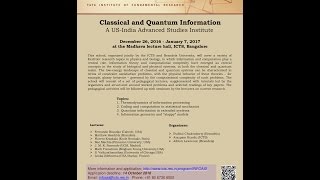
Why Do Simple Models Work? Partial Answers from Information Geometry - Lecture 1
Explores information geometry to understand why simple models effectively describe complex systems, focusing on statistical mechanics, renormalization, and model reduction in physics and biology.

Local Weak Convergence for Random Constraint Satisfaction Problems
Explore local weak convergence in random constraint satisfaction problems with Princeton's Allan Sly, delving into advanced statistical mechanics concepts beyond two dimensions.
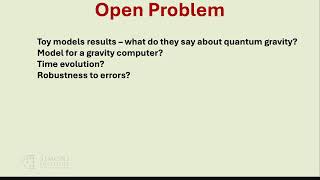
Pseudorandomness and Pseudoentanglement in Holography
Explores the intersection of quantum complexity and holography, discussing pseudo-entangled states and their implications for quantum gravity and computational capabilities in AdS/CFT correspondence.
Holographic Pseudo Entropy and Emergent Spacetime
Explore holographic pseudo entropy, its gravity dual, and implications for emergent spacetime in string theory. Gain insights into AdS/CFT, computational complexity, and quantum entanglement.
Local Minima in Quantum Systems
Explores computational challenges in finding local energy minima of quantum systems, comparing classical and quantum approaches and their implications for understanding Nature's cooling processes.
How Quantum Complexity Found Its Way into Black Hole Physics
Explore the surprising connection between quantum complexity and black hole physics, uncovering new insights into horizon properties and the quantum extended Church Turing Thesis.
Quantum Spin Chains and Symmetric Functions: Connections to Representation Theory and Combinatorics
Explore quantum spin chains' connections to representation theory, combinatorics, and algebraic geometry through quantum integrability and symmetric functions.
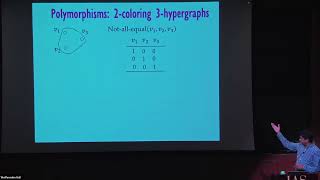
When and How are Promise Constraint Satisfaction Problems Efficiently Solvable
Delve into the mathematical foundations of Constraint Satisfaction Problems (CSP), exploring algorithmic efficiency, polymorphisms, and promise CSP applications in graph coloring and discrepancy minimization.
Fine-Grained Algorithms and Complexity - An Overview of Exact Running Times
Explore the emerging theory of fine-grained reductions in algorithmic complexity, examining modern approaches to determining optimal computational problem-solving speeds beyond traditional NP-hardness.

Simulating Quantum Computation - Classical Data Requirements and Efficiency
Explore the classical simulation methods for quantum computation through probability functions, examining data requirements and computational efficiency in magic state implementations.
Computational Complexity of Quantum Systems - From Theory to Ground State Analysis
Delve into quantum systems' computational complexity, exploring ground states, quantum computing challenges, and algorithmic approaches for simulating quantum phenomena.
Kolmogorov-Arnold Networks: Understanding KAN Architecture and Comparison with MLPs
Dive into Kolmogorov-Arnold Networks (KAN), a groundbreaking alternative to Multi-Layer Perceptrons, exploring its architecture, implementation, and potential advantages in neural network development.
Quantum Complexity Theory Meets TFNP - Product Quantum Satisfiability on Qudits
Delve into advanced quantum complexity theory, exploring the intersection of Total Function NP and Quantum Satisfiability through innovative frameworks and theoretical breakthroughs in qudit systems.