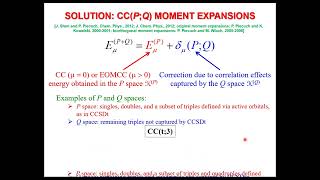
Approaching Exact Quantum Chemistry by Semi-Stochastic and Selected-CI-Driven CC Computation
Explore advanced quantum chemistry techniques, including semi-stochastic methods and selected-CI-driven CC computation, for achieving near-exact results.
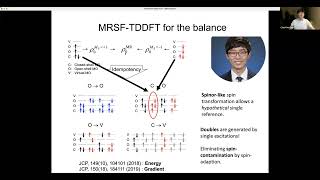
MRSF-TDDFT - A Simple Yet Powerful Quantum Theory
Explore a powerful quantum theory, MRSF-TDDFT, and its applications in computational chemistry and materials science.
Quantum Chemistry with Qiskit
Explore quantum chemistry applications using Qiskit, focusing on simulating molecular systems and solving electronic structure problems.
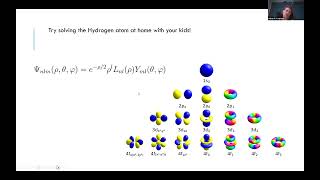
A Mathematical Approach to Coupled Cluster Methods
Explore mathematical foundations of Coupled Cluster methods for many-body problems, covering essential concepts and recent advances in quantum chemistry and nuclear physics.
Differentiable Simulations for Enhanced Sampling of Rare Events
Explore differentiable simulations for enhanced sampling of rare events in chemical reactions, focusing on path-integral optimization and improvements to standard DiffSim techniques.
Rigid Body Flows for Sampling Molecular Crystal Structures
Explore normalizing flows for modeling 3D molecular crystal structures. Learn about flows on rigid bodies, sign-equivariant flows, and implementations like Moebius flows and convex gradient maps.
Systematic Analysis of Biomolecular Conformational Ensembles with PENSA
Explore biomolecular conformational ensembles using PENSA. Learn systematic analysis techniques, featurization methods, and state-specific information quantification for efficient molecular mechanism determination.
Molecular Modeling of Complex Biological Systems
Explore molecular modeling techniques for complex biological systems, focusing on chromatin dynamics, DNA methylation effects, and histone tail modeling. Learn to predict system responses to modifications and mutations.
Learning Quantum Mechanics Using Embedding, Symmetric Polynomials and Composition
Explore quantum mechanics through embedding, symmetric polynomials, and composition. Gain insights into molecular dynamics, atomic cluster expansion, and catalysis with practical demonstrations.
Introduction to Applications of Quantum Computing to Quantum Chemistry - Class 1
Explore quantum computing applications in quantum chemistry, focusing on fundamental concepts and their practical implementation.
Myriad LLM Approaches to Drug Discovery Generative Artificial Intelligence
Explore diverse LLM approaches in drug discovery GenAI, empowering medicinal chemists to enhance the process through informed prompts and molecule generation techniques.
Computational Modeling of Active Systems - Class 4
Explore computational modeling techniques for active systems, focusing on advanced concepts and practical applications in the field of active matter.
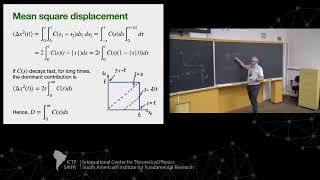
Computational Modeling of Active Systems - Class 3
Explore computational modeling techniques for active systems, focusing on advanced concepts and practical applications in the field of active matter.
Spacetime Correlations of the Classical Toda Chain in Thermal Equilibrium
Explore spacetime correlations in the classical Toda chain, comparing molecular dynamics simulations with Landau-Lifshitz theory predictions based on generalized hydrodynamics.
Discovering Dynamic Laws from Observations: The Case of Self-Propelled Particles
Explore machine learning techniques for uncovering forces in active matter systems, from cellular to animal scales. Learn to extract local dynamics crucial for understanding collective phenomena.
Fascination and Industrial Value of Materials Modeling
Explore materials modeling's role in sustainable energy solutions. Discover how simulations across scales support technological advancements in alloys, batteries, and CO2 capture.

Koopmans Functionals in Practice - QE Tutorial 2022
Explore Koopmans functionals in Quantum ESPRESSO, focusing on practical applications and advanced techniques for electronic structure calculations.
Chemical Foundation Models for Drug Discovery
Explore chemical foundation models for drug discovery, focusing on innovative approaches and potential breakthroughs in pharmaceutical research.
Idea of Z-Matrix
Explore the concept of Z-matrix in molecular geometry, understanding its structure and applications in computational chemistry.
Computational Modeling of Active Systems - Class 1
Explore computational modeling techniques for active systems, focusing on fundamental principles and practical applications in the field of active matter.
Structured State-Space Sequence Models for De Novo Drug Design
Explore the potential of Structured State-Space Sequence (S4) models in advancing chemical language modeling for de novo drug design, including bioactive compound identification and natural product design.