Sci-Fi Science and Complex Systems - Exploring Alien Civilizations
Explore the intersection of sci-fi and science as researchers model a three-parent alien civilization, discussing societal implications, speculative research, and the impact of small changes on complex systems.
Complexity Science and the Nobel Prize in Physics 2021
Explore Parisi's groundbreaking work on spin glasses and its impact on understanding complex systems across physics, biology, and computer science, from atomic to planetary scales.
Thoughts on Rational Inference - Is Information Theoretic Inference Rational?
Exploring rational inference approaches for incomplete information in complex sciences. Discusses defining and implementing rational methods, handling misspecifications, and addressing model uncertainty and robustness.
Geoffrey West on Scaling, Open-Ended Growth, and Accelerating Crisis/Innovation Cycles
Geoffrey West explores scaling laws in cities, discussing how urban environments amplify human creativity and challenges, and examines the accelerating cycle of crisis and innovation driving our global economy towards potential peril.
Scaling Laws and Social Networks in the Time of COVID-19 - Part 1
Exploring scaling laws in biology, cities, and economies, and their implications for societal challenges like pandemics and sustainability. Insights from complex systems science for understanding human civilization.
Better Scientific Modeling for Ecological and Social Justice
Exploring how mathematical models can encode blind spots and create externalities, emphasizing the need for rigorous empiricism to achieve ecological and social justice through better scientific modeling.
Social and Economic Networks - Understanding Power, Beliefs, and Behaviors
Explore how social networks shape power, beliefs, and behaviors, and their impact on information spread, economic resilience, and societal structures with Stanford economist Matthew Jackson.
Metabolic Scaling in Biology and Computation
Explore metabolic scaling in biology and computation, examining energy requirements, evolutionary processes, and complex systems. Discover implications for space exploration, economics, and technology design.
Global Catastrophic and Existential Risks - The Weightiest Complex Phenomena?
Explore the interdisciplinary field of global catastrophic and existential risks, their complex dynamics, and potential mitigation strategies for ensuring a safer future for humanity.
Text-Based Timeline Analysis and New Instruments for the Science of Stories
Exploring Twitter data as a telescope for observing collective human thought, revealing insights into sentiment, narrative power, and social dynamics through innovative text analysis techniques.

Alien Crash Site - Speculative Science of Three-Parent Alien Civilizations - Episode 8
Explore speculative "sci-fi science" with SFI researchers, discussing extraterrestrial civilizations, three-parent families, and the interplay between individuals and society. Delve into counterfactuals and their role in scientific research and sci-fi.
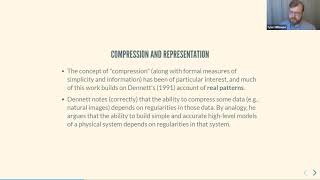
Patterns and Parsimony - High-Level Representations in Scientific Modeling
Explore the role of compression in developing effective high-level representations for scientific modeling, and discover why good representations require more than simplicity alone.

Music, Brain, and Networks: A Search for Universality
Explore the intersection of music, neuroscience, and complex systems with experts discussing universal features and evolutionary perspectives across cultures.
Epidemic Spread Through Segregated Spaces - Racial Disparities in COVID-19
Explore racial disparities in COVID-19 impact, examining structural factors and spatial segregation. Learn how to improve epidemic models by incorporating multi-scale spatial interactions and socio-economic factors.
Complexity as Seen Through Modern Statistical Mechanics - New Perspectives
Explore nonextensive statistical mechanics and its applications in studying complex systems across various fields, with insights from Constantino Tsallis on recent developments and q-triplets.
Networks, Complexity, and Disease Dynamics
Explore the intricate relationship between network structures, complex systems, and the spread of diseases in this insightful seminar by Dirk Brockmann from Humboldt University.
Projects in Time Series Analysis - Chaos Detection with Persistent Homology and Process Monitoring
Explore chaos detection in time series using persistent homology and process monitoring techniques, with applications in complex systems analysis and data-driven decision making.
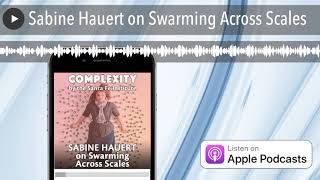
Swarming Across Scales - From Robotic Swarms to Nanoparticles
Explore swarm intelligence and its applications in robotics, medicine, and engineering. Learn how simple rules create complex behaviors, revolutionizing technology across various fields.
On Coronavirus, Crisis, and Creative Opportunity
Exploring how crises reshape opportunities, this talk examines evolutionary strategies for navigating disruptions and the potential for innovation amidst catastrophe in a post-coronavirus world.
Halting the Spread of COVID-19 - Network Epidemiology and Containment Measures
Network epidemiology insights on COVID-19 spread, discussing contagion across scales, co-infections' impact, and evidence supporting containment measures. Explores complexities of pandemic modeling and intervention strategies.
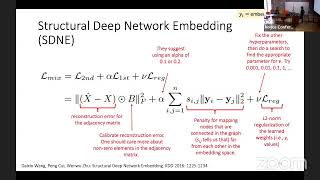
Trustworthy Network Science - Measuring Instability and Reliability in Data Algorithms
Explore network science methodologies, focusing on measuring instability, data algorithms, embedding methods, and reliability metrics for robust analysis and insights.