Future Directions in SFI Science: Potential Ideas - 2012 Annual Science Board Symposium
Exploración de direcciones futuras en ciencia de sistemas complejos, abordando temas como computación cuántica, física no equilibrada, diversidad biológica y cultural, y leyes fundamentales de innovación y crecimiento social.
Computation in Natural Systems - Mesoscopic Theories and Information Processing
Explore computation in natural systems, from primate behavior to physics, examining how information processing occurs across scales and the implications for understanding complex systems.
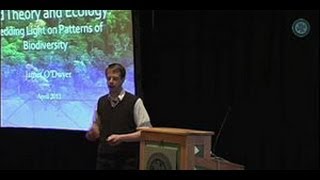
How Field Theory Can Help Solve Problems in Ecology - 2011
Explore how field theory concepts from physics can be applied to solve ecological problems, offering new insights into biodiversity and ecosystem dynamics.
Parables from Complex Systems and Their Possible Meanings for Our Lives - Lecture 2
Explore complex systems through parables, examining prediction models, chaos theory, and market dynamics to gain insights applicable to everyday life and decision-making.
Parables from Complex Systems and Their Possible Meanings for Our Lives - Lecture 1
Explore complex systems through parables, uncovering insights into human life and society. Gain a unique perspective on interconnectedness and emergent behaviors in various systems.
Diverse Intelligence - From Human Minds to Complex Systems
Exploring diverse forms of intelligence: from human evolution to complex systems and future discoveries. Experts discuss biological, artificial, and collective intelligence across species and technologies.
The Statue in the Stone: How Dynamical Systems Discover Environmental Patterns
Explores how complex systems adapt to environmental patterns, favoring stable configurations that match external forces. Illustrates with toy models and swarm-robotics experiment.
Information Transfer in Collective Computation by Ants and Slime Molds
Explores information transfer in collective problem-solving by ants and slime molds, revealing surprising mechanisms for regulating information flow and decision-making in simple organisms.
Models for Interdisciplinarity Inspired by Mathematical Biology
Explore frameworks for interdisciplinary modeling, including "Rule-of-Five" and disciplines as coevolving networks, to improve teaching and research across fields.
Reverse Engineering Complexity - Dynamics, Architecture, and Robustness in Complex Systems
Explore robustness, tradeoffs, and feedback in complex systems through computational models. Discover applications in earthquakes, wildfires, biomaterials, infectious diseases, and more, emphasizing dynamics, architecture, and adaptation.
The Connected World - Networks and Their Properties
Explore the hidden world of networks, from social connections to cellular metabolism, and discover how scientists study these complex systems to unravel their mysteries.
The Shape of Music - Mathematical Order in Western Tonality
Exploring the mathematical structure of Western music, revealing hidden geometries and patterns that connect diverse musical styles from Bach to The Beatles, and their relation to complex systems science.

On Composition and Complexity
Explore the intricate relationship between composition and complexity, delving into how elements combine to create emergent properties and complex systems across various disciplines.
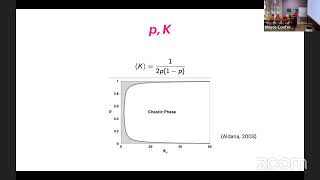
Criticality - A Balance Between Robustness and Adaptability
Explore the concept of criticality and its role in balancing robustness and adaptability in complex systems, offering insights into system behavior and optimization.
Prediction, Explanation, and Control - From AI to Human Mind
Explore the connections between AI and human cognition, focusing on prediction, explanation, and control mechanisms in both artificial and biological intelligence systems.

Emergence, Self-Organization, and Complexity
Explore the interconnected concepts of emergence, self-organization, and complexity with Carlos Gershenson, gaining insights into how these phenomena shape our world and understanding of systems.
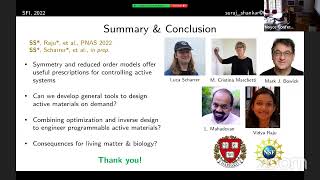
Designing Active Matter in Space-time
Explore the cutting-edge field of active matter design across space and time, delving into innovative concepts and their potential applications in various scientific domains.
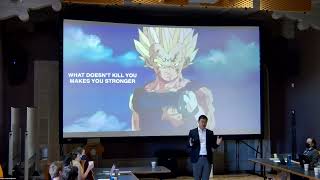
Quantifying Failure - Understanding Patterns and Predictors of Setbacks
Explore the science of failure and its quantification with Dashun Wang. Gain insights into measuring, understanding, and leveraging setbacks for future success in various fields.
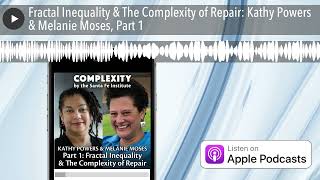
Fractal Inequality and the Complexity of Repair - Part 1
Exploring how complex systems science can address societal inequalities, from vaccine distribution to economic opportunities. Insights on repairing structural inequities using network analysis and modeling to protect vulnerable populations.
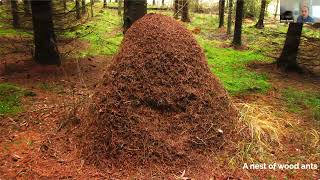
The Self-Assembling Horde: Building Functional Structures on the Move
Explore how collective organisms build functional structures while in motion, focusing on self-assembling processes and their applications in various fields of science and engineering.
On the Shape of Epidemics
Explore the patterns and dynamics of epidemic spread, examining factors that influence their shape and progression through populations.