Data Analytics and Machine Learning Innovation for Climate and Earth Surface Processes
Explore innovative data analytics and machine learning techniques for climate and Earth surface processes, focusing on big data challenges and opportunities in Earth system modeling and predictability.
Future Climate
Novel perspectives on Earth's climate future, exploring ice sheets, clouds, ecological tipping points, renewable energy, and personal action. Experts discuss challenges and solutions for shaping our climate destiny.
Microbes Controlling the Climate
Explore how airborne microorganisms may influence weather events, focusing on bacteria's role in hailstone formation and its implications for understanding microbial impact on climate.
Positive Tipping Points - Viewing the World as a System
Exploração de pontos de inflexão climáticos e sociais, destacando a urgência da ação climática e identificando mudanças positivas necessárias para limitar o aquecimento global.
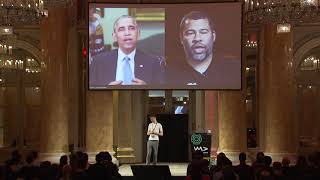
What We Need to Do to Continue Advancing Deep Learning
Explore advancements in deep learning, including reinforcement learning, generative adversarial networks, and neural networks, with insights on AI's future and its impact on various fields.
Meteorology, Climate and Python - Desperately Trying to Forget Technical Details
Explore meteorology and climate analysis using Python, focusing on practical applications and data visualization techniques while avoiding unnecessary technical complexities.

The Threat of Ocean Acidification
Explore ancient seabeds and corals to understand climate history, set baselines for current climate issues, and track the alarming rise of ocean acidification.
Subzero.jl: Fast and Flexible Sea Ice Physics
Explore efficient sea ice modeling with Subzero.jl, leveraging Julia's speed for advanced climate simulations. Learn about discrete-element modeling and performance improvements in sea ice dynamics research.
如何當一位好的環境祖先 - 重新定義綠色減碳行動
探討如何成為環境好祖先,提倡將綠色減碳融入組織業務中,重新定義減碳行動,為後代創造永續未來。
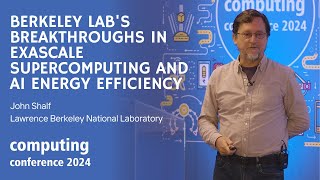
Berkeley Lab's Breakthroughs in Exascale Supercomputing and AI Energy Efficiency
Explore Berkeley Lab's journey from atomic age to supercomputing forefront. Discover exascale computing challenges, energy efficiency innovations, and future HPC directions with specialized hardware and chiplets.
GENIE: Generative Foundation Models for Automated Climate Science
Explore generative foundation models for automated climate science with Rose Yu's GENIE project, advancing AI applications in environmental research.
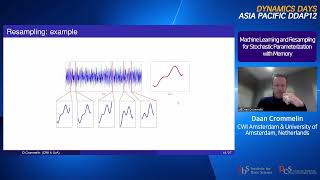
Machine Learning and Resampling for Stochastic Parameterization with Memory
Explore machine learning and resampling techniques for stochastic parameterization with memory in multiscale dynamical systems, focusing on overcoming challenges in long-memory scenarios.
Portable Communications Interface for Earth System Model - JuliaCon 2024
Explore ClimaComms.jl's high-level interface for Earth System Model components, enabling efficient communication patterns and distributed simulations across various architectures.
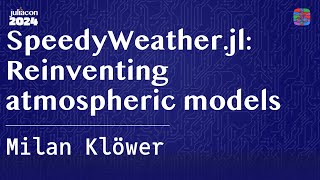
SpeedyWeather.jl - Reinventing Atmospheric Models
Innovative Julia-based atmospheric modeling tool offering interactive, user-friendly simulations for climate research, overcoming traditional Fortran constraints with flexible, extensible components.
Applied Data Science & Engineering for Local Weather Forecasts
Explore data science applications in local weather forecasting, covering numerical prediction models, scaling with Apache Airflow, and forecast verification techniques for improved accuracy.
Climate, GHG Mitigation and CO2 Removal - A Role for Soils?
Explore climate change mitigation strategies, focusing on soil management's potential for greenhouse gas reduction and carbon dioxide removal.
Programming for the Planet - Functional Programming for Environmental Analysis
Explore functional programming's role in building resilient systems for climate analysis, addressing global crises through data-driven conservation and policy decisions.

ML for Solving PDEs: Neural Operators on Function Spaces
Explore AI advancements in scientific applications, including neural operators for weather and climate modeling, offering significant speedups and zero-shot generalization across function spaces.
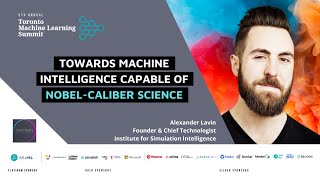
Towards Machine Intelligence Capable of Nobel-Caliber Science
Explore AI-driven scientific discovery, its challenges, and potential for Nobel-caliber breakthroughs. Learn about key AI/ML areas, recent progress, and human-machine collaboration in advancing scientific innovation.
Frontiers of Foundation Models for Time Series
Explore foundation models for time series data, addressing challenges in science applications and discussing future research directions in deep learning for time series analysis.
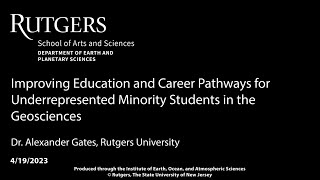
Improving Education and Career Pathways for Underrepresented Minority Students in the Geosciences
Explore strategies to enhance diversity and inclusion in geoscience education, focusing on underrepresented minority students' pathways to success.