
Links between Eddy Horizontal and Vertical Structure: A Geostrophic Turbulence Perspective
Explores connections between horizontal and vertical eddy structures in geostrophic turbulence, offering insights into ocean dynamics and energy transfers across scales.
Understanding Climate Dynamics Through Linear Response Theory
Explore climate dynamics using Linear Response Theory. Learn how this mathematical framework helps predict and analyze complex climate system behaviors, offering insights into future climate scenarios.
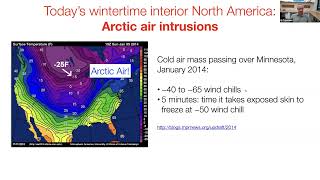
The Dynamics of Very Warm Climates - Past and Future
Explore the dynamics of extremely warm climates throughout Earth's history and potential future scenarios with Harvard's Professor Eli Tziperman in this engaging virtual seminar.
Reynolds Decomposing Heat Waves - Geophysical Fluid Dynamics
Explore Reynolds decomposition for analyzing heat waves, focusing on atmospheric dynamics and energy transfers across scales. Gain insights into geophysical fluid dynamics and climate modeling techniques.
Observations of Localized Submesoscale Kinetic Energy Fluxes
Explores submesoscale kinetic energy fluxes in geophysical fluid dynamics using observational data, contributing to understanding of multi-scale energy transfers in Earth's climate system.
Links Between Eddy Horizontal and Vertical Structure: A Geostrophic Turbulence Perspective
Explores connections between horizontal and vertical structures in geostrophic turbulence, focusing on eddy dynamics in oceanic and atmospheric flows.
Exploring Climate Dynamics Through Physics of Complex Systems
Discover how complex systems physics illuminates climate dynamics, offering insights into multi-scale interactions, energy transfers, and modeling challenges in Earth's atmospheric and oceanic systems.
Mesoscale and Submesoscale Ekman Pumping in a Turbulent Ocean - Lecture 2
Explores mesoscale and submesoscale Ekman pumping in turbulent oceans, examining dynamics, energy transfers, and interactions across scales in geophysical fluid systems.
Stochastic Multi-Scale Reconstruction of Turbulent Rotating Flows
Explores stochastic methods for reconstructing turbulent rotating flows across multiple scales, advancing understanding of complex fluid dynamics in geophysical systems.
Unraveling the Dynamical Interactions Between Mesoscales and Submesoscales in Geophysical Fluid Dynamics
Explore dynamical interactions across oceanic scales, focusing on energy transfers, turbulent mixing, and instabilities. Learn cutting-edge techniques in geophysical fluid dynamics and climate modeling.
Meso- to Submesoscale Turbulence in the Ocean - Lecture 2
Explores meso- to submesoscale ocean turbulence, focusing on energy transfers, instabilities, and mixing processes. Examines theoretical frameworks and observational insights to enhance understanding of multi-scale oceanic dynamics.
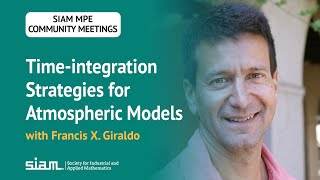
Advanced Time-Integration Methods for Atmospheric Modeling - SIAM MPE Webinar
Explore advanced time-integration methods for atmospheric modeling, focusing on element-based Galerkin methods and horizontally explicit vertically implicit time-integrators for weather and climate prediction.
An Overview of IMDAA Regional Reanalysis
Comprehensive exploration of IMDAA Regional Reanalysis, covering methodology, applications, and significance in atmospheric research and weather forecasting.
Satellite Data Assimilation - Techniques and Applications
Explore satellite data assimilation techniques for weather and climate modeling, focusing on theory, methods, and practical applications in atmospheric and oceanic sciences.
Data Assimilation and Dynamical Systems in Earth Sciences - Lecture 2
Explore data assimilation in Earth sciences, focusing on dynamical systems and their applications in weather and climate modeling. Learn theoretical foundations and practical implementations.
Data Assimilation and Dynamical Systems in Earth Sciences - Lecture 3
Explore data assimilation theory and applications in Earth sciences, focusing on dynamical systems. Gain hands-on experience with practical techniques for integrating observations and forecasts in weather and climate models.
Application of Particle Filters on Data Assimilation
Explore particle filters in data assimilation, a powerful technique for integrating observations and forecasts to estimate atmospheric states and uncertainties in weather and climate modeling.
Data Assimilation Experiments for Operational Weather Forecast in NARL
Explore data assimilation techniques for operational weather forecasting, focusing on experiments conducted at NARL. Learn about integrating observations and short-range forecasts to improve atmospheric state estimation.
Modelling Rainfall Extremes and Floods Over Karnataka
Explore modelling techniques for rainfall extremes and floods in Karnataka, focusing on data assimilation methods and their applications in weather and climate prediction.
Bayesian Theory, Cost Function, Minimization, and Incremental Optimization in Data Assimilation
Explore data assimilation in weather and climate models, covering theory, methods, and applications. Gain hands-on experience with various techniques and their use in atmospheric and oceanic studies.
Ocean Data Assimilation - Lecture 2
Explore advanced ocean data assimilation techniques, their applications in climate modeling, and methods for integrating diverse oceanic observations to improve forecasting accuracy and understanding of marine systems.