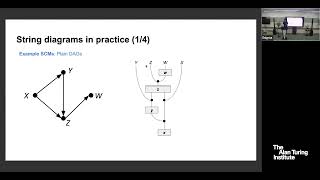
String Diagrams for Structural Causal Modeling and Inference
Explore structural causal modelling and inference using string diagrams, a powerful visual tool for understanding complex causal relationships in data analysis.

Causal Data Integration
Techniques for integrating datasets with unobserved confounding variables and summarizing causal DAGs to address data management challenges in causal inference.

Tractable Bounding of Counterfactual Queries by Knowledge Compilation
Explores bounding partially identifiable queries in causal models using knowledge compilation, offering computational advantages for inference in Bayesian networks with shared structures.
Causal Inference in Single-cell Genomics - Machine Learning in Computational Biology
Explore causal inference in single-cell genomics, focusing on differential expression analysis and integrating bulk data for high-resolution insights into complex disease mechanisms.
Causal Behavioral Modeling Framework - Discrete Choice Modeling of Consumer Demand
Explore causal behavioral modeling and discrete choice models for consumer demand. Learn about heterogeneity, market simulation, and applications in marketing science, with insights on neural network representations.
Cause and Effect - Understanding Causation in Scientific Research
Exploring causal inference methods in epidemiology and their impact on scientific understanding, challenging traditional views on correlation vs. causation in data analysis.
Causal Inference in Python: From Theory to Practice
Explore causal inference in Python, moving beyond association to causation. Learn graphical causal models, do-calculus, and apply the causal data science pipeline to retail problems using DoWhy library.

Learning Gaussian DAGs from Network Data
Descubre técnicas avanzadas para aprender DAGs gaussianos a partir de datos de red con el Dr. Oscar Hernán Madrid Padilla de UCLA.

Introduction to Causal Inference - Asking Your Data "Why?"
Explore causal relationships in data beyond correlation. Learn to ask "Why?" and unveil insights using simple techniques, avoiding misinterpretation pitfalls like Simpson's Paradox.
Advanced Causal Inference Made Simple
Explore automated causal inference techniques using auto-causality package. Learn to analyze A/B test results, measure impacts, and identify customer responses to different options.
Causal Data Science in Retail - Understanding Supply Chain and Customer Behavior
Explore causal inference and Bayesian techniques in retail, focusing on supply chain, customer behavior, and promotion effects at M&S. Learn to answer "why" and "what-if" questions using machine learning.
Improving Insights by Utilizing Causal Inference Methods
Explore causal inference methods to de-bias data, approximate incremental improvements, and accelerate insights using propensity score matching and regression discontinuity.

Proving the Impact: Using Synthetic Control to Evaluate Intervention Effectiveness
Explore Synthetic Control methodology for measuring intervention impact when A/B testing isn't feasible. Learn to construct "synthetic" units, estimate causal effects, and apply this innovative approach to real-world scenarios.

Using Causal Inference to Increase a FinTech's Customer Acquisitions
Explore causal inference techniques to optimize customer acquisition strategies in FinTech, focusing on reducing disengagement during onboarding and improving contact timing.
A Causal Inference Framework for Combinatorial Interventions
Explore a novel latent factor model for estimating causal effects of combinatorial interventions, addressing challenges in factorial experiments and recommendation systems.

Causal Abstractions Using Generalized Functions
Explore generalized functions and their applications in causal models, including nondeterministic structural models and novel types of model reduction, leading to new definitions of causal abstraction.

Meaningful Causal Aggregation and Paradoxical Confounding
Explore causal aggregation challenges, macro interventions, and micro-realism in statistical analysis. Gain insights into ill-defined causality and its impact on confounding in aggregated variables.
Weakly Supervised Causal Representation Learning
Explore weakly supervised causal representation learning, its theoretical foundations, and practical applications in disentangling causal variables from unstructured data like images for improved causal reasoning.
Linear Causal Representations from Interventions under General Nonlinear Mixing
Explore causal representation learning from latent interventions in nonlinear settings. Uncover geometric structures, analyze precision matrices, and evaluate a contrastive algorithm for identifying latent variables.
Causal Representation Learning via Soft Interventions
Explore causal representation learning through soft interventions, focusing on identifiability, prediction of intervention effects, and applications in single-cell biology using auto-encoding variational Bayes.
Identifiability of Causal Models and Applications to Perturb-Seq Data
Explore causal model identifiability, structure learning, and applications to Perturb-seq data. Delve into interventions, latent variables, and causal disentanglement for advancing AI in drug discovery.