TMCF Workshop Use-Cases - Counterfactual CPMS & Emerging COVID Work, Niels Peek
Exploring causal inference in AI prediction algorithms for decision-making, focusing on 'what if' scenarios in healthcare and insurance, with applications to COVID-19 pandemic response.
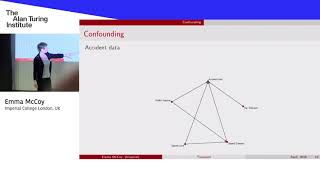
Causal Inference in Observational Studies - Emma McCoy, Imperial College London
Explore causal inference in observational studies with Prof. Emma McCoy. Learn about robust estimation of treatment effects, time-series methodology, and applications in transport settings.
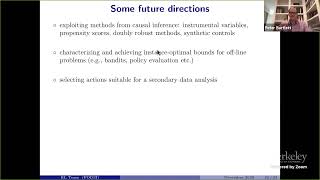
Reinforcement Learning
Explore reinforcement learning's foundations, applications, and advanced concepts, including Q-learning, exploration-exploitation trade-offs, and instance-optimality in policy evaluation.
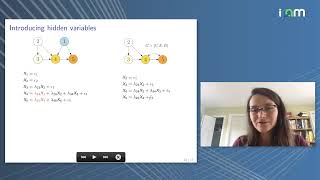
Hidden Variables in Linear Non-Gaussian Causal Models
Explore hidden variables in linear non-Gaussian causal models, using high-order cumulant information to uncover causal structures in data science applications with multiple observed variables.
Causal Inference for Individualized Treatment Effects - From Theory to Algorithms
Explore cutting-edge applications of causal inference in data science for individualized treatment effects, bridging theory and practical algorithms in economic research and policy-making.
Visualizing and Analyzing Event Sequence Data
Explore techniques for analyzing event sequence data, including causal inference, deep learning, and generative AI, to extract valuable insights from high-dimensional business process data.

Causal Effects via Propensity Scores - Introduction and Python Implementation
Explore propensity scores for causal effects in observational data. Learn three methods: matching, stratification, and inverse probability weighting. Includes Python example and cautionary notes.
From Causal Inference to Autoencoders, Memorization & Gene Regulation - Caroline Uhler, MIT
Exploring causal inference, autoencoders, and gene regulation through genomics and 3D genome organization. Integrates data modalities, analyzes overparameterized autoencoders, and links memorization to real-valued data retrieval.
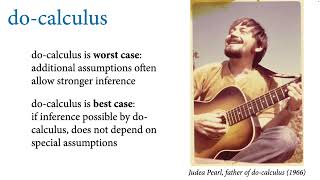
Statistical Rethinking 2023 - Good & Bad Controls
Explore causal inference, do-calculus, and the backdoor criterion. Learn to distinguish good and bad controls in statistical analysis, with insights on the Table 2 Fallacy.
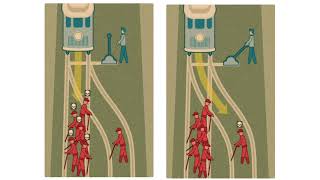
Statistical Rethinking 2022 - Ordered Categories
Explore advanced statistical concepts like ordered categories, cumulative log-odds, and Dirichlet priors. Learn to handle sample bias, confounding, and complex causal effects in statistical analysis.
Statistical Rethinking 2022 - Golem of Prague
Explore statistical modeling, scientific workflow, and causal inference through the lens of golems, owls, and DAGs in this thought-provoking introduction to statistical rethinking.
Science Before Statistics - Causal Inference
Comprehensive workshop on causal inference, covering key concepts like causal design, graph analysis, and Bayesian inference. Equips researchers with tools to navigate complex causal relationships in data analysis.
Bayesian Inference Is Just Counting
Explore foundations of Bayesian data analysis, focusing on conceptual understanding and causal inference. Learn key principles from renowned expert Richard McElreath's book, covering topics like T-tests and machine learning.
Kernel Methods for Causal Inference
Explore kernel ridge regression for causal inference, covering dose responses, treatment effects, and extensions to various settings. Learn about consistency, efficiency, and robustness in estimation.
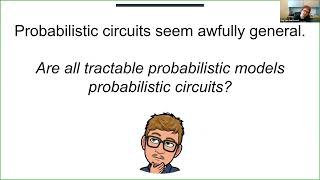
Tractable Probabilistic Circuits
Explore recent developments in tractable probabilistic circuit models, their efficient learning from data, and applications in causal inference algorithms for computing marginal probabilities and related queries.
Causal Inference for Earth System Sciences - Jakob Runge
Exploring causal inference techniques for Earth system sciences, focusing on advanced methods to uncover complex relationships in climate data and improve understanding of multi-scale processes.
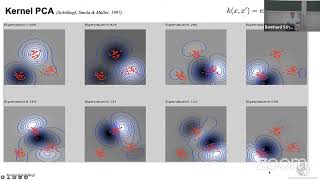
Bernhard Schölkopf- From Statistical to Causal Learning
Explore the evolution of AI systems, from symbolic to statistical and causal approaches, examining key challenges in machine learning and the role of causality in advancing AI understanding and modeling.
Theory and Methods Challenges in Counterfactual Prediction - Karla Diaz-Ordaz
Explore causal inference in AI prediction, enhancing algorithms with 'what if' capabilities for decision-making and fairness. Learn about counterfactual prediction challenges and methodologies.
Enriching Latent Class Models With Counterfactual Prediction - Mark Gilthorpe
Exploring counterfactual prediction in AI: enhancing prediction algorithms with 'what if' capabilities for improved decision-making and fairness in healthcare, insurance, and beyond.
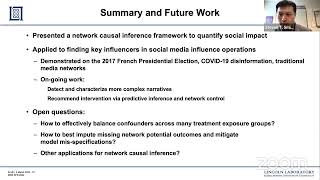
Causal Inference on Networks to Characterize Disinformation Narrative Propagation
Explore techniques for detecting and analyzing disinformation spread on social networks using causal inference, focusing on network construction, influence scoring, and bot detection.
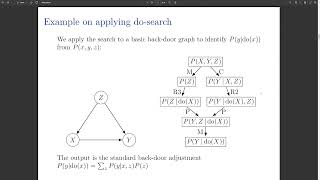
Causal Effect Identification from Multiple Incomplete Data Sources
Explore causal effect identification using do-calculus search algorithms, addressing complex data scenarios like missing data and context-specific independence in causal inference.