
Why the Internet Won't Get You Any More Friends
Explore the biological limits of human social networks and why digital connections don't expand our meaningful relationships beyond our brain's cognitive capacity.

The Brain and the Law - How Neuroscience Will Shift Blameworthiness
Explore how neuroscience challenges criminal justice assumptions, examining brain equality, incarceration effectiveness, and rehabilitation technologies. Insights into unconscious behavior drivers and future-focused legal approaches.
The Leverage Cycle and Debt Forgiveness - Ulam Lectures 2017 Part 2
Explore debt's role in economic cycles, crises, and recovery. Geanakoplos examines leverage, forgiveness, and systemic risks, using recent financial crises as case studies.
Trust and Panic: The History and Impact of Debt - Lecture 1
Explore the historical, literary, and economic significance of debt, default, and financial crises through John Geanakoplos' analysis of the leverage cycle and its impact on major economic events.
The Complexity of Economics - Exploring Markets as Complex Adaptive Systems
Explore the intersection of complexity science and economics with experts discussing agent-based modeling, behavioral economics, and machine learning to gain insights into real-world economic systems.
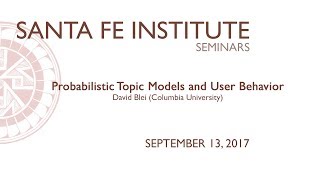
Probabilistic Topic Models and User Behavior
Explore latent thematic structures in document collections and user behavior data. Learn how topic modeling algorithms can enhance predictions and understanding of collection organization.
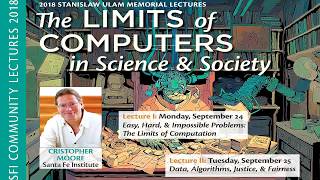
Data, Algorithms, Justice and Fairness - Lecture 2
Exploring algorithmic fairness in justice systems: accuracy, data sources, and potential biases. Discusses AI decision-making, explainability, and societal implications of algorithms in criminal justice.

InterPlanetary Festival - Opening Remarks and Sandbox Thinking Panel
Explore innovative sandboxes for thinking and playing, featuring insights from experts on creative problem-solving and interactive learning environments.

Blessings of Dimensionality for Gaussian Latent Factor Models
Explore how high-dimensional data analysis can benefit from restricted latent factor overlaps, with applications in brain fMRI and financial markets.

How Social Media Might Help You Survive the Next Big Disaster
Explore how social media and technology empower citizens to participate in disaster response, revolutionizing information sharing and emergency management during crises.

Stability in Complex Financial Systems - Lessons from Ecology - Lecture 2
Exploring financial system stability through an ecological lens, examining how to design efficient yet robust capital distribution systems without hidden costs and fragility.

Why We Come to the Aid of Our Friends - An Evolutionary Puzzle
Explore the evolutionary puzzle of unconditional friendship, its benefits, and how humans avoid exploitation. Discover the origins, cultural variations, and comparisons to social ties in other species.

How We Came To Be Deluged By Tweets - The Evolution of Information Technology
Explore the evolution of information technologies and their impact on human consciousness, from ancient scripts to modern digital communication, featuring key historical figures.

Social Networks and the Diffusion of Health Behaviors - 2012
Explore how social networks influence the spread of health behaviors, examining their impact on public health strategies and behavioral change.

Parables from Complex Systems and Their Possible Meanings for Our Lives - Lecture 2
Explore complex systems through parables, examining prediction models, chaos theory, and market dynamics to gain insights applicable to everyday life and decision-making.

The Connected World - Networks and Their Properties
Explore the hidden world of networks, from social connections to cellular metabolism, and discover how scientists study these complex systems to unravel their mysteries.

On Composition and Complexity
Explore the intricate relationship between composition and complexity, delving into how elements combine to create emergent properties and complex systems across various disciplines.
Prim Dreams of Order vs. Messy Vitality in Economics, Math, and Physics - Part 2
Exploring the limitations of algebraic theory in economics and advocating for algorithmic approaches to capture the evolving nature of innovation and exchange in complex systems.
Better Scientific Modeling for Ecological and Social Justice
Exploring how mathematical models can encode blind spots and create externalities, emphasizing the need for rigorous empiricism to achieve ecological and social justice through better scientific modeling.
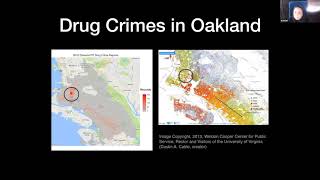
Fairness, Accountability, and Transparency in Predictive Models for Criminal Justice
Explore fairness, accountability, and transparency in predictive modeling for criminal justice, with examples highlighting their importance in real-world applications.
Social and Economic Networks - Understanding Power, Beliefs, and Behaviors
Explore how social networks shape power, beliefs, and behaviors, and their impact on information spread, economic resilience, and societal structures with Stanford economist Matthew Jackson.