Exponentials, Economics, and Ecology with David Krakauer
Explore exponential changes, nonlinear dynamics, and interconnected systems in ecology and economics. Gain insights on aligning individual and public good in a complex world.

Environment X Everything Interactions - From Evolution to Epidemics and Beyond
Explore environment-actor interactions across various fields, from evolution to epidemics, using mathematical frameworks and simulations to understand complex systems and their impacts.
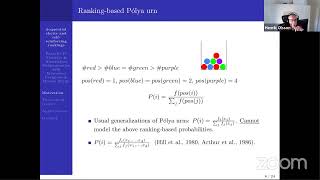
Sequential Choice and Self-Reinforcing Rankings
Explore the mathematical consequences of choice systems where option rankings influence selection probabilities, and popularity determines rankings, leading to potential convergence and unpredictability.
The Science of Networks - C4 Public Lectures
Explore the emerging science of networks, their structure, and function across diverse systems. Learn about phase transitions, interdependence, and mathematical models for predicting network behavior and consequences.
The Science of Pandemics - C4 Public Lecture
Explore global pandemics, influenza threats, and the role of mathematical modeling in disease surveillance and control through advanced computing techniques.
Demonology - Intelligence in Physics & Biology
Explore the historical role of intelligence in physics and biology, from Laplace's demon to modern information theory, and its implications for understanding natural phenomena.
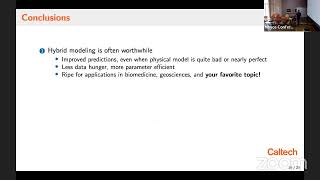
A Framework for Machine Learning of Model Error in Dynamical Systems
Explore a framework for machine learning to model error in dynamical systems, focusing on linear oscillators, partial information, and hybrid modeling techniques.
Transient Dynamics - The Key to Ecological Understanding - Alan Hastings, SFI + UC Davis
Explore transient dynamics in ecology, challenging classical theory focused on long-term behavior. Examine implications for modeling, management, and understanding complex ecological systems.
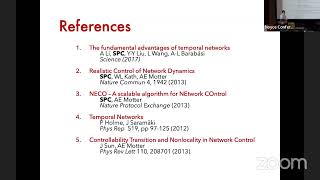
The Power of Temporal Networks
Explore how time-varying networks offer advantages in controllability, cooperation, and synchronization, challenging traditional views on network analysis and dynamics.

Using Curvature to Understand the Structure of Dynamics
Explore curvature's role in understanding attractor dynamics and its application in time-series data reconstruction, focusing on optimal time-delay parameter selection for delay-coordinate embeddings.

The Swine Flu and You: Predicting and Controlling the H1N1 Pandemic
Explore the H1N1 pandemic: its impact, control strategies, and mathematical modeling for prediction and prevention. Learn about public health responses and the science behind epidemic management.
The Conceptual Framework of Urban Scaling - 2014
Explore the theoretical foundations of urban scaling, examining how cities grow and evolve over time through complex systems analysis and mathematical modeling.
Mandelbrot, 1/f Noise, and The Mind's Eye in Complexity Science
Exploring Mandelbrot's contributions to 1/f noise, long-range dependence, and fractional models. Discusses the impact of cognitive diversity on scientific progress and the importance of visual thinking in mathematics.

Male Mate Choice and Female Ornamentation - A Mathematical Model
Explores mathematical model challenging assumptions about male mate choice and female ornamentation in polygynous species, revealing weak sexual selection on female traits despite common inferences.

The Unlikely Power of Uncertainty and Contradiction in Mathematics
Explore the power of uncertainty and contradiction in mathematics, and how these concepts can be applied to real-world situations, from disease modeling to political predictions.
Using Buckingham's Π Theorem for Dimensionless Similarity Parameters in Macroecology
Explore dimensionless similarity parameters in macroecology using Buckingham's Π theorem, presented by Sandra Chapman from the University of Warwick.
Technological Requirements for Sustaining Socio-ecosystems with Hyper-dense Humans
Exploring ecological theory to analyze human societies' energy use and density compared to other mammals, and modeling sustainable conditions for hyper-dense populations through green technologies.

Gene-Culture Co-Inheritance of Behavioral Traits: A Price Equation Approach
Explores gene-culture co-inheritance of behavioral traits using a Price equation model, examining how cultural selection can overcome genetic selection and modify genetic selection pressures for complex phenotypes like altruism.

The Statue in the Stone: How Dynamical Systems Discover Environmental Patterns
Explores how complex systems adapt to environmental patterns, favoring stable configurations that match external forces. Illustrates with toy models and swarm-robotics experiment.

On the Shape of Epidemics
Explore the patterns and dynamics of epidemic spread, examining factors that influence their shape and progression through populations.

Models of Identity Signaling
Explore mathematical models of identity signaling, examining their impact on cooperation, conflict, and social learning in complex human behavior and communication strategies.