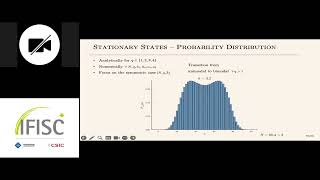
Stochastic Thermodynamics of Imitation Models
Explore stochastic thermodynamics in imitation models, examining complex systems and interdisciplinary physics concepts at the forefront of research.
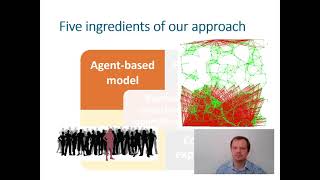
Agent Based Modeling
Explore agent-based modeling for social research, covering model creation, analysis, and documentation, with insights on time dynamics and data quality assessment.
Agents.jl and the Next Chapter in Agent-Based Modelling
Explore Agents.jl for complex system modeling: learn its philosophy, simplicity, performance, interactivity, and integration with Julia ecosystem. Discover the future of agent-based modeling.
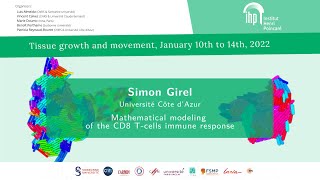
A Multiscale Model of the CD8 T-Cells Immune Response
Explore mathematical models of CD8 T-cell immune response, examining molecular heterogeneity and population dynamics during pathogen infection.
Introduction to NetLogo by Bill Rand
Learn agent-based modeling with NetLogo to simulate complex systems, explore emergence, and understand when to use ABM for research in social sciences and economics.
Where Does the Statistics of Complex Systems Come From?
Explore the origins of complex systems statistics through sample space reducing processes, Zipf's law, and network diffusion. Gain insights into driven non-equilibrium systems and their statistical properties.
A Unifying Framework for Analyzing Complex Systems
Explore complex systems analysis through genetic algorithms, agent-based models, network analysis, and time series analysis. Learn quantitative methods for social sciences and economics research.
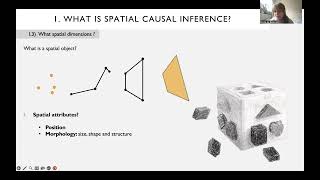
Spatial Causal Inference and Neighborhood Effects
Explore spatial causal inference, interference problems from social interactions, and neighborhood effects in multilevel analyses. Examine agent-based models to question area-level effects and their causal interpretations.
The Role of Computational Social Science in Policymaking - Session 6
Expert panel explores computational social science's role in policymaking, discussing micro data, agent-based models, empirical validation, and applications in fisheries, energy, and digital twins to enhance decision-making processes.
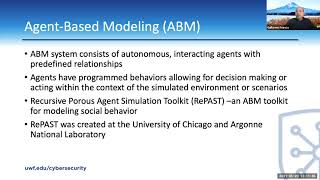
Agent-Based Modeling of Entity Behavior in Cyberspace
Explore entity behavior modeling in cyberspace using agent-based techniques. Learn advanced cybersecurity concepts and applications from an expert in the field.
Uniform Propagation of Chaos for a Dollar Exchange Model
Explore a mathematical model for money exchange, focusing on agent-based dynamics and the convergence to a Poisson distribution as time and agent numbers increase.
Simulation - The Challenge for Data Science
Exploring the fusion of simulation models and machine learning for policy analysis, addressing challenges in parameter estimation and initialization for complex systems forecasting.
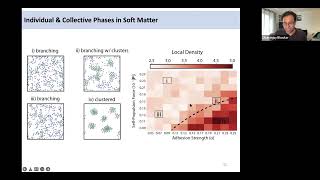
Data-Driven Modeling & TDA of Self-Organized Multicellular Architectures
Explore data-driven modeling and topological data analysis for classifying multicellular structures in cancer and embryonic development, focusing on cell motility and adhesion patterns.
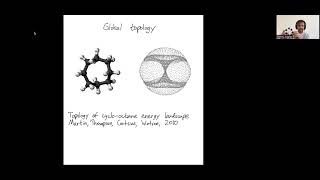
Henry Adams - Topology in Machine Learning
Explore persistent homology in machine learning, covering applications in materials science, computer vision, and agent-based modeling. Learn how topology relates to dataset geometry and explainable AI.
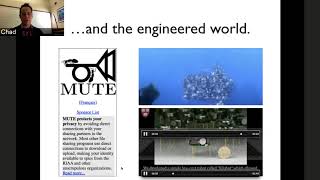
Topological Data Analysis of Collective Motion
Explore topological data analysis for collective motion in nature, examining bird flocks, fish schools, and insect swarms through innovative mathematical models and simulations.
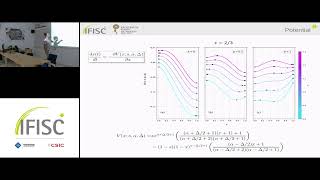
Master Thesis - Asymmetric Language Shift in Bilingual Communities
Explore asymmetric language shift dynamics in bilingual communities through advanced modeling and analysis techniques.
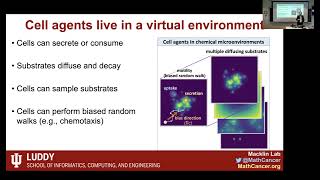
Progress and Next Steps in Agent-Based Modeling of the Hallmarks of Cancer
Explore advancements in agent-based modeling for cancer research, examining current progress and future directions in simulating cancer hallmarks and their interactions.
Chasing Memories
Exploring synaptic dynamics in memory formation, focusing on competitive mechanisms that lead to long-term memory emergence in neural networks and their implications for understanding human memory.
Turing's Reaction-Diffusion System and Agent-Based Models in Biology - Lecture 2
Explore Turing's reaction-diffusion system and its applications in biology, from animal patterns to agent-based models. Gain insights into theoretical frameworks for understanding complex biological phenomena.
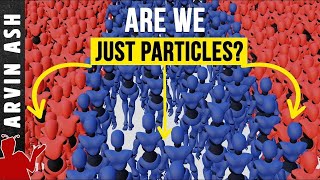
How Science Predicts Emergence in Human and Animal Behavior
Explore how physics principles predict group behavior in humans and animals, from crowd movements to bird flocks, revealing emergent patterns and universal laws of collective dynamics.
Emergence of Multiflocks in Collective Dynamics - Tutorial I
Explore the emergence of multiflocks in collective dynamics with Professor Eitan Tadmor, delving into mathematical insights on group behavior and movement patterns.