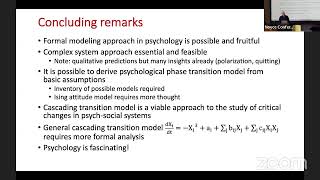
Cascading Transitions in the Behavioral and Social Sciences
Explore cascading transitions in psycho-social systems, focusing on opinion change, learning, and addiction. Discover how these multilevel processes work and their potential impacts on society.
Reasons Why Social Networks Make Us Vulnerable to Misinformation
Explore how cognitive, social, and algorithmic biases in social networks make us susceptible to misinformation, and learn about efforts to counter online opinion manipulation.
Modeling Energy & Environmental Behavior from Individual to Aggregate Levels
Explore decision-making processes in energy and climate change, from individual psychology to global models, emphasizing non-rational choices and social dynamics that can lead to rapid behavioral shifts.
Modeling the Distributional Epidemic-Economic Effects of the Covid-19 Pandemic
Explore a data-driven Agent-Based Model simulating Covid-19's impact on industries, occupations, and income levels, revealing insights for effective and equitable interventions.
How Can We Understand Our Complex Economy?
Explore complex systems approach to economics, blending insights from physical and natural sciences to predict and mitigate economic crises, offering a new perspective on global financial challenges.
Where Does the Statistics of Complex Systems Come From?
Explore the origins of complex systems statistics through sample space reducing processes, Zipf's law, and network diffusion. Gain insights into driven non-equilibrium systems and their statistical properties.
A Unifying Framework for Analyzing Complex Systems
Explore complex systems analysis through genetic algorithms, agent-based models, network analysis, and time series analysis. Learn quantitative methods for social sciences and economics research.
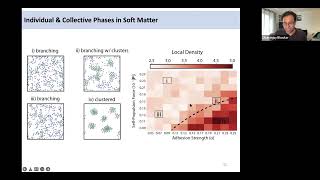
Data-Driven Modeling & TDA of Self-Organized Multicellular Architectures
Explore data-driven modeling and topological data analysis for classifying multicellular structures in cancer and embryonic development, focusing on cell motility and adhesion patterns.
Topological Data Analysis of Collective Motion
Explore topological data analysis for collective motion in nature, examining bird flocks, fish schools, and insect swarms through innovative mathematical models and simulations.
Chasing Memories
Exploring synaptic dynamics in memory formation, focusing on competitive mechanisms that lead to long-term memory emergence in neural networks and their implications for understanding human memory.
How Science Predicts Emergence in Human and Animal Behavior
Explore how physics principles predict group behavior in humans and animals, from crowd movements to bird flocks, revealing emergent patterns and universal laws of collective dynamics.
Emergence of Multiflocks in Collective Dynamics - Tutorial I
Explore the emergence of multiflocks in collective dynamics with Professor Eitan Tadmor, delving into mathematical insights on group behavior and movement patterns.

The LangChain Cookbook - Beginner Guide to 7 Essential Concepts
Explore 7 essential LangChain concepts: Schema, Models, Prompts, Indexes, Memory, Chains, and Agents. Learn how to leverage these components for building powerful language AI applications.
Generalizing Scientific Machine Learning and Differentiable Simulation Beyond Continuous Models
Explore advanced scientific machine learning, extending differentiable simulation to complex models like jump diffusions and agent-based systems, addressing challenges in implementation and numerical stability.

Interpretable Hierarchical Calibration of Agent-Based Models
Explore scientific machine learning's fusion of traditional modeling and ML, focusing on neural network surrogates for agent-based models in epidemiology and automated hierarchical calibration.
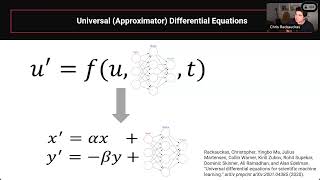
Generalizing Scientific Machine Learning and Differentiable Simulation Beyond Continuous Models
Explore generalizing scientific machine learning beyond continuous models, covering differentiable simulation for chaotic systems, stochastic processes, and inverse problems in advanced scientific computing.
Agent-Based Dynamic Models of Opinion Formation: Where Are We Now?
Explore dynamic models of opinion formation, focusing on continuous opinions at the microscopic level. Examine achievements in analysis and new challenges in dynamical systems, control theory, and AI.
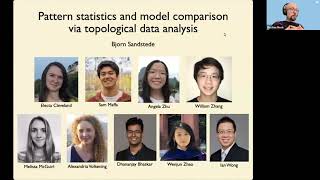
Pattern Statistics and Model Comparison via Topological Data Analysis
Exploring topological data analysis for pattern quantification, model comparison, and feature design in zebrafish skin patterns and other complex systems.