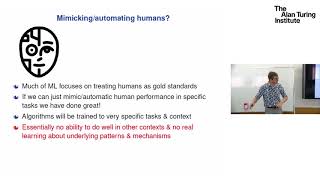
Beyond Tech - Machine Learning in Science & Policy - Professor David Dunson, Duke
Exploring machine learning applications beyond tech, highlighting challenges in science and policy. Discusses fair algorithms, interpretable models, and the need for targeted methods in complex domains.
Uncertainty-Aware Machine Learning Models of Many-Body Atomic Interactions
Explore symmetry-aware machine learning models for atomic interactions, focusing on E(3)-equivariant neural potentials and Bayesian force fields for improved accuracy in materials modeling.
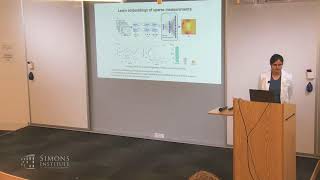
Robust Equation Discovery and Sparse Sensing with Guarantees
Explore statistical mechanics for robust sparse equation discovery and optimal sensor placement, with applications in nuclear digital twins and high-dimensional field reconstruction.
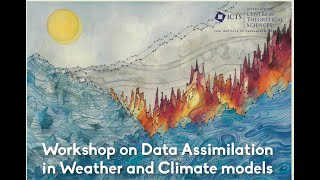
Data Assimilation and Dynamical Systems in Earth Sciences - Lecture 2
Explore data assimilation in Earth sciences, focusing on dynamical systems and their applications in weather and climate modeling. Learn theoretical foundations and practical implementations.
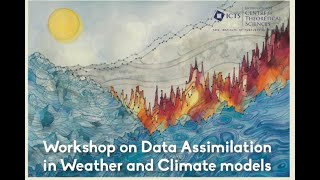
Data Assimilation Experiments for Operational Weather Forecast in NARL
Explore data assimilation techniques for operational weather forecasting, focusing on experiments conducted at NARL. Learn about integrating observations and short-range forecasts to improve atmospheric state estimation.
Role of AI in Tackling Climate Change - How Uncertain is Future Sea Level Rise
Explore AI's potential in addressing climate change, focusing on predicting sea level rise uncertainties, with insights from a leading expert in the field.
Exploring Lagrangian Data Assimilation: Methods and Uncertainty - SIAM MPE Community Meeting
Explore Lagrangian data assimilation methods and uncertainty in fluid dynamics. Learn about ensemble techniques, analytical solutions, and optimal tracer deployment for improved state estimation.
Training Neural Network Potentials: Bayesian and Simulation-based Approaches
Explore advanced techniques for training neural network potentials in molecular dynamics simulations, including data-efficient methods, experimental data integration, and uncertainty quantification for reliable results.

New Microfluidic Methods for Advanced CCE
Explore cutting-edge microfluidic techniques for PVT and CCE testing, extracting extensive data from minimal oil samples to enhance accuracy and efficiency in fluid analysis.
Differentiable Simulations for Enhanced Sampling of Rare Events
Explore deep learning applications in molecular simulations, including surrogate functions, sampling complex distributions, and time-propagation of differential equations. Learn about active learning, generative models, and reaction path finding.
Uncertainty, Prompting, and Chain-of-Thoughts in Large Language Models - Part 2
Dive into advanced AI concepts including temperature scaling, Bayesian calibration, prompt-based finetuning, and chain-of-thought techniques for more reliable and explainable language models.
Bayesian Inference Using Probabilistic Programming
Explore Bayesian inference techniques and probabilistic programming concepts with expert insights from Hong Ge at LAFI'24.
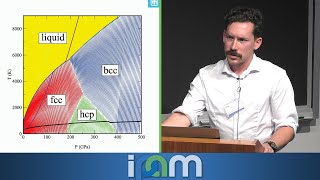
Machine Learning in Equation of State and Transport Modeling at Extreme Conditions
Explore machine learning applications in equation of state and transport modeling for extreme conditions, enhancing accuracy and efficiency in material science and astrophysics research.

End-to-End Learning and Auto-Differentiation - Forces, Uncertainties, Etc.
Explore deep learning and auto-differentiation in molecular simulations, covering surrogate functions, sampling distributions, and time-propagation of differential equations for scientific problem-solving.
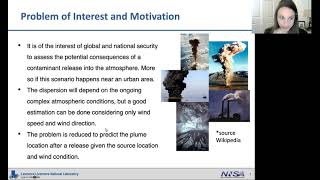
Machine Learning Approaches for Predicting Seismic, Acoustic and Atmospheric Data
Explore machine learning techniques for predicting seismic, acoustic, and atmospheric data, focusing on KNN and neural networks with uncertainty quantification for improved accuracy.
Generalization and Robustness in Offline Reinforcement Learning
Explore offline reinforcement learning for safety-critical applications, covering generalization, robustness, and imitation learning in large-scale settings with rich function approximation.
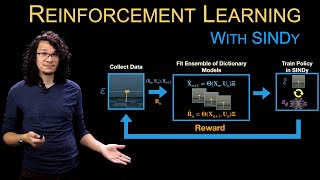
SINDy-RL: Interpretable and Efficient Model-Based Reinforcement Learning
Explores SINDy-RL, a framework combining sparse identification of nonlinear dynamics with reinforcement learning for efficient, interpretable control policies in complex environments.
Some Thoughts on Gaussian Processes for Emulation of Deterministic Computer Models
Explore Gaussian Process emulators for complex computer models in uncertainty quantification, focusing on theoretical aspects and applications to climate, tsunami, and earthquake problems.
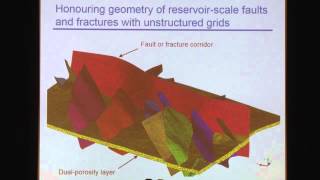
Numerical Simulation of Fractured Reservoirs
Explore advanced techniques for simulating fractured reservoirs, including dual-porosity models, unstructured grids, and probabilistic approaches to enhance flow prediction and reservoir management.
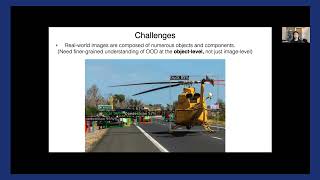
Why Detecting Distributional Shift is So Hard and So Important
Explore challenges and opportunities in detecting data distributional shift, a crucial aspect of AI robustness and reliability in real-world applications.
Uncertainty Quantification in Metacognition
Explore uncertainty quantification in metacognition and its applications in AI research, focusing on DARPA-funded efforts and advancements in neuro-symbolic approaches.