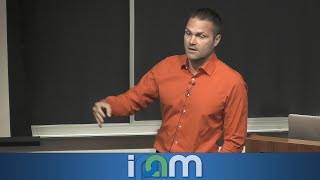
Gaussian Process Approximation & Uncertainty Quantification for Autonomous Experiment
Explore advanced Gaussian process techniques for function approximation, uncertainty quantification, and autonomous experimentation, addressing challenges and improving performance in real-world applications.

Uncertainty Quantification for Kinetic Equations II
Explore uncertainty quantification for kinetic equations, focusing on Monte Carlo methods, multi-fidelity approaches, and stochastic Galerkin particle techniques to address high-dimensional challenges.
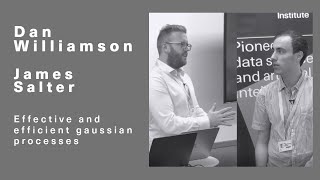
Efficient and Effective Calibration of Spatio-Temporal Models - Dan Williamson & James Salter, Exeter
Explore efficient calibration techniques for spatio-temporal models, focusing on uncertainty quantification and Gaussian Process emulation in complex physical systems like climate and natural disasters.
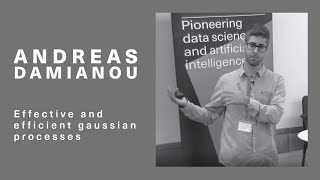
Deep and Multi-Fidelity Learning with Gaussian Processes
Explore uncertainty quantification using Gaussian Process emulators for complex systems, focusing on deep learning and multi-fidelity approaches in climate, tsunami, and earthquake modeling.
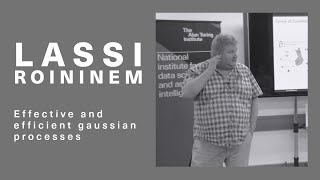
High-Dimensional Hierarchical Models for Large-Scale Geophysical Applications
Explore high-dimensional hierarchical models for geophysical applications, focusing on uncertainty quantification and Gaussian Process emulation in complex physical systems.
Variational Bayesian Approximation of Inverse Problems Using Sparse Precision Matrices
Explore Variational Bayes as an efficient alternative to MCMC for solving inverse problems in PDEs, using sparse precision matrices and stochastic optimization for improved computational tractability.
Uncertainty Quantification with Physics-Informed Machine Learning
Exploring uncertainty quantification in physics-informed machine learning, focusing on architecture and learning approaches for scientific applications and complex real-world phenomena.
Introduction to Probability and Bayesian Inference - Lecture 1
Explore probability fundamentals and Bayesian inference principles in this comprehensive lecture, laying the groundwork for advanced data assimilation techniques in weather and climate modeling.

Collaborating with Mathematicians on Major Societal Challenges - Session B02
Explore interdisciplinary collaborations between mathematicians and physicists addressing societal challenges, from quantum computing to climate science, through talks by leading researchers.
UQ for ML and ML for UQ - Uncertainty Quantification and Machine Learning in Physics-Based Modeling
Explore the interplay between Uncertainty Quantification and Machine Learning in physics-based modeling, examining their roles in solving complex computational challenges across various applications.
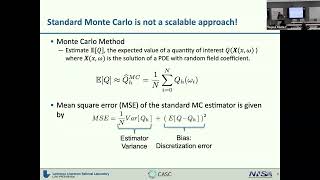
Uncertainty Quantification, Software Ecosystems, and Infrastructure Resilience - Technical Talk
Explore uncertainty quantification, exascale software ecosystems, and infrastructure resilience in this technical talk by Sarah Osborn at WiDS Livermore 2024.

Uncertainty Quantification and Deep Learning for Water-Hazard Prediction
Explore uncertainty quantification and deep learning techniques for predicting water hazards, focusing on storm surge impacts and urban infrastructure damage assessment.
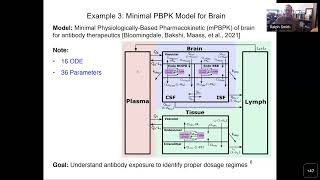
Parameter Subset Selection and Active Subspace Techniques for Engineering and Biological Models
Explore parameter subset selection and active subspace techniques for engineering and biological models, focusing on influential parameter isolation and uncertainty quantification in complex systems.
From Quantum Entanglement to Future Data-Driven Engineering - Rothschild Lecture
Explore high-dimensional Bayesian statistics in engineering, focusing on efficient data-physical model integration and uncertainty quantification. Learn about multilevel MCMC and measure-transport approaches.

Uncertainty Quantification for Bayesian Inverse Problems - Efficient Methods in the Small Noise Regime
Explore efficient methods for uncertainty quantification in Bayesian inverse problems, focusing on small noise regimes and data-driven engineering applications.

Better Priors for Everyone - Keynote
Explore advanced techniques for improving prior distributions in probabilistic models, enhancing Bayesian inference across various applications.

ME3255 - Quantitative Descriptions on Monte Carlo Models
Explore Monte Carlo models through quantitative descriptions, enhancing understanding of statistical simulation techniques and their applications in engineering and science.
Bayesian Inference of Causal Graphs: Current Status and Future Directions
Explore Bayesian inference for causal discovery, examining recent progress, challenges, and assumptions in modeling cause-effect relationships from observational data.
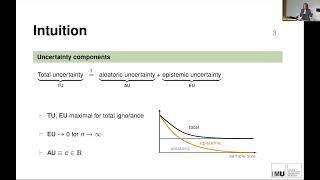
Quantifying Aleatoric and Epistemic Uncertainty in Machine Learning - Session 2
Explore critical analysis of uncertainty quantification in machine learning, examining conditional entropy and mutual information as measures for aleatoric and epistemic uncertainty.
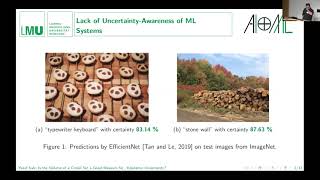
Is the Volume of a Credal Set a Good Measure for Epistemic Uncertainty - UAI 2023 Oral Session 2
Explore the effectiveness of credal set volume as a measure of epistemic uncertainty in binary and multi-class classification, highlighting implications for machine learning.
Geologic Interrogation of Photogrammetric Outcrop Reconstructions - Uncertainty and Mitigation
Explore techniques for analyzing 3D outcrop reconstructions, focusing on visualization, data extraction, and interpretation strategies to enhance accuracy and reproducibility in geologic studies.