C# Values and Value Types
Explore C#'s evolving type system, comparing user-defined types and examining when to use classes, structs, records, or record structs for optimal program design and performance.
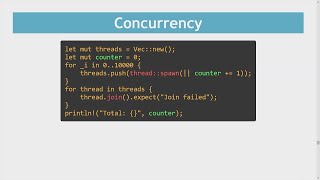
Rust for the Recalcitrant C++ Programmer - ACCU 2023
Comparative exploration of Rust features for C++ programmers, highlighting ownership, type system, immutability, pattern matching, and concurrency, with practical examples and discussions.
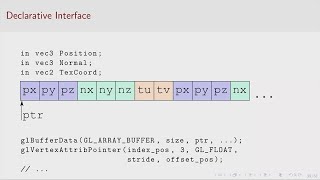
Building C++ Interfaces That Are Hard to Use Incorrectly
Techniques for designing robust C++ library interfaces that prevent misuse, leveraging the type system to catch errors at compile-time and reduce opportunities for bugs in user code.
Why Algebraic Data Types Are Important
Explore type theory, category theory, and logic in functional programming, focusing on algebraic data types and their role in enhancing code reliability and expressiveness.

Haskell Taketh Away - Limiting Side Effects for Parallel Programming
Exploring how limiting side effects in programming languages enhances parallel programming, with insights from Haskell and C++ on determinism, purity, and embedded domain-specific languages.

Fun with Boost.Hana
Explore advanced C++ metaprogramming techniques using Boost.Hana, focusing on real-world applications like event systems and type erasure to enhance code expressiveness and maintainability.
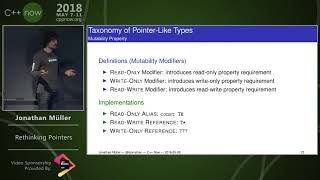
Rethinking Pointers
Comprehensive analysis of pointer-like types in C++, exploring their properties, use cases, and best practices for choosing the right pointer type in different situations.

Simplest Strong Typing Instead of Language Proposal
Explore simplest strong typing in C++ to create safer, more robust code. Learn techniques to define useful types, avoid common pitfalls, and implement a framework for easier strong type creation.
Static Typing in Python
Explore Python's optional static typing, its advantages, and tools for implementation. Learn about type hints, gradual typing, and when to use static typing in your Python projects.
Python Types for Fun and Profit
Hands-on introduction to Python type annotations, covering basic concepts and advanced features. Practice adding types to real code and using type checkers to catch bugs early in development.
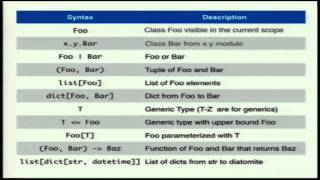
Static Type-Checking Is Dead, Long Live Static Type-Checking in Python
Explore static type-checking in Python, including PEP 484, type hints, and libraries like Hypothesis. Gain insights into type systems and their impact on code robustness.

Leveraging Documentation Power for Better Web APIs
Explore leveraging documentation and type systems for web APIs, offering features like browsable interfaces, input/output validation, and automated testing to enhance development and user experience.

A Neatly Typed Message - Improving Code Readability
Explore techniques to enhance Swift code readability using type system features, examining popular Cocoa patterns and language constructs to identify tradeoffs and improvement opportunities.
Dotty Support in IntelliJ IDEA
Explore differences between Scala and Dotty, and learn about Dotty support in IntelliJ IDEA's Scala plugin, including type systems, language features, and build processes.
Dotty Support in IntelliJ IDEA
Explore Dotty's differences from Scala and its support in IntelliJ IDEA, covering type systems, language features, and build processes for Scala developers.
Dotty Linker - Precise Types Bring Performance
Explore how advanced type systems drive powerful optimizations in Scala, reducing performance overhead for generic methods, lazy vals, implicit conversions, and closures through the Dotty Linker.

Roll Your Own Shapeless
Explore advanced Scala type system techniques to recreate Shapeless framework elements, focusing on HList, context-dependence, and Peano arithmetic without macros.
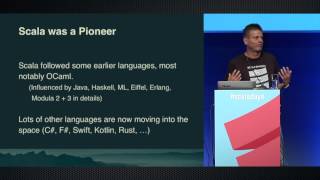
What's Different in Dotty
Explore Dotty, the next iteration of Scala, with Martin Odersky. Learn about major changes, innovations, and new features that enhance program legibility and safety in this comprehensive keynote.
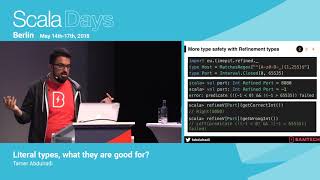
Literal Types - What They Are Good For
Explore the practical applications and benefits of literal types in Scala programming, enhancing code safety and expressiveness.

Networks and Types - the Future of Akka
Explore the future of Akka with insights on networks and types, focusing on advancements in distributed systems and type-safe communication for robust, scalable applications.
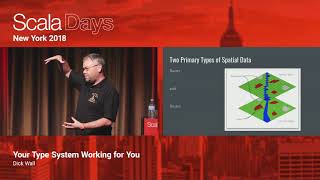
Your Type System Working for You
Explore advanced Scala type system techniques for geospatial data handling, including CRS tracking, type parameters, and implicit extensions for improved code safety and expressiveness.