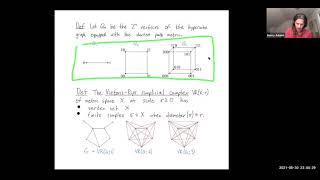
Henry Adams - Vietoris-Rips Complexes of Hypercube Graphs
Explore Vietoris-Rips complexes of hypercube graphs, their homotopy types, and applications in genetic recombination and persistent homology. Discover formulas, open questions, and conjectures in this fascinating area of applied algebraic topology.

Other Persistence Invariants - Homotopy and the Cohomology Ring
Explore persistent homotopy groups and cohomology rings, focusing on fundamental groups, rational homotopy, and cup-length diagrams. Learn about new tools complementing persistent homology in topological data analysis.

Massimo Ferri - Selection of Points in Persistence Diagrams
Explore point selection in persistence diagrams, including Kurlin's criterion and the Ziqqurat method, for noise reduction and improved data analysis in topological data analysis.
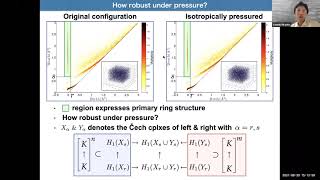
On Characterizing Rare Events in Persistent Homology
Explore rare events in persistent homology, focusing on indecomposables in multi-parameter settings. Learn about large deviation principles and laws of large numbers in topological data analysis.
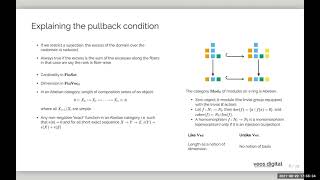
Comparing Neural Networks via Generalized Persistence
Exploring generalized persistence to compare neural network architectures, analyzing data representations at each layer and providing insights into network behavior and performance.

Star Clusters in Clique Complexes and the Vietoris-Rips Complex of Planar Sets
Explore star clusters in simplicial complexes and their applications to independence complexes and Vietoris-Rips complexes of planar sets, with insights on homotopy information and related conjectures.
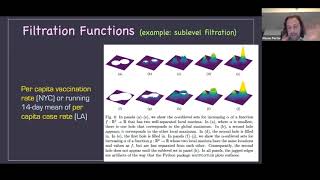
Mason Porter - Topological Data Analysis of Spatial Complex Systems
Explore topological data analysis in spatial systems, from spider webs to COVID-19 spread. Learn filtered simplicial complexes and their applications in various real-world scenarios.
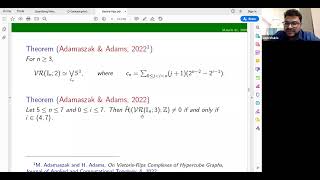
Vietoris-Rips Complexes of Hypercube Graphs
Explore Vietoris-Rips complexes of hypercube graphs, their collapsibility, and applications in genetic trees and persistent homology. Gain insights into simplicial complexes and topological data analysis.
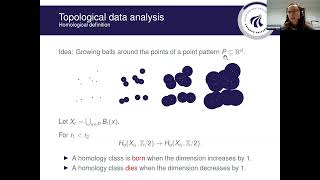
Analyzing Point Processes Using Topological Data Analysis
Explore point processes using topological data analysis, covering models, statistical techniques, and applications in spatial statistics. Learn to distinguish between process types and understand central limit theorems.
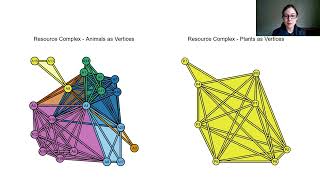
Topological Data Analysis of Plant-Pollinator Resource Complexes - Melinda Kleczynski
Explore topological data analysis in ecology, focusing on plant-pollinator interactions. Learn about resource complexes and insect-flower visitation patterns using advanced mathematical tools.
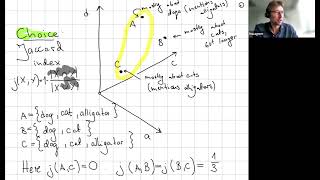
Hubert Wagner - Topological Data Analysis in Non-Euclidean Spaces
Explore topological data analysis in non-Euclidean spaces, focusing on techniques for applying TDA tools and their applications in detecting neural network backdoor attacks.

GPU Accelerated Computation of VR Barcodes in Evaluating Deep Learning Models
GPU-accelerated computation of VR barcodes for evaluating deep learning models, focusing on Ripser++ software and its applications in measuring data distribution shifts and analyzing attention graphs in BERT models.
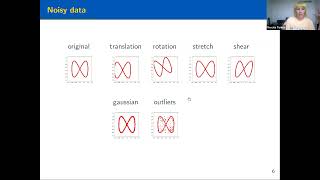
On the Effectiveness of Persistent Homology
Exploring persistent homology's effectiveness in shape analysis tasks, outperforming baselines in detecting holes, curvature, and convexity from point clouds, with robustness to limited resources and data transformations.
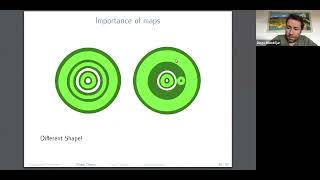
Approximation of Compact Metric Spaces by Finite Samples
Explore topological data analysis through finite approximations of compact metric spaces, connecting Shape Theory and Persistence for robust feature extraction from noisy datasets.
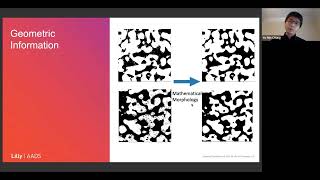
A Multi-Parameter Persistence Framework for Mathematical Morphology
Exploring mathematical morphology through persistent homology, offering new insights for image processing and automated denoising techniques in binary, grayscale, and color images.
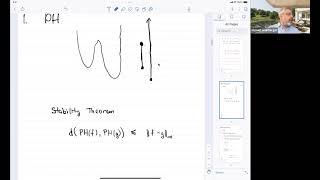
Shmuel Weinberger - PH(X^Y) and the Geometry of Function Spaces
Exploring persistent homology in function spaces through geometric considerations, focusing on examples that illuminate this central topic in algebraic topology.
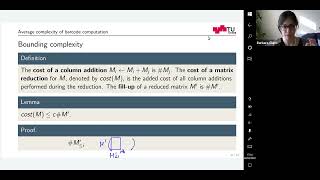
Barbara Giunti - Average Complexity of Barcode Computation for Vietoris-Rips Filtrations
Explore algorithmic complexity of persistent homology in random Vietoris-Rips filtrations, focusing on boundary matrix fill-up and its implications for computational efficiency.
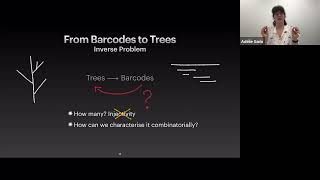
From Trees to Barcodes and Back Again - Combinatorial and Geometric Perspectives
Explore topological data analysis, focusing on the inverse problem from barcodes to merge trees. Discover connections between barcodes, symmetric groups, and geometric group theory for statistical insights.
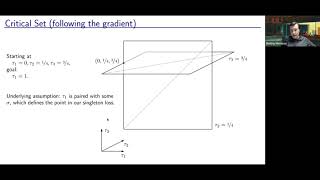
Topological Optimization with Big Steps
Explore persistent homology for optimization, using cycles and chains to prescribe gradients. Learn about a linear-time algorithm for special cases and its practical benefits in reducing optimization steps.

Minimal Cycle Representatives in Persistent Homology Using Linear Programming
Explores optimization techniques for selecting minimal cycle representatives in persistent homology, comparing effectiveness and computational costs of various algorithms using linear programming methods.
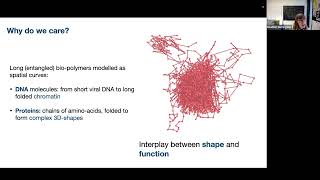
Shape of Data in Biology - Extending the PH Pipeline
Exploring spatial structure in biological data using topological data analysis, with focus on knotted proteins and introducing hyperTDA for interpretable, automated analysis of complex systems.