Linear Programming - Bit Complexity - Lecture 17c of CS Theory Toolkit
Explore bit complexity in Linear Programming, feasible solutions, and the implications for NP ∩ coNP. Delve into fundamental concepts for theoretical computer science research.
Expander Graph Application 2: Derandomization - Lecture 16c of CS Theory Toolkit
Explore derandomization techniques using expander graphs to reduce error in randomized algorithms without significantly increasing random bits used.
Expander Graph Constructions - Lecture of CS Theory Toolkit
Explore explicit expander graph constructions, including Gabber-Galil, Ramanujan, and Zig-Zag product expanders. Learn about their properties, applications, and mathematical foundations in theoretical computer science.
Spectral Graph Theory - Eigenvalues at CMU - Lecture 15a of CS Theory Toolkit
Explore eigenvalues of the Laplacian and Markov operator in spectral graph theory, including associated formulas and their applications in theoretical computer science research.
Spectral Graph Theory - Minimizing/Maximizing the Quadratic Form
Explore spectral graph theory, focusing on minimizing and maximizing quadratic forms, with connections to graph components and bipartiteness in this graduate-level lecture.
Spectral Graph Theory - The Quadratic Form
Explores spectral graph theory, focusing on the quadratic form associated with undirected graphs. Covers basic setup and provides examples for graduate-level computer science research.
Factorial Asymptotics, Stirling's Formula - Lecture 3b of CS Theory Toolkit
Explore factorial asymptotics and Stirling's Formula in this graduate-level lecture, covering mathematical techniques for theoretical computer science research.
Big O and Friends - Lecture 2a of CS Theory Toolkit
Explore asymptotic notation in theoretical computer science, covering Big O, Omega, and related concepts. Essential for understanding algorithm efficiency and complexity analysis.
How to Do CS Theory - Lecture 1b: Research Tips for Theoretical Computer Science
Insights and tips for aspiring theoretical computer science researchers, covering research methods, paper writing, presentation skills, and essential resources in the field.
Great Ideas in Theoretical Computer Science - Polynomials
Explore theoretical computer science through polynomials, covering fields, division, evaluation, interpolation, and error-correcting codes. Gain insights into fundamental concepts and their applications.
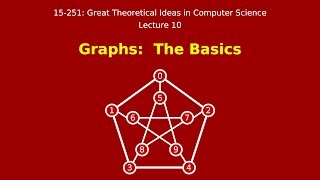
Great Ideas in Theoretical Computer Science - Graphs - The Basics
Explore fundamental concepts of graph theory, including definitions, basic questions, regular graphs, and perfect matching. Gain insights into connecting graphs and equivalence relations.
Finding Large Cliques in Random and Semi-Random Graphs
Explore algorithms for finding large cliques in graphs, including constructive arguments, polynomial-time proofs, and paradigms for tackling this NP-hard problem.
An Almost Constant Lower Bound of the Isoperimetric Coefficient in the KLS Conjecture
Explore the KLS Conjecture's isoperimetric coefficient, its implications for MC sampling, and recent breakthroughs in establishing a near-constant lower bound.
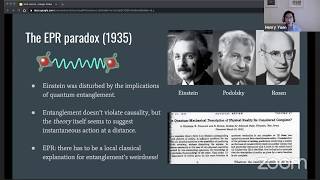
A Tale of Turing Machines, Quantum-Entangled Particles, and Operator Algebras
Explore the convergence of computational complexity, quantum information, and operator algebras in solving long-standing problems, including Connes' Embedding Problem, in this accessible lecture for a general scientific audience.

Graph Theory and Fixed-Parameter Tractability
Explore fixed-parameter tractability in graph theory, focusing on counting patterns, galactic algorithms, and key concepts like minors and topological minors.
Thomas Vidick - Connes Embedding Problem, Tsirelson’s Problem, and MIP* = RE
Explore the connections between operator algebras, quantum correlations, and computational complexity in this advanced mathematical lecture on recent breakthroughs in theoretical physics and computer science.
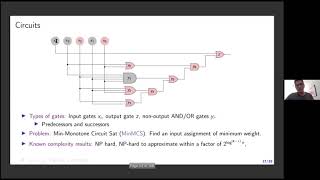
Hardness Results in Discrete Morse Theory for 2-Complexes
Explore inapproximability and parameterized complexity in discrete Morse theory for 2-complexes, focusing on minimizing critical simplices and presenting new hardness results and an approximation algorithm.
Peter Dybjer - Intuitionistic Type Theory - Lecture I
Explore intuitionistic type theory's foundations, historical context, and applications in mathematics and computer science with Prof. Peter Dybjer's comprehensive lecture.
High Dimensional Expanders
Explore high-dimensional expanders, their mathematical properties, and applications in theoretical computer science. Learn about coboundary and spectral expansion, and their implications for complex structures.
Quantum Field Theory as the Language of Physics by Nathan Seiberg
Explore quantum field theory's role as the universal language of physics, its applications, limitations, and potential reformulation in this insightful talk by Nathan Seiberg.
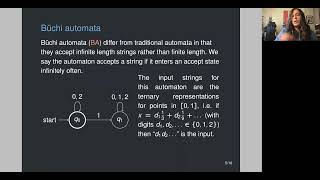
Buchi Automata and Fractals on R
Explore Buchi automata and fractals on R, covering regular languages, model theory, and first-order logic. Gain insights into sparse sets and omega languages in this mathematical journey.