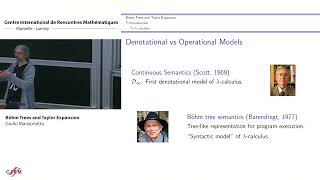
Böhm Trees and Taylor Expansion
Explore Böhm trees and Taylor expansion in lambda calculus, delving into their mathematical properties and applications in differential linear logic.
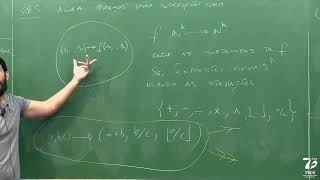
Mestrado: Computação, Lógica e Teoria dos Conjuntos - Aula 04
Explore conceitos avançados de computação teórica, incluindo linguagens formais, máquinas de registro, decidibilidade e complexidade algorítmica. Aprofunde-se em lógica de primeira ordem e teoria dos conjuntos.
Mestrado: Computação, Lógica e Teoria dos Conjuntos - Aula 02
Explore formal languages, register machines, decidability, algorithmic complexity, first-order logic, and set theory in this advanced mathematics lecture.

Mestrado: Computação, Lógica e Teoria dos Conjuntos - Aula 01
Explore fundamentos de computação, lógica e teoria dos conjuntos em aula de mestrado. Aborde linguagens formais, máquinas de registro, decidibilidade, complexidade algorítmica e lógica de primeira ordem.
Theory Seminar - Differential Privacy in Theory and Practice, Abie Flaxman
Explore differential privacy in the US Census, its impact on data accuracy, and potential improvements. Insights from analyzing test runs and 1940 data application.
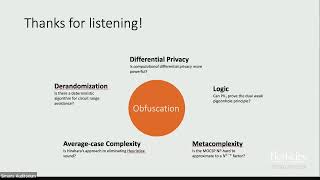
Tales of Obfuscation in Bounded Arithmetic, Metacomplexity, and Differential Privacy
Explores obfuscation's role in theoretical computer science, covering Circuit Range Avoidance, metacomplexity of Kolmogorov complexity, and computational differential privacy, with focus on recent results and open questions.
Fourier Analysis of Boolean Functions - Lecture 8a of CS Theory Toolkit
Explore Fourier analysis of Boolean functions, focusing on real-valued functions and their Fourier transforms in this graduate-level theoretical computer science lecture.
Fast Fourier Transform - Lecture 7c of CS Theory Toolkit
Explore the Fast Fourier Transform algorithm and its application in efficient integer multiplication, with insights from a CMU graduate-level computer science theory course.
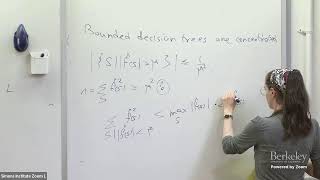
Random Restrictions and Fourier Concentration - Part 2
Explore advanced concepts in Fourier analysis and random restrictions, focusing on their applications in theoretical computer science and mathematical analysis.
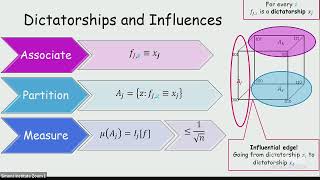
Random Restrictions and Fourier Concentration - Part 1
Explore random restrictions and Fourier concentration in analysis and theoretical computer science with MIT researcher Esty Kelman.
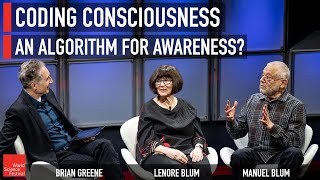
Coding Consciousness - An Algorithm for Awareness?
Explore theories of consciousness with computer scientists Lenore and Manuel Blum as they discuss the potential for coding self-awareness into algorithms, moderated by Brian Greene.

Machine Learning - Lecture 8
Explore advanced machine learning concepts, focusing on ensemble methods and boosting techniques to enhance model performance and predictive accuracy.

Machine Learning - Lecture 6
Explore advanced machine learning concepts, focusing on ensemble methods and boosting techniques to enhance model performance and predictive accuracy.

Machine Learning - Lecture 4
Machine learning techniques for classification, including decision trees, logistic regression, and support vector machines. Explores model evaluation, feature engineering, and handling imbalanced datasets.
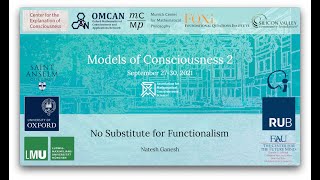
No Substitute for Functionalism
Explores types of variations in consciousness models, proving broad functionalist theories immune to substitution arguments. Discusses implications for consciousness science and functionalism.
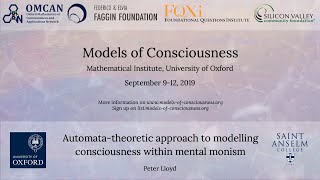
Automata-Theoretic Approach to Modelling Consciousness Within Mental Monism
Automata-theoretic approach to modeling consciousness in mental monism, exploring constraints and implications for substrate-free models of the mind's structure and dynamics.
Mean Estimation in High Dimension
Exploring recent advances in high-dimensional mean estimation, focusing on statistical challenges and computational aspects for independent, identically distributed data.
Convex Optimization IV - Sebastien Bubeck, Microsoft Research
Explore advanced concepts in convex optimization, including gradient flow, comparison techniques, and optimal algorithms with Sebastien Bubeck from Microsoft Research.
Sets, Logic and Computability - Math History - NJ Wildberger
Overview of set theory, logic, and computability in late 19th/early 20th century math, covering Cantor's work, Dedekind's constructions, paradoxes, and philosophical schools addressing foundational issues.
Goemans-Williamson: Rounding the Max-Cut SDP - Lecture 20a of CS Theory Toolkit
Efficient algorithm for approximating maximum graph cuts using semidefinite programming and randomized rounding, with guaranteed performance ratio of 0.878.
The SDP Relaxation for Max-Cut - Lecture 19b of CS Theory Toolkit
Explore SDP relaxation for Max-Cut, transforming a quadratic program into a semidefinite program solvable by the Ellipsoid Algorithm. Part of CMU's graduate-level CS Theory Toolkit course.