How rCTM Answers Questions About Consciousness - A Robot with CTM Brain Model
Explore how the Conscious Turing Machine Robot (rCTM) model addresses fundamental questions about consciousness through a theoretical framework and formal machine modeling approach.
Finite Automata as a Tool for Modeling Psychological Phenomena
Explore how finite automata can effectively model psychological theories, focusing on stress and cognitive processes through clear mathematical frameworks and comparative analysis techniques.
Significance of Regular Languages and Regular Operations - Lecture 5
Explore regular languages, non-regular examples, and key operations like union, concatenation, and Kleene star to deepen understanding of formal language theory.
Elimination of Left Recursion in Compiler Design - Examples and Explanation
Explore left recursion in compiler design, its impact on parsing, and techniques for elimination. Learn to identify and resolve left-recursive grammars for efficient parsing.
Left Factoring in Compiler Design - Elimination of Left Factored Grammar
Explore left factoring in compiler design, including left factored grammar and elimination techniques. Learn to optimize grammar for efficient parsing and reduce ambiguity in language processing.
Specification of Tokens in Compiler Design - Regular Expressions, Languages, and Alphabets
Explore token specification in compiler design, covering regular expressions, languages, strings, and alphabets. Learn key concepts for effective lexical analysis and token recognition.
Deep CPCFG for Information Extraction
Explore deep learning techniques for information extraction using Conditional Probabilistic Context-Free Grammars. Learn about document parsing, schema representation, and handling noisy data in this advanced lecture.
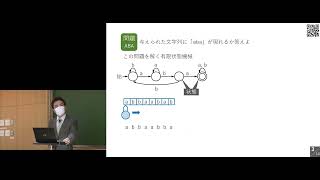
計算量理論入門 - 問題と機械 - 第1回
Dive into computational complexity theory through fundamental concepts of finite state machines, Turing machines, and the Church-Turing thesis, exploring how to measure and understand mathematical complexity.
Uncomputable Functions - Exploring the Limits of Computation
Explore the fascinating world of uncomputable functions, their implications for lambda calculus, and the limits of computation in this thought-provoking presentation.
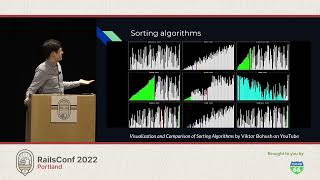
Computer Science Topics for Rails Developers - Relevance and Applications
Explore the relevance of Computer Science topics to professional Rails development, examining their practical applications and limitations.
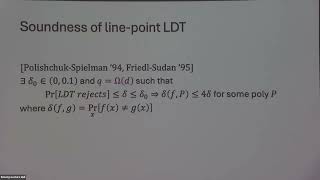
An Improved Line-Point Low-Degree Test for Polynomials Over Finite Fields - Lecture
Explore an improved line-point low-degree test for polynomials over finite fields, addressing a long-standing open question in low-degree testing with novel analysis techniques.
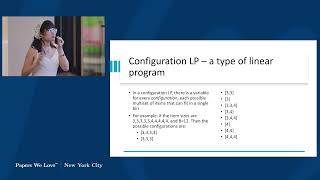
Bin Packing Can Be Solved Within 1 + ε in Linear Time - Lecture
Explore bin packing optimization with Yiduo Ke, delving into a linear-time solution within 1 + ε. Gain insights into this fundamental problem's applications and theoretical advancements.
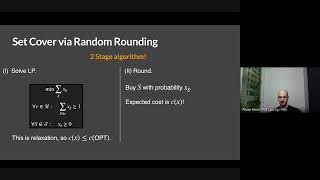
Online Covering: Secretaries, Prophets and Universal Maps
Explore polynomial-time algorithms for online covering IPs, including random-order constraints and prophet versions, with applications to universal maps and competitive ratios.
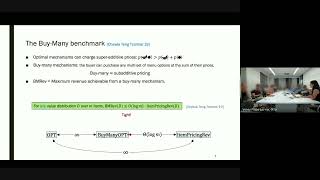
A Multi-Dimensional Online Contention Resolution Scheme for Revenue Maximization
Explore multi-buyer multi-item sequential pricing mechanisms for revenue maximization, focusing on approximating ex ante optimal revenue for subadditive buyers through a new multi-dimensional Online Contention Resolution Scheme.
Self-Adjusting Networks for Optimized Datacenter Topology Design
Explore self-adjusting networks optimized for datacenter traffic, including metrics, design principles, and research challenges. Gain insights into demand-aware graphs and related optimization problems.
Building Grammar Libraries for Mathematics and Avoiding Manual Work
Explore techniques for constructing efficient grammar libraries in mathematics, focusing on automation to minimize manual effort and enhance productivity in formal language development.
Challenges in Formalising Recent Results in Formal Language Theory
Explore challenges in formalizing recent results linking formal language theory and computational group theory, with insights on making proofs more amenable to formalization.
Keynote - Six Impossible Things
Explore software development limits, from integer representation to task estimation, and learn to create solutions within these constraints for more effective development.
Mathematical Structures in Generative Linguistics
Explore mathematical structures in generative linguistics, from formal languages to Hopf algebras and geometric spaces for modeling semantics and syntactic variation across languages.
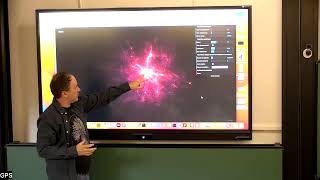
Where the Cosmos is Chaotic or Indeterministic
Explore cosmic chaos, determinism, and indeterminism through galaxies, cosmology, and black holes. Gain insights into the universe's fundamental nature and its implications.

Programming Language as Language
Explore programming languages as human languages, examining their structural elements, cognitive impacts, and role in shaping developer communities and mental models.