On Optimal Algorithms and Assumption Factories
Explore optimal algorithms and assumption factories in cryptography, covering sum-of-squares algorithms, proof systems, and tensor recovery. Gain insights into low-degree PRGs and open questions in the field.
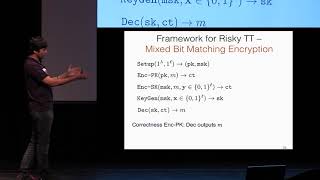
Hardness of Non Interactive Differential Privacy from One Way Functions and Risky Traitor Tracing
Explore cryptographic techniques for differential privacy and traitor tracing, examining their hardness and implications for data security and privacy protection.
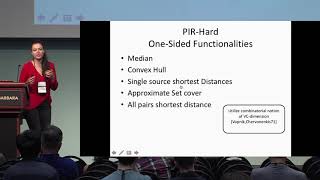
Limits of Practical Sublinear Secure Computation
Explore theoretical boundaries of efficient secure computation, focusing on sublinear communication complexity and its practical implications in cryptography.
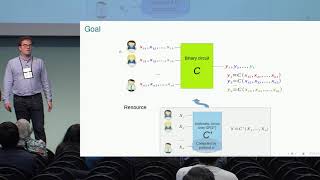
Amortized Complexity of Information Theoretically Secure MPC Revisited
Explore advancements in secure multi-party computation, focusing on amortized complexity and information-theoretic security in distributed systems.
Non Uniform Bounds in the Random Permutation, Ideal Cipher, and Generic Group Models
Explore non-uniform bounds in cryptographic models, examining their implications for security proofs and practical applications in modern cryptography.
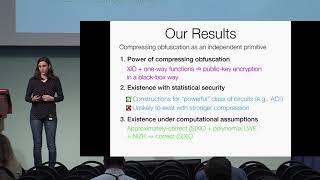
On the Complexity of Compressing Obfuscation
Explore the complexity of compressing obfuscation, focusing on indistinguishability obfuscation, compression hierarchy, and statistically secure compressing obfuscation in cryptography.

Symbolic Encryption with Pseudorandom Keys
Explore innovative cryptographic techniques using symbolic encryption and pseudorandom keys, enhancing security in modern cryptographic systems.
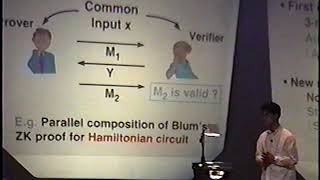
On the Existence of 3-Round Zero-Knowledge Protocols
Explores the existence and properties of 3-round zero-knowledge protocols in cryptography, discussing theoretical implications and potential applications in secure communication systems.
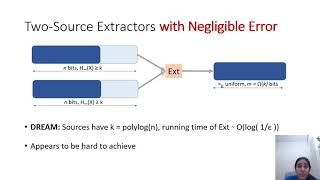
Low Error Efficient Computational Extractors in the CRS Model
Explore efficient computational extractors with low error in the CRS model, covering weak sources, two-source extractors, and non-malleable extractors. Gain insights into cutting-edge cryptographic research.
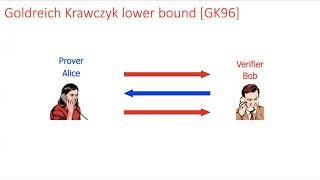
Which Languages Have 4-Round Fully Black-Box Zero-Knowledge Arguments from One-Way Functions
Explore the construction of 4-round fully black-box zero-knowledge arguments for specific languages using one-way functions, as presented in a Eurocrypt 2020 paper.
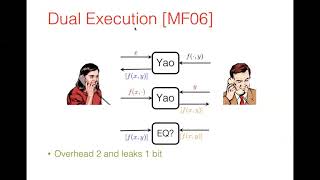
Going Beyond Dual Execution - MPC for Functions with Efficient Verification
Explore advanced secure multiparty computation techniques, focusing on efficient verification methods for 2-party protocols with minimal leakage, applicable to various functions including perfect matching.
Insights from the Conscious Turing Machine - A Machine Model for Consciousness
Explore a substrate-independent model of consciousness inspired by Turing's computation model and Baars' Global Workspace theory, offering insights into conscious experiences across animals and machines.
A Theoretical Computer Science Approach to Consciousness and AGI
Explore a theoretical computer science approach to consciousness and AGI through the Conscious Turing Machine model, offering insights into processor utilization and problem-solving.
Compile-time Reparsing - C++Now 2012
Explore compile-time parsing techniques in C++ for creating embedded domain-specific languages, including runtime expressions, compile-time strings, and angle-bracket expressions.
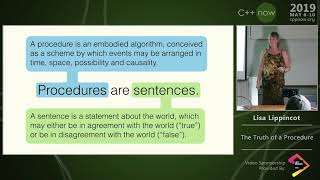
The Truth of a Procedure in Programming
Explore the mathematical logic behind programming procedures, treating them as statements about event arrangements and bridging programming with formal languages and truth concepts.
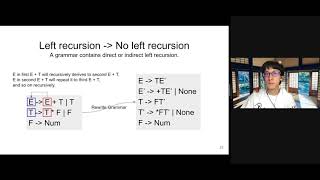
Learn from LL-1 to PEG Parser the Hard Way
Explore parser evolution from LL(1) to PEG, covering compiler fundamentals, traditional techniques, and CPython's implementation. Gain insights into parsing concepts and their practical applications.
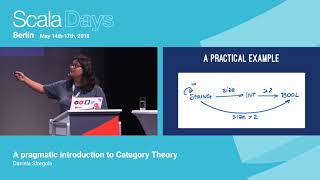
A Pragmatic Introduction to Category Theory
Explore the fundamentals of Category Theory and its practical applications in functional programming, with a focus on Scala implementations and real-world examples.
A Theoretical Computer Science Perspective on Consciousness
Explore the Conscious Turing Machine model and its insights into consciousness phenomena, including blindsight, inattentional blindness, and free will.
Turing's Toy - The Story of a Mathematical Idea That Changed the World
Explore Turing's revolutionary 'universal machine' concept, its historical context, and far-reaching impact on computer science and technology in this engaging talk.

Automated Ambiguity Detection in Layout-Sensitive Grammars
Explore automated ambiguity detection in layout-sensitive grammars using SMT solving. Learn about local ambiguity, reachability conditions, and their application to language design.
The Conscious Turing Machine as a Model for Artificial General Intelligence
Explore the Conscious Turing Machine model and its implications for AGI development through Manuel Blum's insightful analysis of computational consciousness and intelligence.