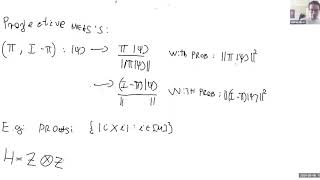
Quantum Random Walks
Explore quantum random walks and their applications in algorithms, complexity, and cryptography, with insights from expert Andras Gilyen.
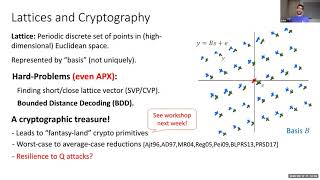
Lattices and Quantum
Explore the intersection of lattice-based cryptography and quantum computing with expert Zvika Brakerski, delving into cutting-edge research and potential implications for future security systems.
Recent Hardness of Approximation Results in Parameterized Complexity
Survey of recent hardness of approximation results in parameterized complexity, focusing on k-clique problem inapproximability, with technical insights and open problems discussion.
Parametrized Algorithms and Possible Future Directions
Explore current research and future directions in Parameterized Complexity, focusing on algorithmic approaches and potential areas for further investigation.
The Approximation Ratio of the k-Opt Heuristic for Euclidean TSP
Explore the k-Opt heuristic's approximation ratio for Euclidean TSP, improving upper bounds and providing new lower bounds for k ≥ 3, applicable to various p-norms.
On Prover-Efficient Public-Coin Emulation of Interactive Proofs
Explore the relationship between private-coin and public-coin interactive proofs, focusing on efficiency-preserving transformations and their implications for cryptographic assumptions and protocol design.
On the Randomness Complexity of Interactive Proofs and Statistical Zero-Knowledge Proofs
Explore randomness complexity in interactive and statistical zero-knowledge proofs, focusing on reducing verifier's random bits and achieving tradeoffs in SZK protocols.
Money, Circuits, Mythic Figures, and More - Theory in the Allen School
Diverse theoretical computer science research: algorithms, data structures, complexity, combinatorics, and economics. Insights from UW Allen School's theory group on cutting-edge topics.
Theory Seminar - On Linear Data Structures and Matrix Rigidity, Sivaramakrishnan Ramamoorthy
Explores systematic linear data structures, rectangular rigidity, and their equivalence. Discusses rigidity lower bounds and Cayley graphs, presenting recent research findings and open problems.
Parallel Approximate Undirected Shortest Paths Via Low Hop Emulators
Explore parallel algorithms for approximating undirected shortest paths using low hop emulators. Learn about innovative techniques and their applications in graph theory.
Theory Seminar - Spectral Independence in High-Dimensional Expanders, Kuikui Liu
Explore spectral independence in high-dimensional expanders and its application to the hardcore model, including rapid mixing of Glauber dynamics for generating random independent sets.
Theory Seminar - Algorithms and Hardness for Linear Algebra on Geometric Graphs, Aaron Schild
Explore algorithms and hardness for linear algebra on geometric graphs, focusing on efficient spectral graph theory and its limitations in high-dimensional spaces.
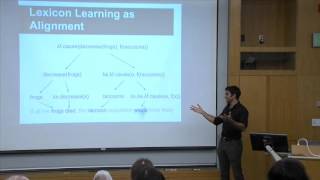
Probabilistic Models for Learning a Semantic Parser Lexicon
Probabilistic models for learning semantic parser lexicons from question/answer pairs, improving accuracy and efficiency without extensive human input or dataset-specific engineering.
Undergrad Complexity at CMU - Turing Machines
Explore Turing Machines in computational complexity theory, covering formalization, the Turing Thesis, examples, and mathematical definitions for a comprehensive understanding.
Dinur's PCP- Degree-Reduction, Expanderizing, Mini-PCP - Lecture 27c of CS Theory Toolkit
Explore Dinur's PCP Theorem proof, covering degree-reduction, expanderizing, and alphabet-reduction in theoretical computer science. Gain insights into advanced concepts for research in computational complexity.
Deterministic Communication Complexity - Lecture 23b of CS Theory Toolkit
Explore deterministic communication complexity, protocols, matrices, and the Log Rank conjecture in this graduate-level lecture on theoretical computer science fundamentals.
Trees and Series-Parallel Graphs - Lecture 22a of CS Theory Toolkit
Explore treewidth, CSPs, and graph theory fundamentals for theoretical computer science research, focusing on trees and series-parallel graphs.
Constraint Satisfaction Problems - Lecture 20b of CS Theory Toolkit
Explore Constraint Satisfaction Problems, their formal definition, examples, and algorithms. Learn about the Dichotomy Theorem and its implications for theoretical computer science research.
The Ellipsoid Algorithm - Lecture 19a of CS Theory Toolkit
Explore the Ellipsoid Algorithm for solving Linear Programming and convex optimization, focusing on its polynomial-time efficiency and use of separation oracles in theoretical computer science.
Linear Programming Duality - Lecture 17b of CS Theory Toolkit
Explore linear programming duality, Farkas Lemma, and Fourier-Motzkin elimination in this graduate-level lecture on fundamental concepts for theoretical computer science research.
Hamming Code and Hadamard Code - Lecture 11c of CS Theory Toolkit
Explore Hamming and Hadamard codes: linear error correction techniques with contrasting rate and distance properties. Learn their applications in theoretical computer science research.