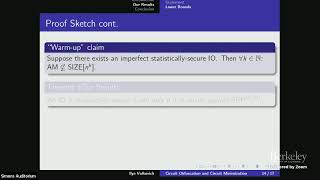
Mutual Empowerment Between Circuit Obfuscation and Circuit Minimization
Exploring connections between Indistinguishability Obfuscation and Minimum Circuit Size Problem, revealing implications for cryptography and computational complexity theory.

Fine-Grained Cryptography
Explore minimal complexity assumptions in cryptography, focusing on fine-grained approaches that provide strong guarantees against restricted adversarial classes.
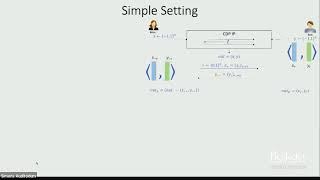
On the Complexity of Two-Party Differential Privacy
Explores limitations and cryptographic requirements for distributed differential privacy in two-party functions like inner product and Hamming distance, with implications for data analysis and privacy.

New Techniques for Zero-Knowledge- Leveraging Inefficient Provers to Reduce Assumptions
Explores novel approaches in zero-knowledge proofs, focusing on transforming NIZK to ZAPs with inefficient provers. Discusses implications for cryptographic assumptions and fine-grained complexity settings.
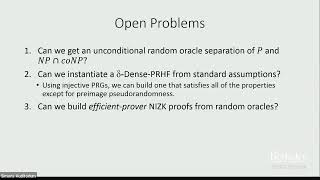
Hard Languages in NP ∩ coNP and NIZK Proofs from Unstructured Hardness
Explores unstructured hard languages in NP ∩ coNP, providing evidence for their existence and introducing a new NIZK proof construction, advancing understanding of computational complexity and cryptography.

What Do the Theory of Computing and the Movies Have in Common?
Explore the fascinating intersection of theoretical computer science, art, and cinema with Pixar co-founder Alvy Ray Smith, tracing the evolution from pixels to digital movies and its impact on modern computer graphics.
Information-Theoretic Quantum Cryptography Part 1 of 2 - IPAM at UCLA
Explore information-theoretic quantum cryptography, covering topics like quantum money, secure computation, and key distribution. Gain insights into the interplay between quantum information and cryptography.
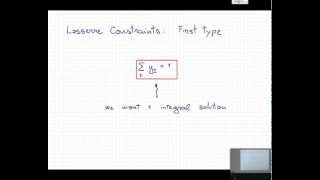
On Some Easy Problems That Are Hard for the Lasserre Hierarchy
Overview of lower bound results for the Lasserre hierarchy, including characterization of hardest problems, integrality gap for scheduling, and analysis of symmetric formulations using polynomial inequalities.
Collision-Resistance from Multi-Collision-Resistance
Exploring the transformation of multi-collision-resistant hash functions into collision-resistant hash functions, with insights on Reed-Solomon codes and cryptographic primitives.
Advisor-Verifier-Prover Games and the Hardness of Information Theoretic Cryptography
Explore proof systems and their implications for information-theoretic cryptography, examining the impossibility of efficient solutions for key tasks in the field.
Quantum Minimalism
Exploring minimal quantum cryptographic assumptions beyond one-way functions, examining their significance and potential implications for future quantum-secure cryptographic systems.
Optimal Broadcast Encryption and More from Evasive LWE
Explore advanced cryptographic techniques using evasive LWE, focusing on optimal broadcast encryption and its applications in secure communication systems.
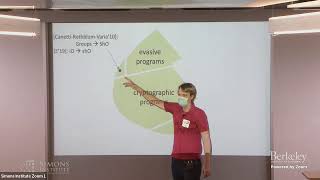
New Quantum Cryptographic Primitives I
Explore cutting-edge quantum cryptography with Mark Zhandry, delving into novel primitives and their implications for secure communication in the quantum era.
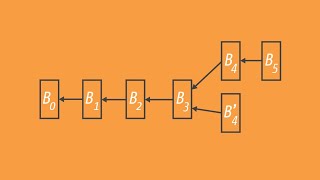
The Long Arm of Theoretical Computer Science - The Case of Blockchains-Web3
Explore how theoretical computer science concepts illuminate blockchain technology, offering a clear, comprehensive view of its essence as a public, ownerless computer system.
Efficient Zero-Knowledge Proofs: A Modular Approach
Explore modular techniques for creating efficient zero-knowledge proofs, focusing on probabilistically checkable and interactive proof systems in cryptography.

Approximation Power
Explore deep learning's approximation capabilities, focusing on theoretical foundations and practical implications for neural network design and performance optimization.
The Barrier Method and the Kadison-Singer Problem
Explore the Barrier Method and its application to the Kadison-Singer Problem in this advanced mathematics lecture by Nikhil Srivastava from UC Berkeley.
Recent Structure Lemmas for Depth-Two Threshold Circuits
Explore recent advancements in structure lemmas for depth-two threshold circuits, focusing on Boolean devices and their implications in computational complexity theory.
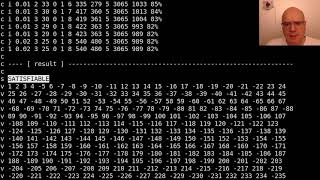
SAT-Solving
Explore the theory and practice of SAT-solving, delving into satisfiability concepts and advanced techniques in this comprehensive lecture by Armin Biere.
Pseudorandomness
Explorations in pseudorandomness: SoS lower bounds, block rigidity, unbounded-width permutation branching programs, computational entropies, and random projections in circuit complexity.

Berkeley in the 80s - Richard Karp and the Theory of Computing
In-depth interview with Turing Laureate Richard Karp, exploring his groundbreaking research on computational theory at Berkeley in the 1980s and its lasting impact on computer science.