Energy-efficient On-device Processing for Next-generation Endpoint ML - tinyML Summit 2020
Explore energy-efficient on-device processing for endpoint machine learning, focusing on Arm's Cortex-M55 CPU and Ethos-U55 NPU for next-generation AI applications.
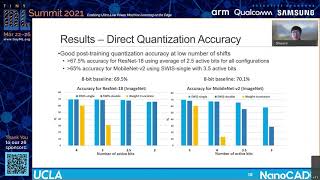
SWIS: Shared Weight Bit Sparsity for Efficient Neural Network Acceleration
Explore SWIS, a quantization framework for efficient neural network inference acceleration, offering improved performance and storage compression through weight decomposition and scheduling algorithms.
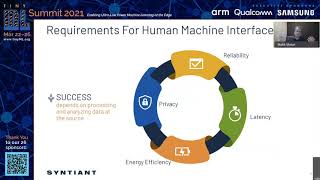
tinyML: Impact and Growth of Always-On Devices
Explore the growing impact of tinyML devices in everyday life, from always-on voice in phones to environmental sensing in machines, and learn about the market's rapid expansion and technological requirements.
Propagating Programming Paradigms - Lifting High Performance Compute Into Kubernetes
Explore how to optimize Kubernetes clusters for high-performance computing workloads, bridging the gap between traditional HPC and cloud-native environments to improve performance and sustainability.
Be the Change Our Planet Seeks: How You Can Contribute to Running Environment-Friendly Workloads on Kubernetes
Discover sustainable software engineering principles for Kubernetes workloads and learn actionable steps to reduce carbon footprint in your projects, contributing to a greener tech industry.
Use Knative When You Can and Kubernetes When You Must - Benefits and Best Practices
Explore Knative's advantages over Kubernetes for deploying services, including automation, simplification, auto-scaling, and improved security, while reducing costs and energy consumption.
Minimizing Energy Consumption in Bare Metal Kubernetes Clusters
Explore strategies to reduce energy consumption in bare metal Kubernetes clusters, covering hardware configuration, power management, and operational techniques while considering performance impacts.
Storage Wars: Evaluating Kubernetes Storage Options
Explore Kubernetes storage options beyond cloud providers. Compare performance, reliability, sustainability, and cost to make informed choices for your specific needs.
Evaluating the Energy Footprint of GitOps Architectures - A Benchmark Analysis
Explore the energy consumption and CO2 emissions of GitOps architectures through benchmark analysis, providing insights for eco-friendly decision-making in cloud-native environments.
GitOps Sustainability with Flux and ARM64
Explore GitOps sustainability using Flux and arm64, covering performance benefits, cost savings, and environmental impact. Learn steps to recompile workloads and implement best practices for efficient cloud-native operations.
Blockchain in Action: Fighting Climate Change Through Traceability and Transparency
Exploring blockchain's impact on climate change through real-world applications in traceability, sustainability, and cross-industry collaboration for a greener future.
Function Dedicated Network Deployment Model in DPU/IPU-Like Devices for Composable Disaggregated Infrastructure
Explore innovative hardware architectures and function dedicated networks using DPU/IPU technologies to reduce energy consumption and enhance performance in cloud-native infrastructures.
Optimizing Full-Stack Sustainability in a Real World Data Center - Practices and Lessons Learned
Explore practices for optimizing sustainability across heterogeneous computing systems. Learn about real-time data analysis, AI-driven failure prediction, and smart job scheduling to maximize efficiency and minimize power consumption.
Sustainable Platforms from Development to Production
Explore strategies for creating sustainable software platforms, from initial development through to production deployment and maintenance.
Adding Runtime Power Management Capabilities to Device Drivers
Learn to implement Runtime Power Management in device drivers, focusing on the RPM subsystem, callback functions, and power optimization techniques using a light sensor driver example.
Sustainability the Container Native Way
Explore container-native approaches to sustainability in cloud computing, focusing on energy efficiency and resource optimization strategies for modern IT infrastructures.
Learnings from Sustainably Steering the Kubernetes Project
Insights into Kubernetes project governance, including Steering Committee roles, community reports, and strategies for sustainable open-source management in cloud-native ecosystems.
Building Carbon Awareness with KEDA - Taking the First Step Towards Sustainability
Explore how the Carbon Aware KEDA Operator helps reduce carbon footprint in software applications without code changes. Learn deployment, usage, and potential integration into KEDA.
Physics-informed Machine Learning for Robust Pedestrian Detection in Embedded Low-power Systems
Innovative machine learning algorithm for efficient pedestrian detection in urban areas using neuromorphic sensors, combining physical motion models for accurate real-time tracking day and night.
Provably Efficient Quantum Algorithms for Nonlinear Dynamics and Machine Learning
Explore quantum algorithms for nonlinear dynamics and machine learning, including efficient solutions for differential equations and training sparse neural networks with potential quantum enhancements.
When Observability Meets Sustainability - A Real World Experience
Explore a comprehensive system for measuring and optimizing sustainability in computing, covering security, reliability, operations, and environmental impact, with real-world data center examples and live demonstrations.