
Causal Effects via Regression with Python Code - Part 5
Explore regression-based techniques for computing causal effects, including linear regression, double machine learning, and metalearners. Gain practical insights with Python code examples.

Causal Effects via DAGs: Handling Unobserved Confounders - Part 4
Explore graphical criteria for evaluating causal effects in non-Markovian models, focusing on handling unobserved confounders through back and front door criteria.

Causal Effects via the Do-operator: Overview and Example - Part 3
Explore the do-operator for estimating causal effects from observational data. Learn alternative formulations of average treatment effect and techniques for handling unmeasured confounders.

Causal Effects - Introduction to the Potential Outcomes Framework
Explore the Potential Outcomes Framework and three types of causal effects in this introductory video on causal inference, laying the groundwork for future discussions on observational data analysis.
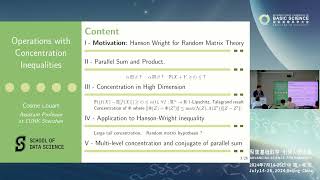
Operation on Concentration Inequalities and Conjugate of Parallel Sum
Explore advanced techniques in concentration inequalities, including operations on concentrated vectors and applications of the convex conjugate of parallel sum in measure theory.
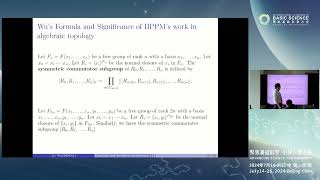
Topology and Artificial Intelligence - Applications and Recent Progress
Explore recent advancements in algebraic topology and AI, including language models for homotopy groups and statistical modeling for complex networks and diseases.
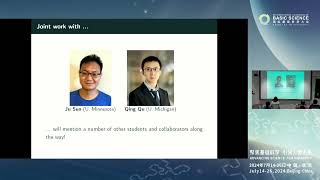
Geometric Analysis of Phase Retrieval
Explore geometric analysis of phase retrieval, examining nonconvex heuristics and proving benign geometric structure for efficient signal recovery using iterative optimization methods.
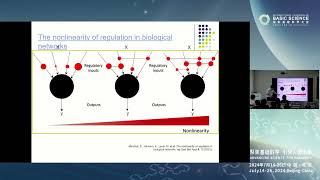
Quasi-Dynamic System Representation of Multiple Nonlinear Regression
Explore evolutionary game theory and allometric scaling to model nonlinear relationships between variables, overcoming limitations of linear regression for complex systems analysis.
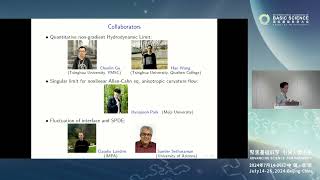
Interface and Its Fluctuation in Interacting Particle Systems - ICBS 2024
Explore particle separation in Glauber-Kawasaki dynamics, interface evolution, and fluctuations. Delve into extended research on anisotropic curvature flow and stochastic partial differential equations.

Recent Progress in Ramsey Theory
Explore recent advancements in Ramsey Theory, focusing on new techniques and proofs related to Ramsey numbers and graph coloring. Gain insights into geometric, algebraic, probabilistic, and combinatorial methods.
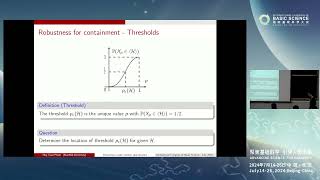
Structures Robust Under Randomness - Probabilistic Combinatorics and Thresholds
Explore robustness of discrete system substructures under random subsampling, examining thresholds in random graphs and key conjectures in probabilistic combinatorics.
Understanding the Relationship Between the Schramm-Loewner Evolution and the Gaussian Free Field
Explore the connection between Schramm-Loewner Evolution, Gaussian Free Field, and Liouville Quantum Gravity through a novel, accessible approach for non-specialists.
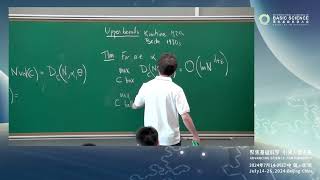
Homogeneous Dynamics and Probabilistic Diophantine Approximations - Cauchy Limit Laws for Linear Forms
Explore homogeneous dynamics and probabilistic Diophantine approximations, focusing on Cauchy limit laws for linear forms with random coefficients and lattice counting problems.
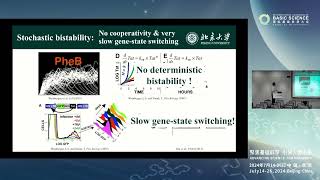
Stochastic Modeling and Statistical Inference for Advancing Biomedical Insights
Explore stochastic modeling and statistical inference applications in single-cell biology, including HIV dynamics and preimplantation genetic testing for monogenetic diseases.
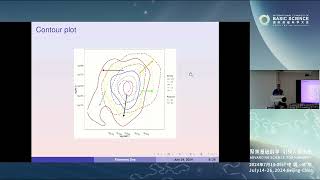
Bayesian Quantile Joint Modeling of Multivariate Longitudinal and Time-to-Event Data
Explore Bayesian quantile joint modeling for multivariate longitudinal and time-to-event data, focusing on non-Gaussian outcomes and time-varying covariates in medical research applications.
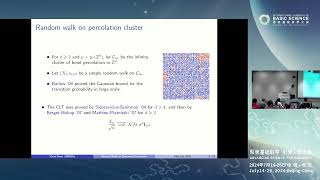
Random Walk on Dynamical Percolation: Separating Critical and Supercritical Regimes
Explore random walks on dynamical percolation, examining critical and supercritical regimes in infinite regular trees and lattices. Analyze speed bounds and mean squared displacement.
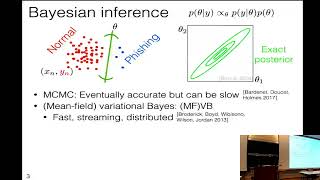
Automated Scalable Bayesian Inference via Data Summarization - 2018
Explore scalable Bayesian inference techniques using data summarization. Learn about coresets, theoretical guarantees, and practical applications in large-scale data settings.
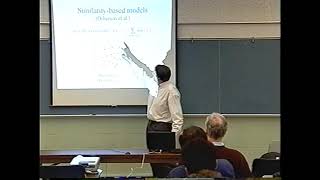
A Bayesian View of Inductive Learning in Humans and Machines - 2004
Explore how humans make successful generalizations from limited evidence through Bayesian inferences constrained by implicit domain theories, with applications to machine learning.
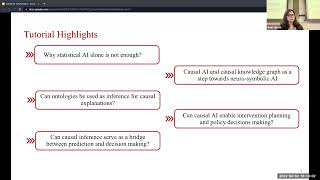
Causal AI for Web and Healthcare
Explore causal AI applications in web and healthcare using knowledge graphs for intervention and counterfactual reasoning, model-based explainability, and domain-specific insights.
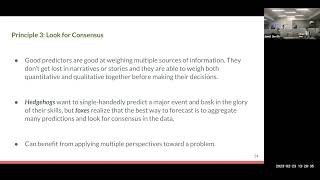
The Signal and the Noise by Nate Silver - Part 2
Explore Nate Silver's insights on data analysis and prediction in "The Signal and the Noise" through an expert review of key concepts and applications.
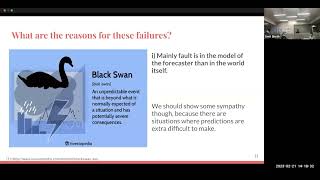
The Signal and the Noise by Nate Silver - Part 1
Explore key insights from Nate Silver's "The Signal and the Noise" in this comprehensive review, focusing on statistical analysis and prediction techniques.