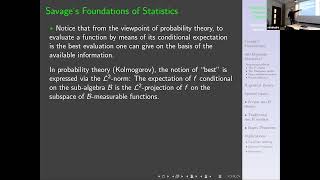
Foundations of Neo-Bayesian Statistics - Part 2
Explore Neo-Bayesian Statistics foundations, examining alternative probability theories and their implications for statistical inference, dynamic consistency, and capacity updating.
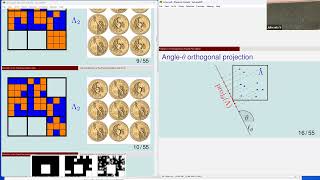
Dynamically Defined Random Fractals
Explore dynamically defined random fractals and their mathematical properties through expert insights from Karoly Simon of Budapest University of Technology and Economics.
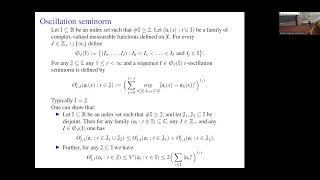
Discrete Harmonic Analysis and Its Applications to Ergodic Theory - Part 2
Explore advanced concepts in discrete harmonic analysis and their ergodic theory applications, building on foundational knowledge from part 1.

Subgroup Tests and the Aldous-Lyons Conjecture
Explore the refutation of the Aldous-Lyons conjecture through novel interactive proof systems and subgroup tests, connecting complexity theory to probability theory and group theory.
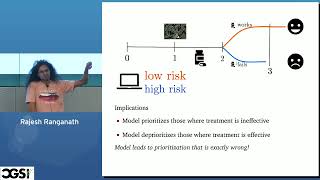
Understanding the Role of Causality in AI for Healthcare
Explore causality's crucial role in AI for healthcare, focusing on improving patient care, addressing self-fulfilling prophecies, and enhancing treatment outcome predictions.
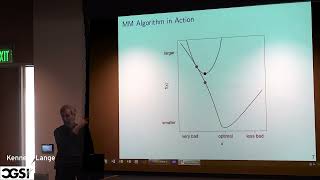
Examples of MM Algorithms - CGSI 2024
Explore MM algorithms through practical examples, enhancing understanding of their applications in statistics, signal processing, and machine learning.

Correlation Coefficient - Karl Pearson Product Method Numerical
Learn to calculate correlation coefficients using Karl Pearson's product method through practical numerical examples in statistics and advanced mathematics.
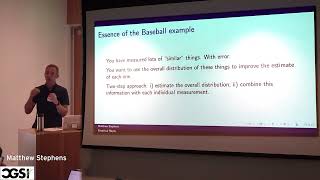
Empirical Bayes and Its Applications: Shrinkage, Hypothesis Testing, and More
Explore Empirical Bayes methods for shrinkage, hypothesis testing, and genomic studies. Learn statistical techniques to estimate and test effects in multiple conditions.
Bayesian Inference of Causal Graphs: Current Status and Future Directions
Explore Bayesian inference for causal discovery, examining recent progress, challenges, and assumptions in modeling cause-effect relationships from observational data.
Robust and Sample-Efficient Simulation-Based Inference
Explore robust and sample-efficient methods for simulation-based inference, addressing model misspecification and computational limitations in scientific and engineering applications.
Functional Priors for Bayesian Deep Learning
Explore functional priors for Bayesian deep learning, focusing on imposing Gaussian process priors on neural networks through Wasserstein distance minimization.
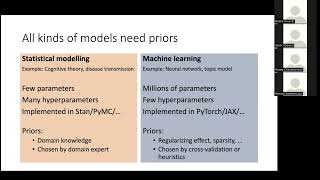
Better Priors for Everyone - Choosing Prior Distributions in Bayesian Modeling
Explore techniques for choosing effective prior distributions in Bayesian modeling, including prior elicitation and automatic selection methods for improved statistical inference.

Parameter Estimation and Interpretability in Bayesian Mixture Models
Explore posterior contraction in Bayesian mixture modeling, examining parameter estimation and model interpretability under correct and misspecified conditions. Gain insights into tradeoffs between expressiveness and interpretability.

Independent Finite Approximations for Bayesian Nonparametric Inference
Explore independent finite approximations for Bayesian nonparametric inference, comparing them to truncated finite approximations and analyzing their performance in real-world applications.
Causality in Artificial Intelligence - Oral Session 3
Explore cutting-edge research in causal inference, including bounding effects, model reduction, interventions in games, and causally abstracted bandits.
All Causal DAGs Are Wrong but Some Are Useful
Explore the concept of causal DAGs, their usefulness, and challenges in causal discovery. Gain insights into evaluating causal models without ground truth and understanding causality's meaning across various tasks.
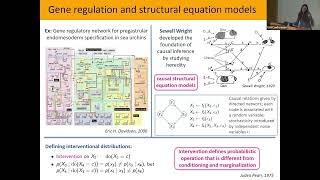
Causal Representation Learning and Optimal Intervention Design
Explore causal representation learning and optimal intervention design with Caroline Uhler's insightful keynote talk at UAI 2023.
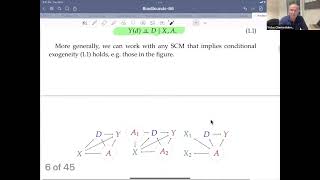
Omitted Variable Bias in Causal Machine Learning
Explore omitted variable bias in causal machine learning with Victor Chernozhukov's keynote address at UAI 2023, offering insights into this critical aspect of AI research.
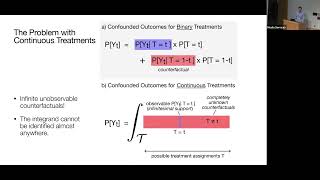
Partial Identification of Dose Responses with Hidden Confounders - UAI 2023 Oral Session 3
Explore novel methods for bounding continuous-valued treatment effects with hidden confounders in causal inference, enhancing decision-making in observational studies.
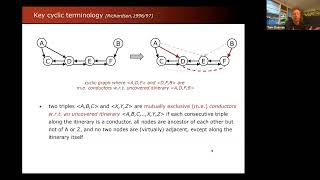
Establishing Markov Equivalence in Cyclic Directed Graphs - UAI 2023 Oral Session 3
Explore an efficient procedure for establishing Markov equivalence in cyclic directed graphs, based on the Cyclic Equivalence Theorem and ancestral perspective.

Causal Representation Learning - Tutorial
Explore causal representation learning, combining machine learning with causal assumptions to identify causal variables from low-level data. Gain insights into core problems and future directions in scientific discovery.