Quantum Phases of Matter - The SYK Model
Explore quantum phases of matter through the SYK model with Prof. Sachdev. Delve into free fermion systems, entropy, random matrices, and complex quantum phenomena in this advanced theoretical physics lecture.
A Scientific Summary of the 2021 Nobel Prize in Physics
Explore complex systems, climate modeling, and statistical mechanics with insights from a Nobel Prize committee member. Gain a graduate-level understanding of interconnected physical phenomena.
Ergodicity Breaking in Quantum Many-Body Systems
Explore ergodicity breaking in quantum systems, focusing on many-body localization and measurement-induced transitions. Gain insights into non-ergodic behavior and entanglement dynamics.
Journey to the Centre of a Neutron Star by Professor G Srinivasan
Explore neutron star formation, structure, and exotic states. Dive into superfluidity, superconductivity, and their implications in these extreme cosmic objects.
Deterministic Solution of the Boltzmann Equation - Fast Spectral Methods
Explore fast Fourier spectral methods for solving the Boltzmann equation, addressing computational challenges and showcasing applications in rarefied gas dynamics.
A Gradient Flow Approach to Kinetic Equations
Gradient flow approach to linear kinetic equations, exploring entropy dissipation inequality and large deviation principles. Discusses potential extensions to non-linear cases and connections to Markov chains.
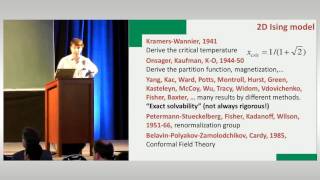
Panorama of Mathematics - Clusters, Loops and Trees in the Ising Model
Explore clusters, loops, and trees in the Ising model with Fields Medalist Stanislav Smirnov, covering topics from conformal field theory to discrete complex analysis and random cost representation.
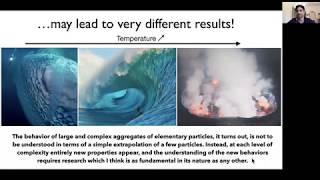
Phase Transitions - From Physics to Computer Science
Explore phase transitions across physics and computer science, from water states to combinatorial optimization and information theory, revealing their universal nature in complex systems.
Quantum Time Correlation Functions in an Open-Chain Path Integral Distribution
Explore quantum time correlation functions using open-chain path integrals, offering a new perspective on semiclassical approximations in computational chemistry with potential applications in rate theory and spectroscopy.
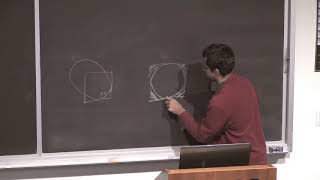
Arctic Curves for Ice Models
Explore arctic curves in statistical mechanics, focusing on the six-vertex model with ice point and domain-wall boundary data. Learn about the geometric tangent method for locating arctic boundaries.
Entanglement Entropy, Quantum Field Theory, and Holography by Matthew Headrick
Explore entanglement entropy in quantum systems, focusing on its applications in field theory and holography. Learn about classical and quantum correlations, mutual information, and entropy in spin systems.
Why Do Simple Models Work? Partial Answers from Information Geometry - Lecture 1
Explores information geometry to understand why simple models effectively describe complex systems, focusing on statistical mechanics, renormalization, and model reduction in physics and biology.

Active Associative Memory by Suri Vaikuntanathan - University of Chicago - KITP Chalk Talk
Explore how non-equilibrium dynamics enhance memory and information processing in biological systems, from neuronal circuits to immune responses, challenging traditional equilibrium-based paradigms.
Absence of Superdiffusion in Certain Random Spin Models - Austen Lamacraft
Explore non-equilibrium many-body physics and universal aspects in diverse fields. Discover novel phases of matter, entanglement dynamics, and connections between classical and quantum systems.
Extracting Complexity of Quantum Dynamics Using Machine Learning - Zala Lenarcic
Explores machine learning techniques to analyze complex quantum dynamics, focusing on non-equilibrium many-body physics and its applications across various fields of physics.
Nonequilibrium Dynamics Following an Interaction Quench in Quantum Materials - Chong Yu Ruan
Explores non-equilibrium dynamics in quantum materials after interaction quench, discussing universal aspects, novel phases, and connections between high-energy physics and condensed matter systems.
Exact Spectral Form Factors in Interacting Lattice Systems - Tomaz Prosen
Explores exact spectral form factors in interacting lattice systems, discussing non-equilibrium many-body physics and universal aspects of quantum systems far from equilibrium at the interface of various physics fields.
Spacetime Mutual Information - Xiaoliang Qi (Stanford)
Explore spacetime mutual information with Stanford's Xiaoliang Qi in this advanced physics talk. Delve into integrable models, quantum systems, and theoretical physics concepts at the forefront of research.
Exploring Entangled Quantum Matter with Programmable Atom Arrays - Mikhael Lukin
Cutting-edge exploration of entangled quantum matter using programmable atom arrays, presented by Harvard's Mikhael Lukin. Discusses recent advances in quantum systems and their applications in physics and technology.
Learning Global Charges from Local Measurements - Romain Vasseur
Explores techniques for extracting global charge information from localized quantum measurements, discussing recent advances in integrable models and their applications in physics and string theory.
Recent Developments in Asymptotically Good Quantum LDPC Codes
Explores recent advancements in quantum LDPC codes, focusing on asymptotically good properties. Discusses theoretical developments and potential applications in quantum error correction and fault-tolerant quantum computing.