Navigating the Sandbox Buffet
Explore diverse sandboxing techniques to isolate risky software, balancing performance, security, and developer experience. Learn to choose the right combination for your workloads.
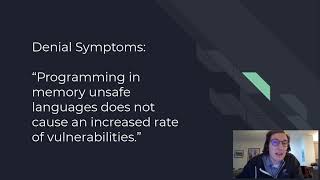
Quantifying Memory Unsafety and Reactions to It
Explore memory unsafety in C/C++, its prevalence in major projects, and developer reactions. Learn strategies for addressing this critical issue in modern secure development.

A Sound Mind in a Vulnerable Body - Practical Hardware Attacks on Deep Learning
Explores hardware vulnerabilities in deep learning systems, demonstrating how fault injection and side-channel attacks can compromise model accuracy and steal proprietary information, highlighting the need for robust ML-level defenses.

A Practical Guide to Fuzz Testing Embedded Software in a CI Pipeline - Dennis Kengo Oka - Ekoparty 2021: Hardware Hacking Space
Practical guide to implementing automated fuzz testing in CI pipelines for embedded software, using Zephyr RTOS as an example. Learn strategies, execution, and vulnerability detection.
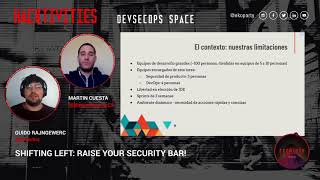
Shifting Left- Raise Your Security Bar! - Guido Rajngewerc & Martin Cuesta - Ekoparty Security Conference - 2020
Integración de seguridad en el ciclo de desarrollo ágil: herramientas y estrategias para detectar vulnerabilidades temprano, empoderando a los desarrolladores como actores clave en la seguridad del producto.

The Forgotten Interface- Windows Named Pipes - Gil Cohen - Hack in Paris - 2017
Explores Windows named pipes as potential security vulnerabilities, covering enumeration, scanning, sniffing, fuzzing, and exploitation techniques, with insights on mitigation and defense strategies.

KOALitionsvertragsAnalyse – Dem Vertrag auf den Zahn fühlen
Analyse des Koalitionsvertrags mit verschiedenen Textanalyse-Methoden: als Sourcecode, Spezifikation, Objektmodell und Literatur. Einblicke in Struktur und Inhalt des Ampel-Vertrags.
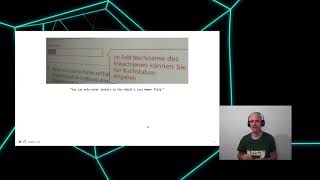
Your Name Is Invalid! - RC3 - 2020
Explore challenges in handling personal names in software, covering encoding, case sensitivity, sorting, and localization issues for more inclusive and robust applications.
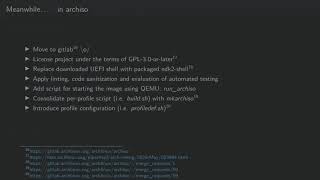
Archiso - Creating an Installation Medium - Arch Conf 2020
Explore Archiso's evolution, recent changes, and future plans for Arch Linux installation media creation, including automation, accessibility, and reproducibility enhancements.

The State of Reproducible Builds - Arch Conf 2020
Explore progress in Arch Linux's reproducible builds, current tooling, rebuilder software, and challenges in ensuring source code integrity and binary artifact distribution.
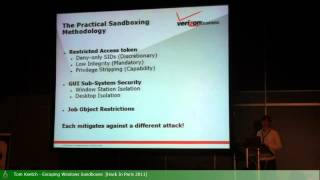
Escaping Windows Sandboxes - Tom Keetch - Hack in Paris
Explore Windows sandbox vulnerabilities in popular applications, evaluating protection mechanisms and uncovering flaws in practical sandboxing techniques.
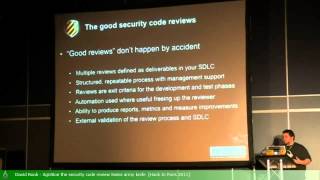
Agnition - The Security Code Review Swiss Army Knife - David Rook - Hack in Paris
Explore Agnitio, a comprehensive tool for secure code review, offering checklists, guidance modules, and automated analysis to enhance software development security practices.
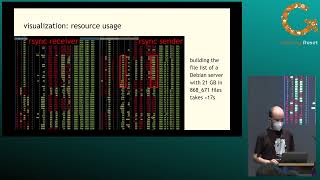
Why I Wrote My Own Rsync - Michael Stapelberg - Media.CCC.De
Explore the creation of a custom rsync implementation in Go, delving into rsync's inner workings, performance improvements, and integration with home networking projects.

Leveraging the Power of Automated Reasoning - USENIX Enigma Conference - 2017
Explores automated bug detection and security exploit generation using symbolic execution and SMT solvers, showcasing their application in Web security analysis and potential for broader automation.

Legislative Engineering - Design Privacy Laws, Don't Just Draft Them - USENIX Enigma Conference - 2017
Exploring software engineering techniques to improve technology legislation, focusing on component-based architecture and modeling to create more effective and consistent laws.
Making Invisible Things Visible - Tracking Down Known Vulnerabilities
Insights on software supply chain practices, revealing vulnerabilities in open source components and strategies for improving application security in high-performance development organizations.
Interact Differently - Get More from Your Tools Through Exposed APIs
Explore how to leverage exposed APIs and plugin interfaces in software tools to enhance functionality, streamline workflows, and create custom solutions for improved efficiency and effectiveness.

Why the LinkedIn Hack Could Be Your Biggest AppSec Threat
Explore account takeover threats, their long-term impact, and effective defense strategies. Learn about hacking techniques, credential stuffing, and tools to protect against evolving cyber risks.

Monitoring Attack Surface and Integrating Security into DevOps Pipelines
Explore strategies for integrating security into DevOps pipelines, focusing on attack surface monitoring, automated testing, and merging static and dynamic results.

Doing Security in 100 Milliseconds - The Speed of Serverless Computing
Explore serverless computing's impact on security, covering key areas like software supply chain and attack detection. Learn practical approaches and see a demo of building and securing a serverless application.

Reversing Web Applications
Explore web application reverse engineering techniques, from information gathering to active testing, to understand behavior, analyze code, and improve security assessments.