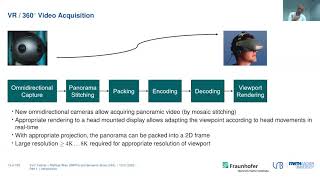
Versatile Video Coding - Algorithms and Specification
Explore advanced algorithms and specifications for Versatile Video Coding, the latest video compression standard, presented by experts in the field.
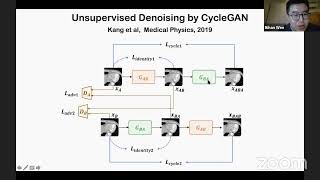
Computational Imaging - Deep Learning Approaches
Explore advanced computational imaging techniques with Jong Chul Ye from KAIST, covering innovative approaches in signal processing and image reconstruction.
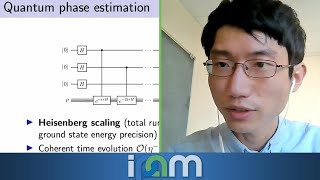
Heisenberg-Limited Ground State Energy Estimation for Early Fault-Tolerant Quantum Computers
Explore Heisenberg-limited ground state energy estimation for early fault-tolerant quantum computers, featuring a simplified circuit and classical post-processing for improved efficiency.
Inverse Problems under a Learned Generative Prior - Lecture 1
Explores inverse problems using generative priors, comparing to sparsity models. Covers theory, algorithms, and applications in compressive sensing and phase retrieval, with focus on deep learning approaches.
Computational Imaging Systems and Optical Design - Webinar
Explore computational imaging systems, diffractive optics, and neural network-based reconstruction in this advanced signal processing webinar by Prof. Wolfgang Heidrich from KAUST.
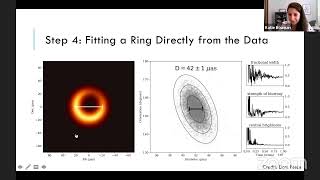
Computational Imaging: Black Hole Shadows and Imaging Algorithms - Webinar
Explore computational imaging techniques for black hole visualization, featuring insights on imaging algorithms, bias avoidance, and telescope design optimization.
Computational Imaging Systems: From DiffuserCam to Neural Activity Tracking - Seminar 2
Explore computational imaging systems, focusing on DiffuserCam technology and its applications in 3D neural activity tracking. Learn about challenges and solutions in image reconstruction and processing.
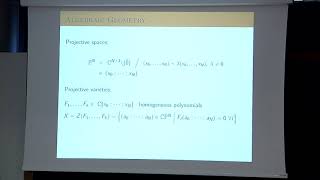
The Geometry of Tensors - Carolina Araujo
Explore tensor decomposition, its applications, and geometric interpretation. Learn about recent developments in determining tensor ranks and their significance in various fields.
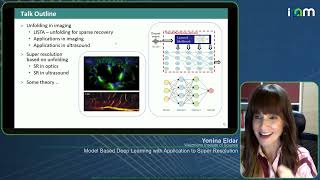
Model Based Deep Learning with Application to Super Resolution - IPAM at UCLA
Explore model-based deep learning for super-resolution microscopy, merging parametric models with optimization tools to create efficient, interpretable networks from limited training data.
Solving Inverse Problems With Deep Neural Networks - Robustness Included?
Exploring robustness of deep learning in inverse problems, focusing on resilience against statistical noise and adversarial perturbations in image reconstruction tasks.
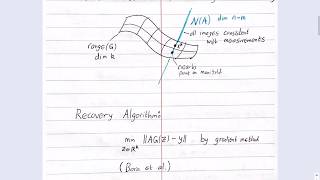
Theory of GANs for Compressed Sensing
Explore the theory of GAN priors in compressed sensing, covering key concepts, proofs, and optimization problems. Gain insights into visual representation and set restricted eigen value conditions.
LED Programming with Arduino - Class 4
Explore advanced LED programming techniques with Arduino, including XY matrix, noise with palettes, pixel art, Fast Fourier Transform, and sound visualization for creative installations.

The Fast Fourier Transform - Most Ingenious Algorithm Ever?
Explore the Fast Fourier Transform algorithm through polynomial multiplication, discovering its efficiency in converting between coefficient and value representations for complex calculations.

Wio Terminal TinyML Course - Audio Scene Recognition on Microcontrollers with Arduino IDE
Learn to implement audio scene recognition on microcontrollers using TinyML, Arduino IDE, and Wio Terminal. Covers data collection, processing, model training, deployment, and mobile notifications with Blynk.
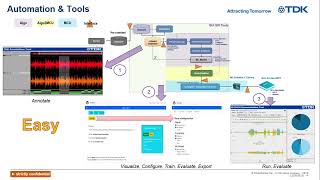
Sensors and Machine Learning: Waking Smarter for Less
Explore how machine learning optimizes sensor systems, reducing resource usage while improving response. Learn about smart wake-up strategies and efficient data conversion at the edge.
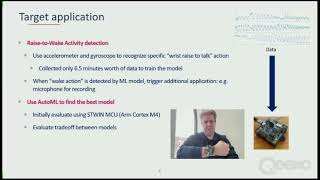
Optimizing AutoML for the tinyML Future
Optimizing AutoML for tinyML: Balancing accuracy, latency, and power efficiency through hardware-aware techniques and full signal flow optimization from sensor to inference.
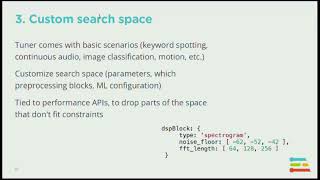
EON Tuner - AutoML for Constrained Devices in TinyML
Explore AutoML for constrained devices with EON Tuner, optimizing tinyML models through pre-processing, DSP, and ML combinations while considering device limitations and real-world performance.
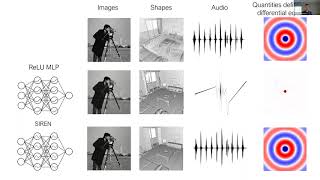
Implicit Neural Scene Representations
Explore implicit neural representations for complex signals, enabling 3D reconstruction from single images and fast inference through gradient-based meta-learning, with applications in scene understanding and semantic segmentation.

Ultra-Low-Power Command Recognition for Ubiquitous Devices
Explore ultra-low-power command recognition for ubiquitous devices, covering noise challenges, system goals, core functions, training, and implementation on tiny hardware.
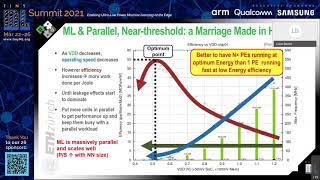
Many Shades of Acceleration - An Open TinyML Platform Perspective
Explore extreme edge AI, energy efficiency, and acceleration techniques for TinyML applications with insights from the PULP platform and RISC-V processors.
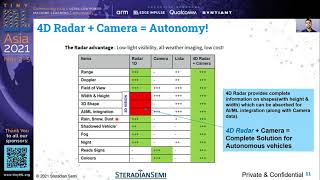
Imaging Radars - Learning for Enhanced Vision in Modern Radar Systems
Explore imaging radars and machine learning for enhanced object classification in traffic enforcement and autonomous driving applications using millimeter-wave technology.