Sparsity, Epistasis, and Models of Fitness Functions - Leveraging Interactions in Protein Function Prediction
Explore sparsity in epistatic interactions to enhance fitness function modeling. Learn about Walsh-Hadamard transform, Graph Fourier transforms, and Epistatic Net for improved protein function prediction.
Learning Differentiation Dynamics from Lineage Tracing Datasets
Uncover robust computational approaches for inferring cell dynamics from single-cell transcriptomics integrated with lineage tracing, focusing on the CoSpar method and its applications in hematopoiesis and reprogramming.
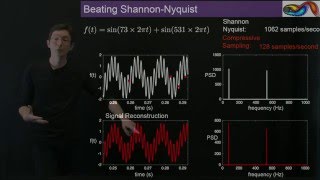
Linear Algebra
Comprehensive exploration of linear algebra concepts, including SVD, Fourier analysis, and compressed sensing, with practical applications and coding examples in MATLAB and Python.
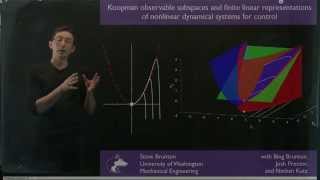
Koopman Analysis
Explore advanced techniques in dynamical systems analysis, including Koopman theory, spectral analysis, and applications to control and chaos in various scientific domains.
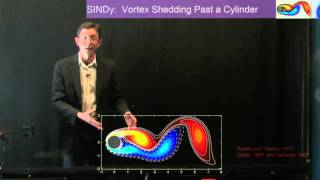
Dynamical Systems
Explore advanced techniques in dynamical systems analysis, including SINDy, Koopman theory, and deep learning applications for modeling complex nonlinear systems.
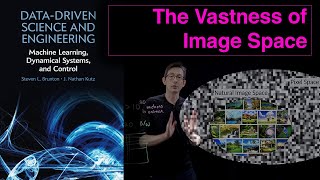
Sparsity and Compression
Explore sparsity and compression techniques, from compressed sensing to robust regression, with practical applications in image processing, signal analysis, and machine learning.
A Compressed Overview of Sparsity
Explore compressed sensing in engineering mathematics, covering sparsity, compression techniques, and L1 minimization. Learn key principles and applications beyond image processing.
On the Unreasonable Effectiveness of Compressive Imaging - Ben Adcock, Simon Fraser University
Explores compressive imaging's effectiveness, discussing compressed sensing theory, optimal sampling strategies, and practical applications in data science and imaging technology.
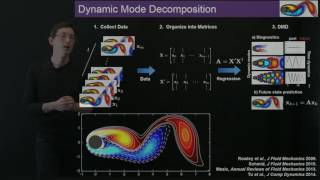
Compressed Sensing and Dynamic Mode Decomposition
Explore leveraging compressed sensing for dynamic mode decomposition, enabling analysis of under-sampled data. Learn techniques to extract meaningful insights from limited information.
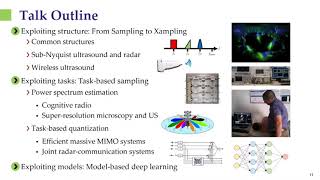
From Compressed Sensing to Deep Learning - Tasks, Structures and Models
Explore signal processing from compressed sensing to deep learning, covering task-based acquisition, sub-Nyquist sampling, super-resolution techniques, and hybrid algorithms combining model-based and data-driven approaches.
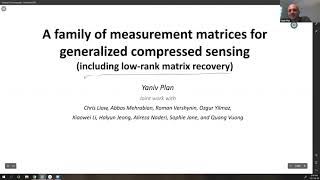
A Family of Measurement Matrices for Generalized Compressed Sensing
Explore generalized compressed sensing with a family of measurement matrices, focusing on signal recovery from noisy linear measurements and the role of effective rank in guaranteeing accurate recovery.
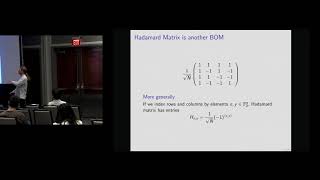
An Improved Lower Bound for Sparse Reconstruction from Subsampled Hadamard Matrices
Explore improved lower bounds for sparse reconstruction using subsampled Hadamard matrices, advancing understanding in signal processing and compressed sensing.
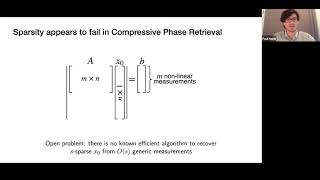
Signal Recovery with Generative Priors - SIAM-IS Virtual Seminar
Explore signal recovery using generative priors in imaging, discussing neural network models, recovery guarantees, and applications in compressed sensing and phase retrieval.
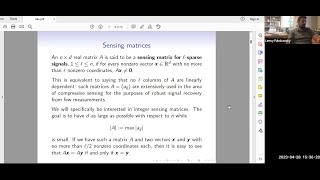
Geometric Constructions for Sparse Integer Signal Recovery
Explore geometric constructions for sparse integer signal recovery, focusing on matrix design for robust vector reconstruction in compressed sensing applications.
Helmut Bölcskei - Lossy Compression on General Data Structures
Explore lossy compression for data on manifolds and fractals, with bounds on rate-distortion function and quantization error. Applications in data science and image processing.
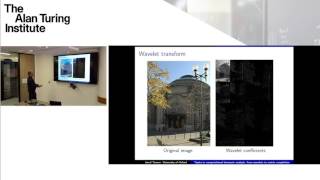
Mathematical Representations and Models - Professor Jared Tanner, Oxford University
Explore mathematical models for high-dimensional data analysis with Oxford's Prof. Tanner. Learn about Fourier series, localisation, coherence, and advanced techniques for efficient information extraction and processing.
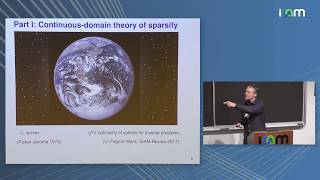
Splines and Imaging - From Compressed Sensing to Deep Neural Networks
Explore splines in imaging, from compressed sensing to deep neural networks. Unser demonstrates spline optimality in inverse problems and their connection to deep learning, offering insights into ReLU architecture and activation optimization.
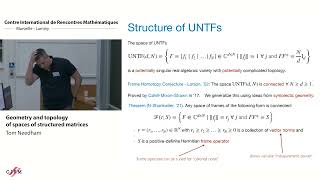
Geometry and Topology of Spaces of Structured Matrices
Explore geometric and topological aspects of structured matrices, including momentum maps, frame spaces, and applications in compressed sensing and graph theory.
Statistical Physics and Statistical Inference - Lecture 2
Explore statistical physics and inference, covering Bayesian methods, error correction, spin glasses, and advanced algorithms like belief propagation. Gain insights into phase transitions and applications in machine learning.
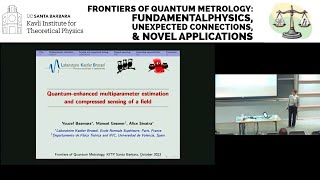
Quantum-Enhanced Multiparameter Estimation and Compressed Sensing of a Field - Alice Sinatra
Explore quantum-enhanced multiparameter estimation and compressed sensing of fields with Alice Sinatra. Discover cutting-edge techniques in quantum metrology and their applications in fundamental physics research.
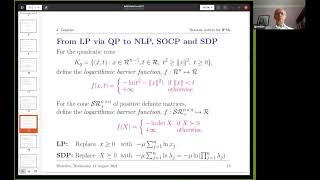
Recent Advances in Iterative Solvers for Interior Point Methods
Explore recent advancements in iterative solvers for interior point methods, covering linear programming, optimization theory, and applications in big data and compressed sensing.