
Оценка качества первичного материала и методика интерпретации замеров - Часть 3
Освойте методы оценки качества и интерпретации геологических данных для повышения точности анализа и принятия решений в геологоразведке.
Heterogeneous Multi-Core Systems for Efficient Edge Machine Learning
Explore heterogeneous multi-core systems for efficient embedded ML, addressing challenges in core optimization, workload mapping, and data sharing. Gain insights from KULeuven MICAS research.
EarHover - Mid-Air Gesture Recognition for Hearables Using Sound Leakage Signals
Discover how sound leakage signals from hearables can enable mid-air gesture recognition, revolutionizing user interface interactions with wearable audio devices.

An Approach Towards the Aaronson-Ambainis Conjecture via Fourier Completely Bounded Polynomials - Part 1
Delve into quantum computing theory through an analysis of the Aaronson-Ambainis conjecture, exploring its relationship with Fourier completely bounded polynomials and implications for quantum algorithm simulation.
Fourier-Enhanced Fine-Tuning Vision Language Models Using PEFT-VFPT
Discover how Visual Fourier Prompt Tuning revolutionizes vision model fine-tuning by integrating Fast Fourier Transform, enhancing adaptability and accuracy while using minimal trainable parameters.
From McCulloch-Pitts to Retina: A Journey Through Neural Networks and Sensory Encoding
Explore the evolution of neural networks from McCulloch-Pitts to modern retina-inspired digital encoding, examining theoretical biophysics' impact on AI and signal processing breakthroughs.
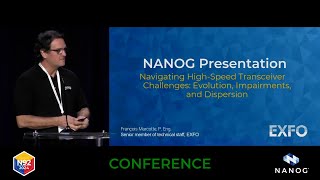
Navigating High-Speed Transceiver Challenges - Evolution, Impairments, and Dispersion
Explore the complexities of high-speed transceiver technology, from signal integrity challenges to optical dispersion effects, while mastering strategies for optimizing modern communication systems performance.

Sending Weird Signals Long Distances Over Existing Optical Infrastructure
Explore unconventional signal transmission techniques over optical networks, examining bandwidth utilization and long-distance capabilities through practical experiments and real-world testing.
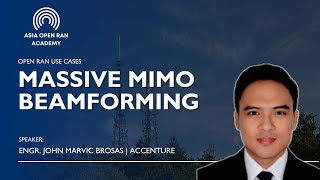
Massive MIMO Beamforming: Principles and Applications in Wireless Networks
Discover how Massive MIMO beamforming technology enhances wireless networks through spatial multiplexing, diversity, and interference suppression to revolutionize communication systems.

Understanding 5G Mobile Networks: Features, Technology, and Applications
Discover the revolutionary world of 5G technology, from ultra-fast speeds to transformative applications in autonomous vehicles, smart cities, and IoT solutions, while exploring core concepts like millimeter waves and beamforming.

Introduction to Signal Processing Windowing - From Audio Compression to Digital Analysis
Discover how windowing techniques in signal processing enable audio compression and spectral analysis through practical examples and clear explanations.

High-Dimensional Classification with Deep Neural Networks: Decision Boundaries
Explore high-dimensional classification theory, focusing on decision boundaries, noise, and margin conditions in neural networks, with applications to efficient approximation and learning rates.
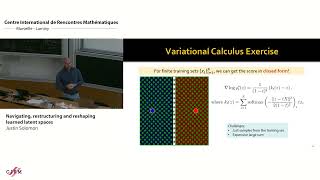
Navigating, Restructuring and Reshaping Learned Latent Spaces
Explore advanced techniques for manipulating learned latent spaces in machine learning, focusing on navigation, restructuring, and reshaping methods for improved model performance and efficiency.

Fourier Multipliers for Functions on the Discrete n-Torus
Explore advanced Fourier multiplier theory and its applications in discrete n-torus, connecting transcendental number theory with dimension-free inequalities and Rademacher projections.

Vertex, Edge, Clique - Understanding Graph Theory Fundamentals
Explore fundamental concepts of graph theory, from basic elements like vertices and edges to complex structures like cliques, enhancing your understanding of network analysis and data relationships.
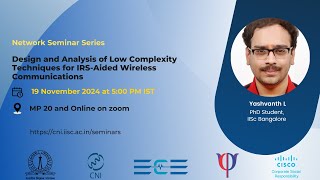
Design and Analysis of Low Complexity Techniques for IRS-Aided Wireless Communications
Explore low-complexity techniques for IRS-aided wireless communications, covering random tuning, multi-operator scenarios, and solutions for wideband beamforming challenges in next-generation systems.
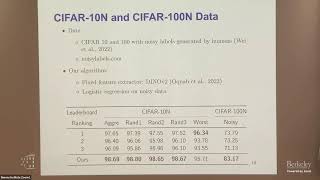
Label Noise and Machine Learning: Why Ignorance is Bliss
Explore theoretical frameworks for handling multi-class label noise in machine learning, focusing on relative signal strength and empirical risk minimization principles.
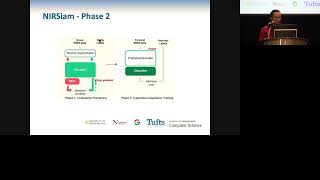
Empower Real-World BCIs with NIRS-X - An Adaptive Learning Framework for Unlabeled Brain Signals
Discover how NIRS-X adaptive learning framework enhances brain-computer interfaces by leveraging unlabeled brain signals for improved real-world applications and user interaction.

Counting Lattice Points in Ellipsoids and the Central Limit Theorem for Quadratic Forms
Delve into advanced mathematical concepts exploring lattice point counting in ellipsoids, error bounds, and their connection to probability theory's central limit theorem.

An Optimal Space Lower Bound for Approximating MAX-CUT
Delve into advanced Fourier analysis techniques for boolean cube applications and discover how they reveal optimal space complexity bounds for MAX-CUT approximation algorithms.